


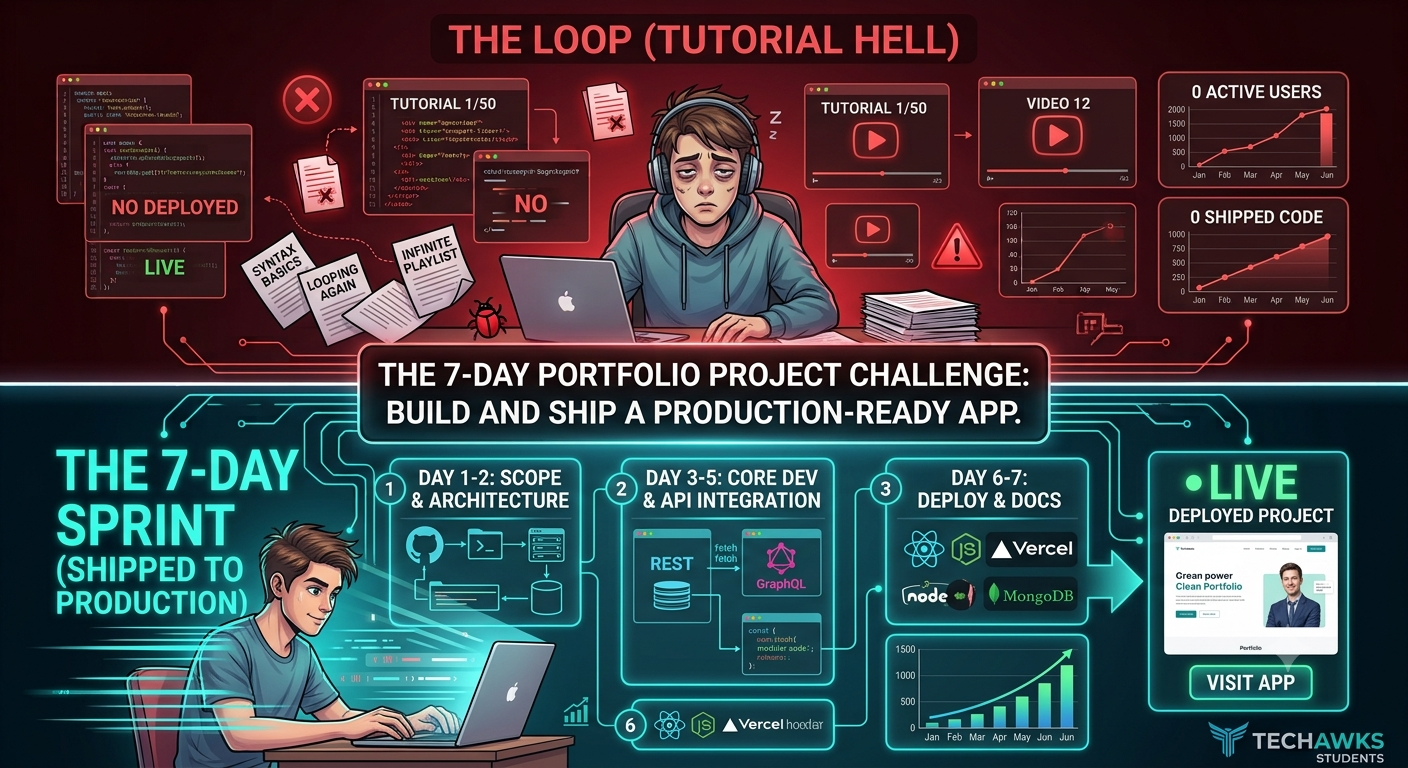
The 7-Day Portfolio Project Challenge: Build and Ship a Production-Ready App
Most student portfolios are filled with identical assignments: basic todo lists, weather apps, or generic clones. Hiring managers skip right past these because they don't demonstrate real-world engineering decisions.
To stand out in entry-level tech applications, you need to showcase project ownership, API integration, and deployment. Here is your 7-day blueprint to ship a functional, production-ready app:
Days 1–2: Scope & Architecture
The Goal: Define a small problem and map your stack.
The Action: Pick a niche utility app (e.g., a lightweight developer cheat-sheet generator, a localized study-timer with stats, or a simple markdown parser).
The Rule: Keep the feature set minimal. Define maximum 2 core endpoints/pages. Draw your database schema and UI layout on paper before opening your IDE.
Days 3–5: Core Development & Integration
The Goal: Build the functional core using real data or external APIs.
The Action: Write clean, modular code. Implement essential features first:
Fetch dynamic data using a public REST or GraphQL API.
Handle loading, error, and empty states gracefully in your UI.
The Rule: Don't get stuck styling early. Make it work first, then make it look clean.
Days 6–7: Deploy, Document & Ship
The Goal: Put your code live on the internet with a professional repository.
The Action: Deploy: Host your app live using free hosting platforms (e.g., Vercel, Render, Netlify, or GitHub Pages).
Write the README: Include a clear project description, system architecture diagram, tech stack badges, local setup instructions, and key technical challenges solved.
Share: Post a 30-second screen recording of your working app on LinkedIn or X with a live link.
Key Takeaways
Ship over perfect: A deployed, 80%-featured project online beats a 100%-featured project sitting on your local localhost.
Document your engineering decisions: A well-structured README.md explaining why you chose specific tools is as important as the code itself.
Break out of tutorial loops: Learn just enough syntax to start building, then Google and solve edge cases as you hit them in production.
CTA (Join Students in Tech)
Ready to build in public, get code reviews from experienced mentors, and collaborate with ambitious peers? [Join Students in Tech] to share your projects, participate in hackathons, and level up your engineering skills!
Most student portfolios are filled with identical assignments: basic todo lists, weather apps, or generic clones. Hiring managers skip right past these because they don't demonstrate real-world engineering decisions.
To stand out in entry-level tech applications, you need to showcase project ownership, API integration, and deployment. Here is your 7-day blueprint to ship a functional, production-ready app:
Days 1–2: Scope & Architecture
The Goal: Define a small problem and map your stack.
The Action: Pick a niche utility app (e.g., a lightweight developer cheat-sheet generator, a localized study-timer with stats, or a simple markdown parser).
The Rule: Keep the feature set minimal. Define maximum 2 core endpoints/pages. Draw your database schema and UI layout on paper before opening your IDE.
Days 3–5: Core Development & Integration
The Goal: Build the functional core using real data or external APIs.
The Action: Write clean, modular code. Implement essential features first:
Fetch dynamic data using a public REST or GraphQL API.
Handle loading, error, and empty states gracefully in your UI.
The Rule: Don't get stuck styling early. Make it work first, then make it look clean.
Days 6–7: Deploy, Document & Ship
The Goal: Put your code live on the internet with a professional repository.
The Action: Deploy: Host your app live using free hosting platforms (e.g., Vercel, Render, Netlify, or GitHub Pages).
Write the README: Include a clear project description, system architecture diagram, tech stack badges, local setup instructions, and key technical challenges solved.
Share: Post a 30-second screen recording of your working app on LinkedIn or X with a live link.
Key Takeaways
Ship over perfect: A deployed, 80%-featured project online beats a 100%-featured project sitting on your local localhost.
Document your engineering decisions: A well-structured README.md explaining why you chose specific tools is as important as the code itself.
Break out of tutorial loops: Learn just enough syntax to start building, then Google and solve edge cases as you hit them in production.
CTA (Join Students in Tech)
Ready to build in public, get code reviews from experienced mentors, and collaborate with ambitious peers? [Join Students in Tech] to share your projects, participate in hackathons, and level up your engineering skills!
The 7-Day Portfolio Project Challenge: Build and Ship a Production-Ready App
Most student portfolios are filled with identical assignments: basic todo lists, weather apps, or generic clones. Hiring managers skip right past these because they don't demonstrate real-world engineering decisions.
To stand out in entry-level tech applications, you need to showcase project ownership, API integration, and deployment. Here is your 7-day blueprint to ship a functional, production-ready app:
Days 1–2: Scope & Architecture
The Goal: Define a small problem and map your stack.
The Action: Pick a niche utility app (e.g., a lightweight developer cheat-sheet generator, a localized study-timer with stats, or a simple markdown parser).
The Rule: Keep the feature set minimal. Define maximum 2 core endpoints/pages. Draw your database schema and UI layout on paper before opening your IDE.
Days 3–5: Core Development & Integration
The Goal: Build the functional core using real data or external APIs.
The Action: Write clean, modular code. Implement essential features first:
Fetch dynamic data using a public REST or GraphQL API.
Handle loading, error, and empty states gracefully in your UI.
The Rule: Don't get stuck styling early. Make it work first, then make it look clean.
Days 6–7: Deploy, Document & Ship
The Goal: Put your code live on the internet with a professional repository.
The Action: Deploy: Host your app live using free hosting platforms (e.g., Vercel, Render, Netlify, or GitHub Pages).
Write the README: Include a clear project description, system architecture diagram, tech stack badges, local setup instructions, and key technical challenges solved.
Share: Post a 30-second screen recording of your working app on LinkedIn or X with a live link.
Key Takeaways
Ship over perfect: A deployed, 80%-featured project online beats a 100%-featured project sitting on your local localhost.
Document your engineering decisions: A well-structured README.md explaining why you chose specific tools is as important as the code itself.
Break out of tutorial loops: Learn just enough syntax to start building, then Google and solve edge cases as you hit them in production.
CTA (Join Students in Tech)
Ready to build in public, get code reviews from experienced mentors, and collaborate with ambitious peers? [Join Students in Tech] to share your projects, participate in hackathons, and level up your engineering skills!

 English
 Arabic
 French
 Spanish
 Portuguese
 Deutsch
 Turkish
 Italiano
 Russian
 Romaian
 Portuguese (Brazil)
 Greek
Greek