


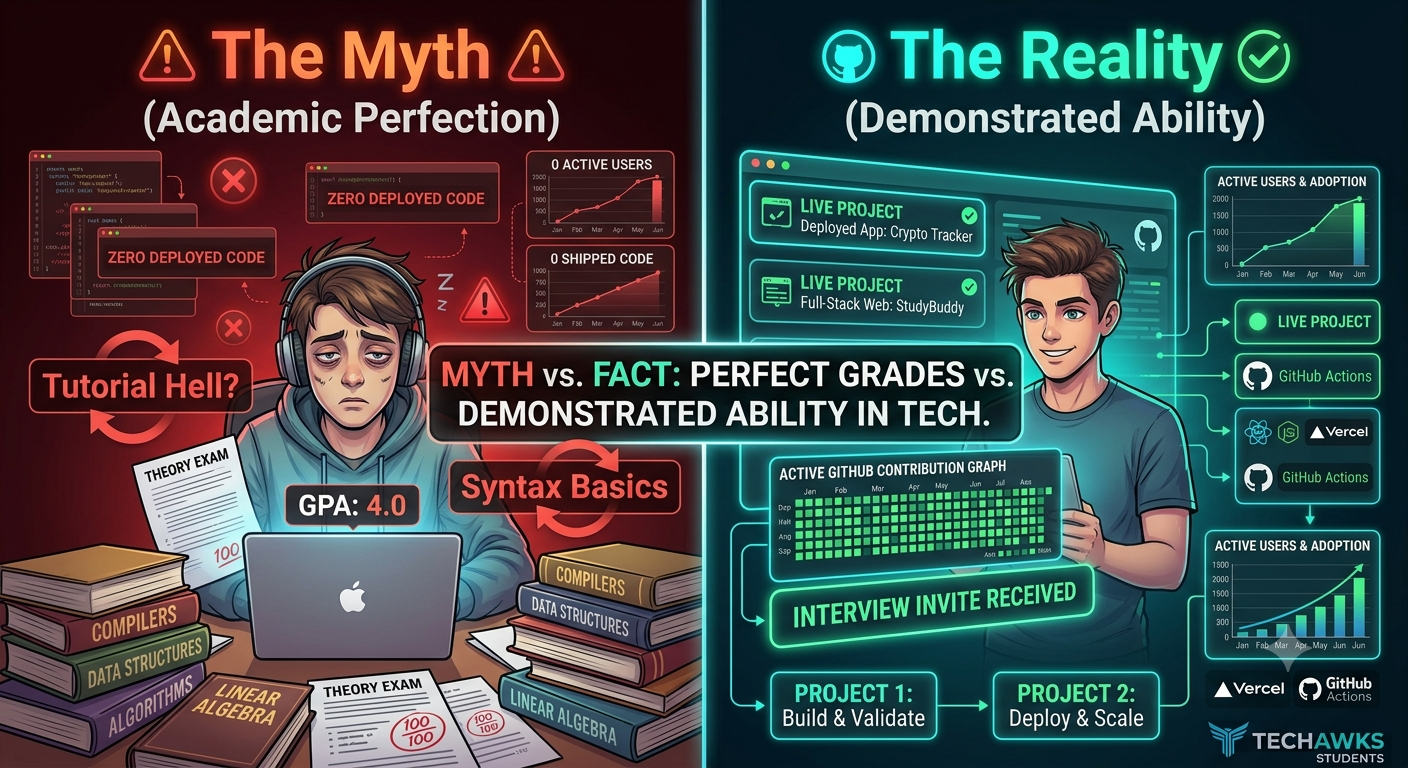
Myth vs. Fact: Do You Need Perfect Grades to Land a Great Tech Role?
Many tech students fall into the trap of believing that academic excellence is the single determining factor for career success. While keeping a respectable grade point average opens certain doors (like research roles or specific graduate programs), the software industry operates primarily on proof of capability.
Here is the truth about how technical hiring actually works:
Myth #1: Top tech companies throw away resumes with GPAs below 3.8.
Fact: Most tech companies prioritize technical assessments, GitHub repositories, and practical experience over GPA.
Why? Grades measure your ability to take tests in structured environments; engineering roles test your ability to debug messy code, collaborate via Git, and build scalable systems. Many top firms don't even ask for transcripts during candidate screening.
The Action: Maintain a solid baseline GPA (e.g., above 3.0 to clear basic enterprise thresholds), but dedicate your extra bandwidth to building real projects, contributing to open-source software, and mastering Data Structures & Algorithms (DSA).
Myth #2: Computer Science theory classes are all you need to be job-ready.
Fact: Academic curricula often lag behind modern industry toolchains, frameworks, and workflows.
Why? Universities excel at teaching foundational computer science concepts (Operating Systems, Compilers, Linear Algebra), but rarely cover industry-standard development workflows like CI/CD pipelines, containerization (Docker), or cloud deployments (AWS/Vercel).
The Action: Treat your degree as the foundation, but actively bridge the gap. Learn modern web/mobile frameworks, version control best practices, and team collaboration workflows on your own time.
Myth #3: If you don't secure a big-tech internship by sophomore year, your career is behind.
Fact: Career trajectories in tech are non-linear; open-source contributions and community projects build equal credibility.
Why? Landing a marquee internship early is great, but hiring managers value consistent output. A well-documented open-source contribution or a launched product with real active users can outshine a passive internship experience.
The Action: Build in public. Document your learning journey on GitHub, write technical write-ups explaining your architecture choices, and ship small utilities that solve real problems.
Key Takeaways
Proof over paper: A live app, active GitHub profile, or open-source contribution carries more weight in technical interviews than a perfect GPA.
Balance theory and tooling: Use university coursework to master foundational CS concepts, but self-teach modern software engineering toolchains.
Focus on execution: Consistency in shipping projects and writing clean, tested code is your strongest asset as an entry-level candidate.
CTA (Join Students in Tech)
Ready to build a strong developer portfolio, get feedback on your code, and prepare for technical interviews with ambitious peers? [Join Students in Tech] to collaborate on projects, participate in study groups, and fast-track your tech career!
Many tech students fall into the trap of believing that academic excellence is the single determining factor for career success. While keeping a respectable grade point average opens certain doors (like research roles or specific graduate programs), the software industry operates primarily on proof of capability.
Here is the truth about how technical hiring actually works:
Myth #1: Top tech companies throw away resumes with GPAs below 3.8.
Fact: Most tech companies prioritize technical assessments, GitHub repositories, and practical experience over GPA.
Why? Grades measure your ability to take tests in structured environments; engineering roles test your ability to debug messy code, collaborate via Git, and build scalable systems. Many top firms don't even ask for transcripts during candidate screening.
The Action: Maintain a solid baseline GPA (e.g., above 3.0 to clear basic enterprise thresholds), but dedicate your extra bandwidth to building real projects, contributing to open-source software, and mastering Data Structures & Algorithms (DSA).
Myth #2: Computer Science theory classes are all you need to be job-ready.
Fact: Academic curricula often lag behind modern industry toolchains, frameworks, and workflows.
Why? Universities excel at teaching foundational computer science concepts (Operating Systems, Compilers, Linear Algebra), but rarely cover industry-standard development workflows like CI/CD pipelines, containerization (Docker), or cloud deployments (AWS/Vercel).
The Action: Treat your degree as the foundation, but actively bridge the gap. Learn modern web/mobile frameworks, version control best practices, and team collaboration workflows on your own time.
Myth #3: If you don't secure a big-tech internship by sophomore year, your career is behind.
Fact: Career trajectories in tech are non-linear; open-source contributions and community projects build equal credibility.
Why? Landing a marquee internship early is great, but hiring managers value consistent output. A well-documented open-source contribution or a launched product with real active users can outshine a passive internship experience.
The Action: Build in public. Document your learning journey on GitHub, write technical write-ups explaining your architecture choices, and ship small utilities that solve real problems.
Key Takeaways
Proof over paper: A live app, active GitHub profile, or open-source contribution carries more weight in technical interviews than a perfect GPA.
Balance theory and tooling: Use university coursework to master foundational CS concepts, but self-teach modern software engineering toolchains.
Focus on execution: Consistency in shipping projects and writing clean, tested code is your strongest asset as an entry-level candidate.
CTA (Join Students in Tech)
Ready to build a strong developer portfolio, get feedback on your code, and prepare for technical interviews with ambitious peers? [Join Students in Tech] to collaborate on projects, participate in study groups, and fast-track your tech career!
Myth vs. Fact: Do You Need Perfect Grades to Land a Great Tech Role?
Many tech students fall into the trap of believing that academic excellence is the single determining factor for career success. While keeping a respectable grade point average opens certain doors (like research roles or specific graduate programs), the software industry operates primarily on proof of capability.
Here is the truth about how technical hiring actually works:
Myth #1: Top tech companies throw away resumes with GPAs below 3.8.
Fact: Most tech companies prioritize technical assessments, GitHub repositories, and practical experience over GPA.
Why? Grades measure your ability to take tests in structured environments; engineering roles test your ability to debug messy code, collaborate via Git, and build scalable systems. Many top firms don't even ask for transcripts during candidate screening.
The Action: Maintain a solid baseline GPA (e.g., above 3.0 to clear basic enterprise thresholds), but dedicate your extra bandwidth to building real projects, contributing to open-source software, and mastering Data Structures & Algorithms (DSA).
Myth #2: Computer Science theory classes are all you need to be job-ready.
Fact: Academic curricula often lag behind modern industry toolchains, frameworks, and workflows.
Why? Universities excel at teaching foundational computer science concepts (Operating Systems, Compilers, Linear Algebra), but rarely cover industry-standard development workflows like CI/CD pipelines, containerization (Docker), or cloud deployments (AWS/Vercel).
The Action: Treat your degree as the foundation, but actively bridge the gap. Learn modern web/mobile frameworks, version control best practices, and team collaboration workflows on your own time.
Myth #3: If you don't secure a big-tech internship by sophomore year, your career is behind.
Fact: Career trajectories in tech are non-linear; open-source contributions and community projects build equal credibility.
Why? Landing a marquee internship early is great, but hiring managers value consistent output. A well-documented open-source contribution or a launched product with real active users can outshine a passive internship experience.
The Action: Build in public. Document your learning journey on GitHub, write technical write-ups explaining your architecture choices, and ship small utilities that solve real problems.
Key Takeaways
Proof over paper: A live app, active GitHub profile, or open-source contribution carries more weight in technical interviews than a perfect GPA.
Balance theory and tooling: Use university coursework to master foundational CS concepts, but self-teach modern software engineering toolchains.
Focus on execution: Consistency in shipping projects and writing clean, tested code is your strongest asset as an entry-level candidate.
CTA (Join Students in Tech)
Ready to build a strong developer portfolio, get feedback on your code, and prepare for technical interviews with ambitious peers? [Join Students in Tech] to collaborate on projects, participate in study groups, and fast-track your tech career!

 English
 Arabic
 French
 Spanish
 Portuguese
 Deutsch
 Turkish
 Dutch
Dutch
 Italiano
 Russian
 Romaian
 Greek
Greek