


Beyond Pre-Training: Why Test-Time Compute Is Rewriting System Architecture
If you build software or manage infrastructure, the shift toward Test-Time Compute (Inference Scaling) is the architectural transition you need to master this quarter.
What Is Test-Time Compute?
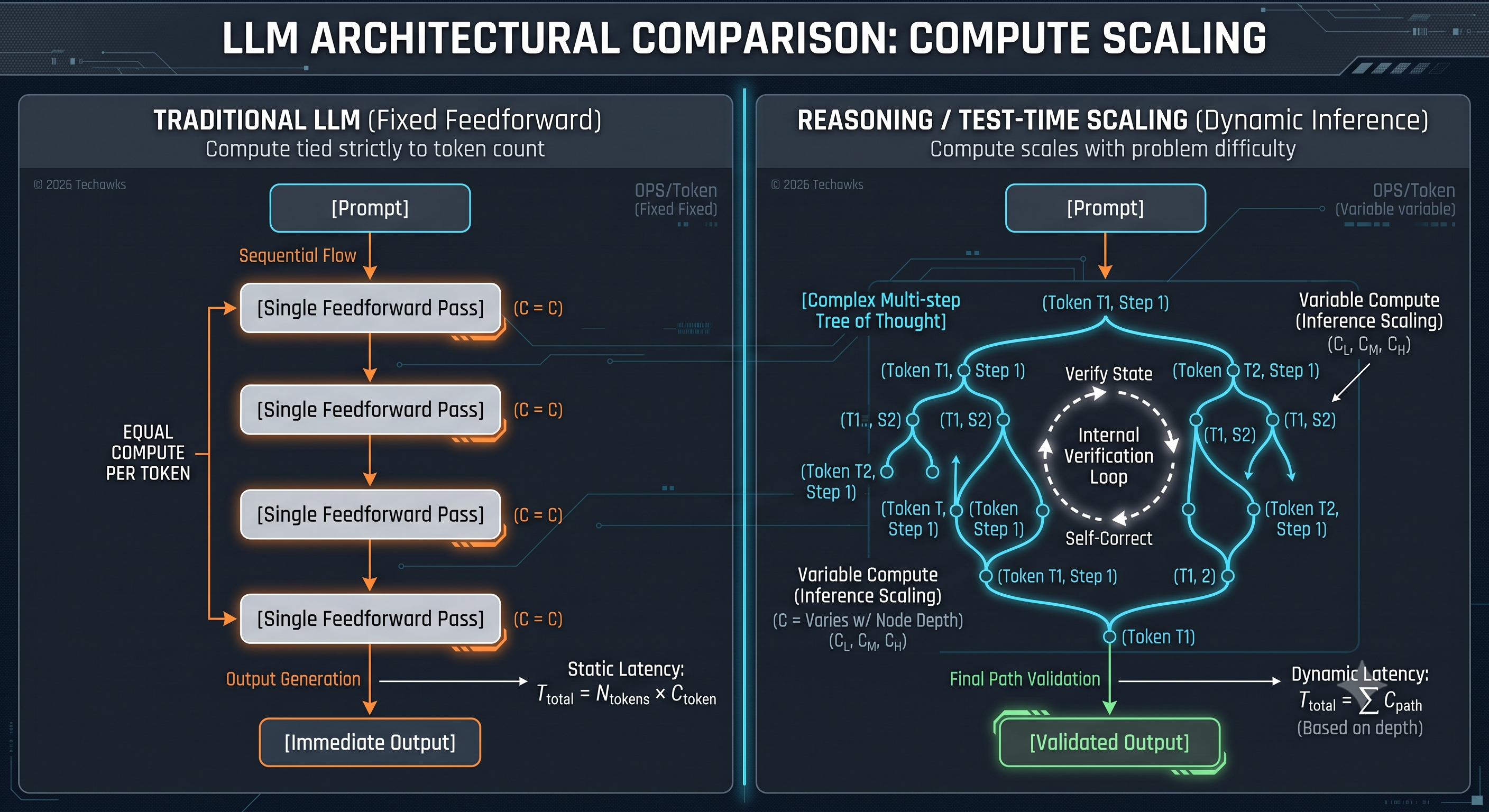
Traditional LLMs operate on a fixed compute budget per token. Whether you ask for a two-sentence summary or a formal mathematical proof, the network executes essentially the same feedforward pass per generated word.
Reasoning architectures decouple output length from processing depth. Instead of directly predicting the final text, the model generates an internal chain of reasoning ("thinking tokens"), verifies intermediate states, self-corrects logic branches, and only then streams the polished response.
It turns token generation into a search problem over solution space.
Why This Matters to Engineers & Architects:
The Death of Static Latency SLAs: We can no longer expect uniform, sub-second API response times across heterogeneous tasks. Complex analytical and code-generation workloads now require asynchronous, streaming, or job-queued architecture patterns.
Dynamic Cost Routing: Running heavy chain-of-thought on every trivial payload destroys unit economics. Modern production systems must implement inference cascades—using ultra-light classifiers or speculative decoders to triage queries, escalating only the high-entropy problems to reasoning engines.
Smaller Base Models, Higher Precision: Rather than hosting a massive, monolithic generalist parameter set, developers can run heavily fine-tuned, smaller models equipped with extended inference-time verification to match or beat previous frontier benchmarks at a fraction of the hosting footprint.
The competitive edge has moved from who has the largest pre-training cluster to who can design the most efficient inference-time orchestrator.
Discussion Question
Are you currently re-architecting your backend pipelines for dynamic inference latency, or are your production workloads still strictly optimized for sub-second TTFT (Time to First Token)?
CTA (Join Techawks General Community)
Level up your system design with engineers building on the edge of modern technology. Join the Techawks General Community to trade architecture patterns, benchmarks, and real-world implementation teardowns.
If you build software or manage infrastructure, the shift toward Test-Time Compute (Inference Scaling) is the architectural transition you need to master this quarter.
What Is Test-Time Compute?
Traditional LLMs operate on a fixed compute budget per token. Whether you ask for a two-sentence summary or a formal mathematical proof, the network executes essentially the same feedforward pass per generated word.
Reasoning architectures decouple output length from processing depth. Instead of directly predicting the final text, the model generates an internal chain of reasoning ("thinking tokens"), verifies intermediate states, self-corrects logic branches, and only then streams the polished response.
It turns token generation into a search problem over solution space.
Why This Matters to Engineers & Architects:
The Death of Static Latency SLAs: We can no longer expect uniform, sub-second API response times across heterogeneous tasks. Complex analytical and code-generation workloads now require asynchronous, streaming, or job-queued architecture patterns.
Dynamic Cost Routing: Running heavy chain-of-thought on every trivial payload destroys unit economics. Modern production systems must implement inference cascades—using ultra-light classifiers or speculative decoders to triage queries, escalating only the high-entropy problems to reasoning engines.
Smaller Base Models, Higher Precision: Rather than hosting a massive, monolithic generalist parameter set, developers can run heavily fine-tuned, smaller models equipped with extended inference-time verification to match or beat previous frontier benchmarks at a fraction of the hosting footprint.
The competitive edge has moved from who has the largest pre-training cluster to who can design the most efficient inference-time orchestrator.
Discussion Question
Are you currently re-architecting your backend pipelines for dynamic inference latency, or are your production workloads still strictly optimized for sub-second TTFT (Time to First Token)?
CTA (Join Techawks General Community)
Level up your system design with engineers building on the edge of modern technology. Join the Techawks General Community to trade architecture patterns, benchmarks, and real-world implementation teardowns.
Beyond Pre-Training: Why Test-Time Compute Is Rewriting System Architecture
If you build software or manage infrastructure, the shift toward Test-Time Compute (Inference Scaling) is the architectural transition you need to master this quarter.
What Is Test-Time Compute?
Traditional LLMs operate on a fixed compute budget per token. Whether you ask for a two-sentence summary or a formal mathematical proof, the network executes essentially the same feedforward pass per generated word.
Reasoning architectures decouple output length from processing depth. Instead of directly predicting the final text, the model generates an internal chain of reasoning ("thinking tokens"), verifies intermediate states, self-corrects logic branches, and only then streams the polished response.
It turns token generation into a search problem over solution space.
Why This Matters to Engineers & Architects:
The Death of Static Latency SLAs: We can no longer expect uniform, sub-second API response times across heterogeneous tasks. Complex analytical and code-generation workloads now require asynchronous, streaming, or job-queued architecture patterns.
Dynamic Cost Routing: Running heavy chain-of-thought on every trivial payload destroys unit economics. Modern production systems must implement inference cascades—using ultra-light classifiers or speculative decoders to triage queries, escalating only the high-entropy problems to reasoning engines.
Smaller Base Models, Higher Precision: Rather than hosting a massive, monolithic generalist parameter set, developers can run heavily fine-tuned, smaller models equipped with extended inference-time verification to match or beat previous frontier benchmarks at a fraction of the hosting footprint.
The competitive edge has moved from who has the largest pre-training cluster to who can design the most efficient inference-time orchestrator.
Discussion Question
Are you currently re-architecting your backend pipelines for dynamic inference latency, or are your production workloads still strictly optimized for sub-second TTFT (Time to First Token)?
CTA (Join Techawks General Community)
Level up your system design with engineers building on the edge of modern technology. Join the Techawks General Community to trade architecture patterns, benchmarks, and real-world implementation teardowns.

 Arabic
 French
 Spanish
 Portuguese
 Deutsch
 Turkish
 Dutch
Dutch
 Italiano
 Russian
 Romaian
 Portuguese (Brazil)
 Greek
Greek