


The "Default Dead" Trap: Why Early Traction Masquerades as Product-Market Fit
Early revenue produces a dangerous dopamine hit. It’s easy to look at an initial spike in sign-ups, assume product-market fit (PMF) is solved, and prematurely pour resources into scaling customer acquisition.
Six months later, churn spikes, cohort retention flattens, and the burn rate catches up.
True PMF isn't demonstrated by initial conversions—it’s proven by what happens after the novelty fades:
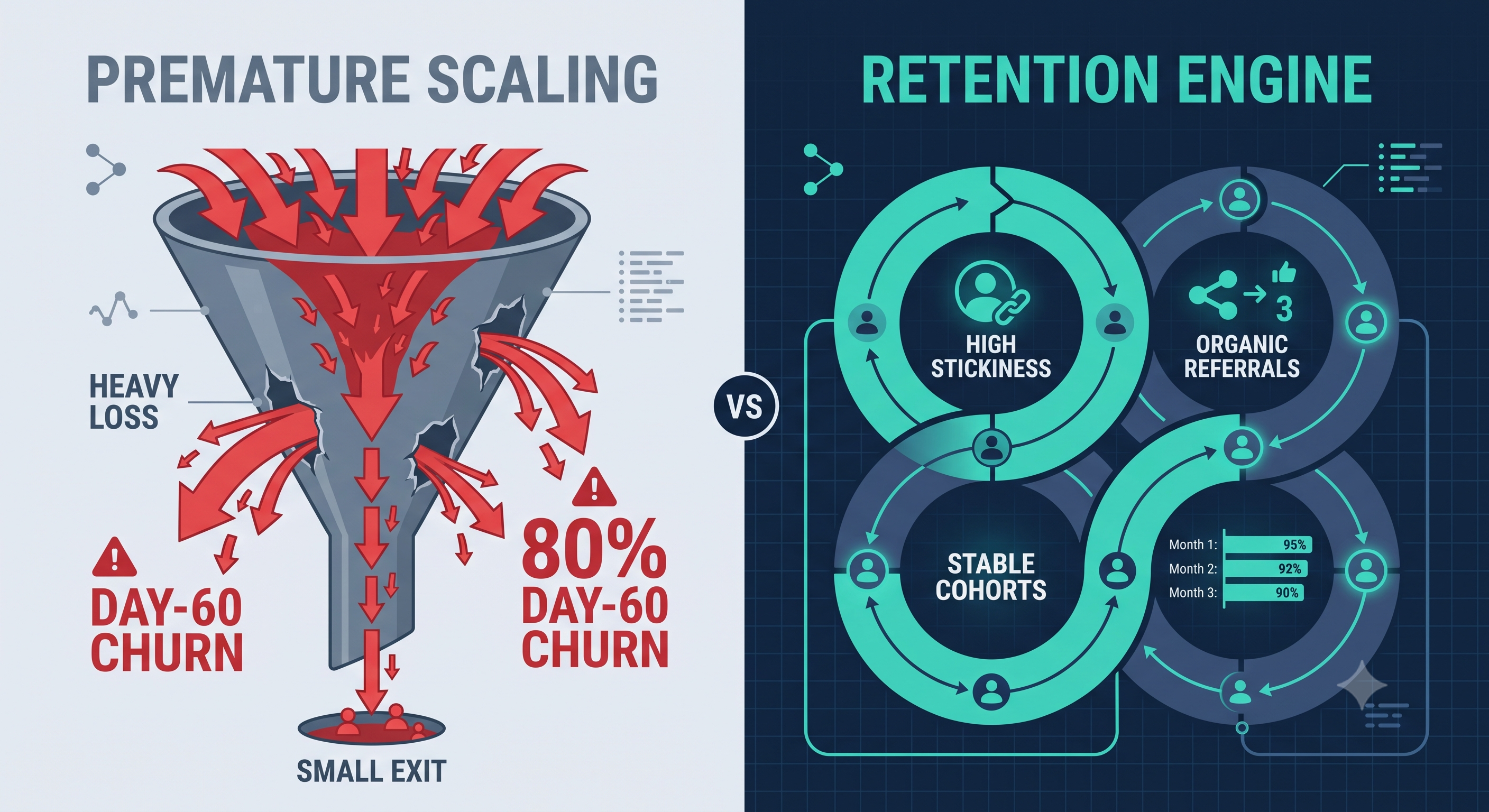
Retention over acquisition: If 80% of your new cohort abandons the platform by day 60, doubling your ad spend or sales outreach just accelerates cash burn. Fix the leak before increasing the water flow.
Founder-led sales distortion: Founders are extraordinary sales reps because passion, charisma, and bespoke feature promises close deals. If an independent rep or self-serve flow can't close the same profile, the product isn't selling itself yet.
The "hair on fire" litmus test: Are users building their daily workflows around your tool, or are they treating it as an easily replaceable convenience? If pulling the product causes genuine operational friction, you have defensibility.
Scaling before retention is the fastest way to turn early momentum into quiet failure.
Key Takeaways
Cohort Health First: A high-churn funnel cannot be fixed with top-of-funnel volume.
Separate Pitch from Product: Verify that the offer converts without the founder personally pushing it across the line.
Qualify Pain Points: True traction means your solution is mission-critical, not just a "nice-to-have" pilot.
CTA
Let’s talk post-mortems and hard pivots:
What was the most misleading metric or false signal you mistook for real product-market fit early on?
What specific change in user behavior finally proved your product was indispensable? Drop your battle-tested lessons below.
Early revenue produces a dangerous dopamine hit. It’s easy to look at an initial spike in sign-ups, assume product-market fit (PMF) is solved, and prematurely pour resources into scaling customer acquisition.
Six months later, churn spikes, cohort retention flattens, and the burn rate catches up.
True PMF isn't demonstrated by initial conversions—it’s proven by what happens after the novelty fades:
Retention over acquisition: If 80% of your new cohort abandons the platform by day 60, doubling your ad spend or sales outreach just accelerates cash burn. Fix the leak before increasing the water flow.
Founder-led sales distortion: Founders are extraordinary sales reps because passion, charisma, and bespoke feature promises close deals. If an independent rep or self-serve flow can't close the same profile, the product isn't selling itself yet.
The "hair on fire" litmus test: Are users building their daily workflows around your tool, or are they treating it as an easily replaceable convenience? If pulling the product causes genuine operational friction, you have defensibility.
Scaling before retention is the fastest way to turn early momentum into quiet failure.
Key Takeaways
Cohort Health First: A high-churn funnel cannot be fixed with top-of-funnel volume.
Separate Pitch from Product: Verify that the offer converts without the founder personally pushing it across the line.
Qualify Pain Points: True traction means your solution is mission-critical, not just a "nice-to-have" pilot.
CTA
Let’s talk post-mortems and hard pivots:
What was the most misleading metric or false signal you mistook for real product-market fit early on?
What specific change in user behavior finally proved your product was indispensable? Drop your battle-tested lessons below.
The "Default Dead" Trap: Why Early Traction Masquerades as Product-Market Fit
Early revenue produces a dangerous dopamine hit. It’s easy to look at an initial spike in sign-ups, assume product-market fit (PMF) is solved, and prematurely pour resources into scaling customer acquisition.
Six months later, churn spikes, cohort retention flattens, and the burn rate catches up.
True PMF isn't demonstrated by initial conversions—it’s proven by what happens after the novelty fades:
Retention over acquisition: If 80% of your new cohort abandons the platform by day 60, doubling your ad spend or sales outreach just accelerates cash burn. Fix the leak before increasing the water flow.
Founder-led sales distortion: Founders are extraordinary sales reps because passion, charisma, and bespoke feature promises close deals. If an independent rep or self-serve flow can't close the same profile, the product isn't selling itself yet.
The "hair on fire" litmus test: Are users building their daily workflows around your tool, or are they treating it as an easily replaceable convenience? If pulling the product causes genuine operational friction, you have defensibility.
Scaling before retention is the fastest way to turn early momentum into quiet failure.
Key Takeaways
Cohort Health First: A high-churn funnel cannot be fixed with top-of-funnel volume.
Separate Pitch from Product: Verify that the offer converts without the founder personally pushing it across the line.
Qualify Pain Points: True traction means your solution is mission-critical, not just a "nice-to-have" pilot.
CTA
Let’s talk post-mortems and hard pivots:
What was the most misleading metric or false signal you mistook for real product-market fit early on?
What specific change in user behavior finally proved your product was indispensable? Drop your battle-tested lessons below.

 Arabic
 French
 Spanish
 Portuguese
 Deutsch
 Turkish
 Dutch
Dutch
 Italiano
 Russian
 Romaian
 Portuguese (Brazil)
 Greek
Greek