


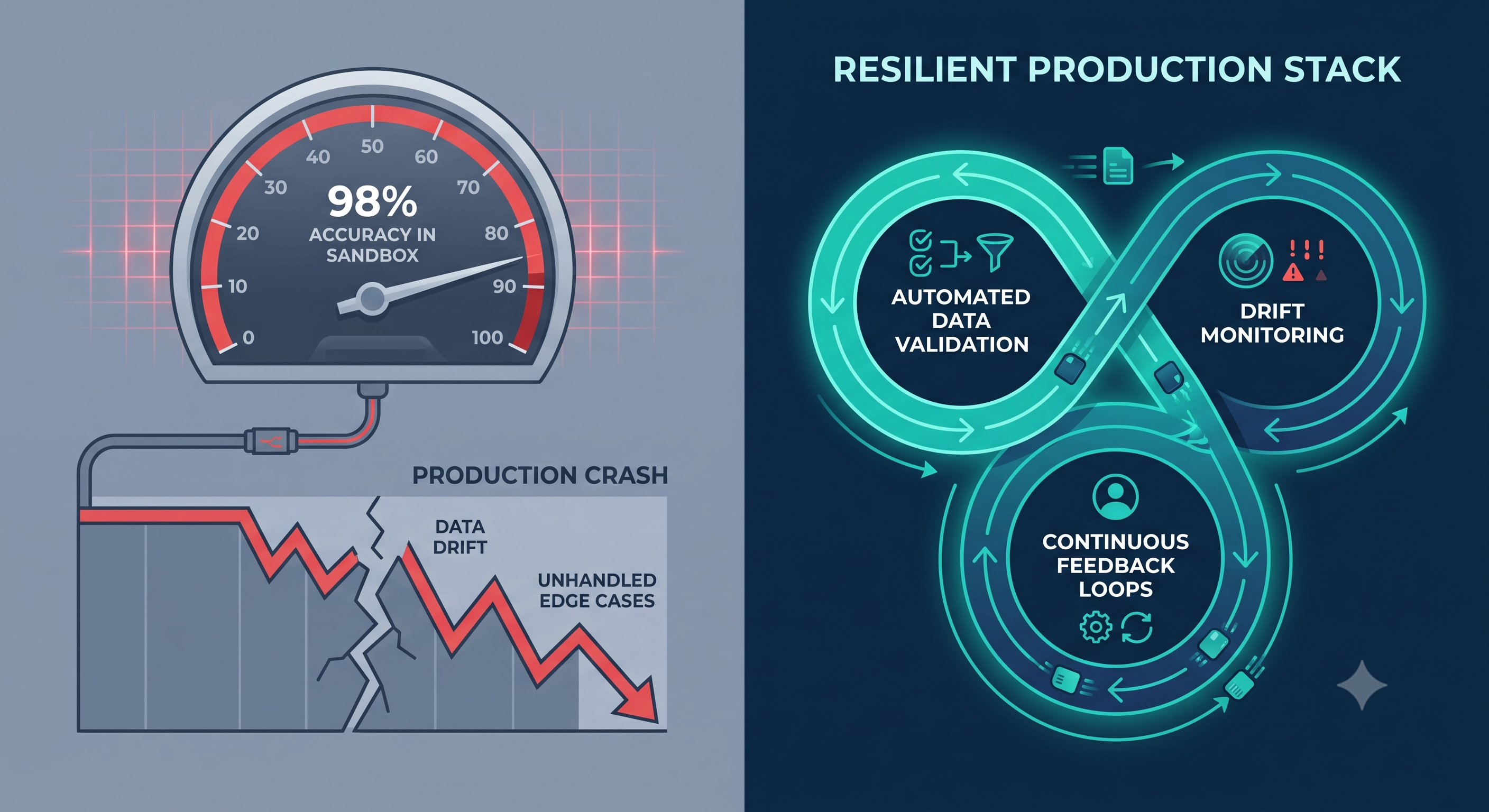
The Accuracy Mirage: Why 98% Test Performance Fails in Production
Kaggle leaderboards and university courses train practitioners to maximize offline metrics like $R^2$, ROC-AUC, or F1 scores. In production, however, a mathematically elegant model is only as good as the reliability of its incoming data pipeline.
When analytical systems fail to deliver business value, the culprit is rarely model architecture:
Training-Serving Skew: Features computed offline over historical batches frequently diverge from real-time features generated during inference. If your feature transformations differ between development and runtime environments, your metrics mean nothing.
Silent Concept and Data Drift: Consumer behavior shifts, external markets fluctuate, and upstream schemas change without notification. Without automated drift detection and data validation checks (like Great Expectations or schema assertions), models fail silently while continuing to output confident predictions.
Optimizing for Metrics Instead of Value: A 1% increase in precision matters very little if latency increases tenfold or if the business team cannot interpret the decision boundary. Aligning the cost function directly with business KPIs—such as false positive remediation cost—trumps raw statistical elegance.
Real-world machine learning is roughly 10% modeling and 90% data engineering, monitoring, and pipeline hygiene.
Key Takeaways
Offline Metrics Don't Guarantee Live Success: High benchmark validation scores often mask data leakage or distribution shifts.
Invest in Monitoring Over Fine-Tuning: Continuous tracking of feature distribution and concept drift is critical for model longevity.
Bridge the Business Gap: Optimize for operational impact and explainability over incremental statistical gains.
CTA
Let’s hear your perspective and analysis:
What was the most painful or surprising way a model failed after being pushed to production in your experience?
What are your go-to practices or tools for catching data drift and maintaining data quality before inference breaks? Share your stack and opinions below.
Kaggle leaderboards and university courses train practitioners to maximize offline metrics like $R^2$, ROC-AUC, or F1 scores. In production, however, a mathematically elegant model is only as good as the reliability of its incoming data pipeline.
When analytical systems fail to deliver business value, the culprit is rarely model architecture:
Training-Serving Skew: Features computed offline over historical batches frequently diverge from real-time features generated during inference. If your feature transformations differ between development and runtime environments, your metrics mean nothing.
Silent Concept and Data Drift: Consumer behavior shifts, external markets fluctuate, and upstream schemas change without notification. Without automated drift detection and data validation checks (like Great Expectations or schema assertions), models fail silently while continuing to output confident predictions.
Optimizing for Metrics Instead of Value: A 1% increase in precision matters very little if latency increases tenfold or if the business team cannot interpret the decision boundary. Aligning the cost function directly with business KPIs—such as false positive remediation cost—trumps raw statistical elegance.
Real-world machine learning is roughly 10% modeling and 90% data engineering, monitoring, and pipeline hygiene.
Key Takeaways
Offline Metrics Don't Guarantee Live Success: High benchmark validation scores often mask data leakage or distribution shifts.
Invest in Monitoring Over Fine-Tuning: Continuous tracking of feature distribution and concept drift is critical for model longevity.
Bridge the Business Gap: Optimize for operational impact and explainability over incremental statistical gains.
CTA
Let’s hear your perspective and analysis:
What was the most painful or surprising way a model failed after being pushed to production in your experience?
What are your go-to practices or tools for catching data drift and maintaining data quality before inference breaks? Share your stack and opinions below.
The Accuracy Mirage: Why 98% Test Performance Fails in Production
Kaggle leaderboards and university courses train practitioners to maximize offline metrics like $R^2$, ROC-AUC, or F1 scores. In production, however, a mathematically elegant model is only as good as the reliability of its incoming data pipeline.
When analytical systems fail to deliver business value, the culprit is rarely model architecture:
Training-Serving Skew: Features computed offline over historical batches frequently diverge from real-time features generated during inference. If your feature transformations differ between development and runtime environments, your metrics mean nothing.
Silent Concept and Data Drift: Consumer behavior shifts, external markets fluctuate, and upstream schemas change without notification. Without automated drift detection and data validation checks (like Great Expectations or schema assertions), models fail silently while continuing to output confident predictions.
Optimizing for Metrics Instead of Value: A 1% increase in precision matters very little if latency increases tenfold or if the business team cannot interpret the decision boundary. Aligning the cost function directly with business KPIs—such as false positive remediation cost—trumps raw statistical elegance.
Real-world machine learning is roughly 10% modeling and 90% data engineering, monitoring, and pipeline hygiene.
Key Takeaways
Offline Metrics Don't Guarantee Live Success: High benchmark validation scores often mask data leakage or distribution shifts.
Invest in Monitoring Over Fine-Tuning: Continuous tracking of feature distribution and concept drift is critical for model longevity.
Bridge the Business Gap: Optimize for operational impact and explainability over incremental statistical gains.
CTA
Let’s hear your perspective and analysis:
What was the most painful or surprising way a model failed after being pushed to production in your experience?
What are your go-to practices or tools for catching data drift and maintaining data quality before inference breaks? Share your stack and opinions below.

 English
 Arabic
 French
 Spanish
 Portuguese
 Deutsch
 Turkish
 Dutch
Dutch
 Italiano
 Russian
 Portuguese (Brazil)
 Greek
Greek