


The Death of the "Mega-Prompt": Why 2026 Belongs to Agentic Choreography
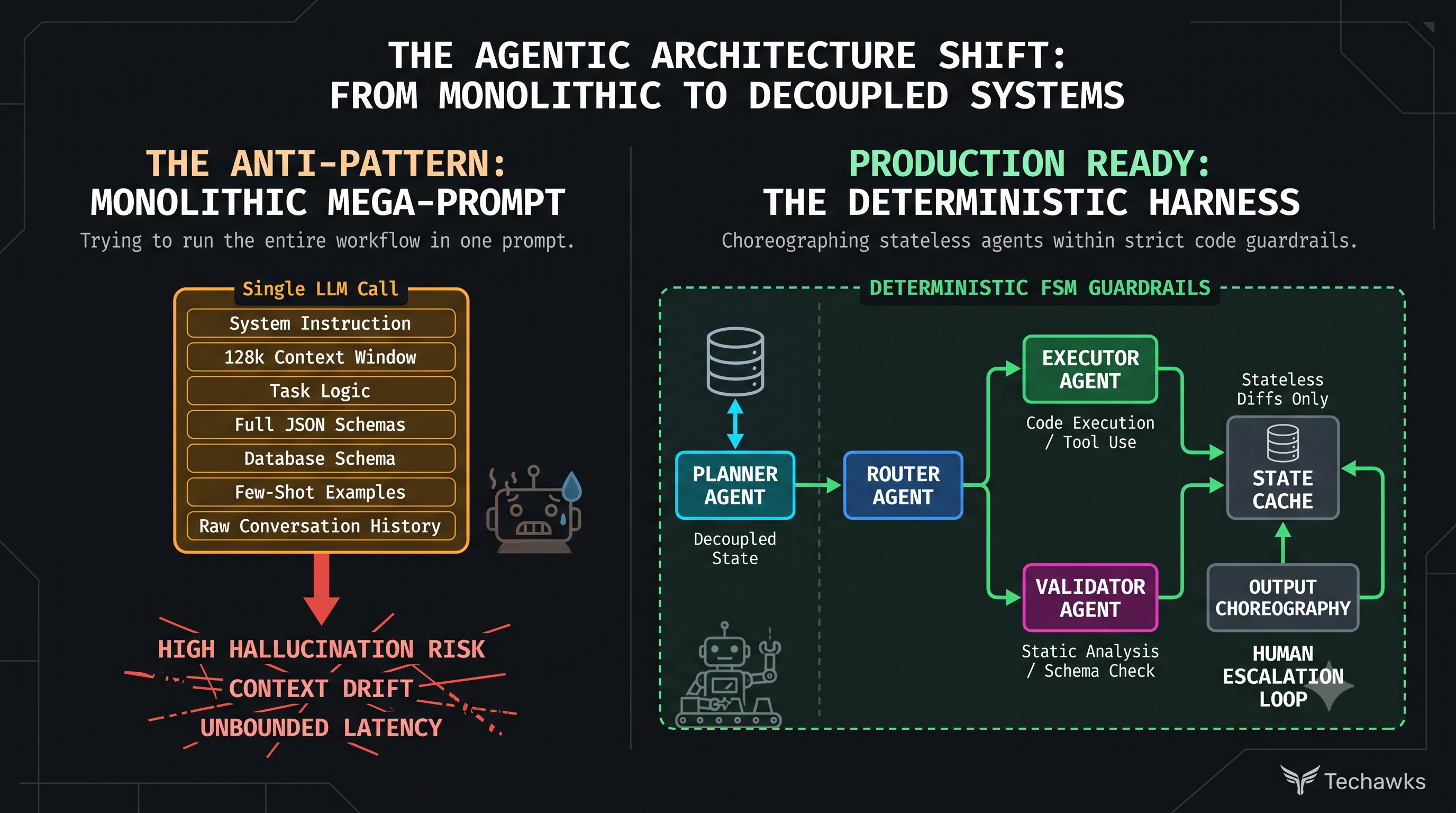
Over the past two years, teams treated foundation models like general-purpose databases: stuffing instructions, schemas, and few-shot examples into giant context windows
.Today, enterprise engineering is facing the Agentic Reality Check. Deploying autonomous agents into production fails when teams try to automate broken, monolithic workflows instead of decoupling system responsibilities.
What You Need to Know: The Deterministic Harness Pattern
Instead of expecting one model to reason, query, execute, and validate simultaneously, high-reliability architectures now isolate tasks into bounded roles wrapped in strict deterministic code:
State Isolation (Decoupled Memory): Agents should be stateless task processors. Persist execution state in structured key-value caches or transactional databases, passing only diffs between turns rather than bloating prompt contexts.
The "Checker-Maker" Architecture: Never let the agent that generates code or mutates data validate its own output. Pair an Executor Agent (high speed, tool-use optimized) with a Validator Agent (policy-restricted, zero-side-effect model running static analysis and schema checks).
Hard Circuit Breakers: Replace open-ended ReAct loops with bounded finite-state machines (FSMs). If an agent attempts tool execution more than three times without state change, force human-in-the-loop escalation.
Building robust AI systems in 2026 isn't about model benchmark scores; it's about system determinism around probabilistic cores.
Discussion Question
For engineers deploying agents today: Where does your multi-agent pipeline fail most often—context drift between handoffs, tool hallucination, or runaway token latency? Drop your architecture patterns below.
CTA
Ready to build systems that survive production?
👉 Join the Techawks General Community to connect with systems architects, AI engineers, and builders pushing the boundaries of reliable tech.
Over the past two years, teams treated foundation models like general-purpose databases: stuffing instructions, schemas, and few-shot examples into giant context windows
.Today, enterprise engineering is facing the Agentic Reality Check. Deploying autonomous agents into production fails when teams try to automate broken, monolithic workflows instead of decoupling system responsibilities.
What You Need to Know: The Deterministic Harness Pattern
Instead of expecting one model to reason, query, execute, and validate simultaneously, high-reliability architectures now isolate tasks into bounded roles wrapped in strict deterministic code:
State Isolation (Decoupled Memory): Agents should be stateless task processors. Persist execution state in structured key-value caches or transactional databases, passing only diffs between turns rather than bloating prompt contexts.
The "Checker-Maker" Architecture: Never let the agent that generates code or mutates data validate its own output. Pair an Executor Agent (high speed, tool-use optimized) with a Validator Agent (policy-restricted, zero-side-effect model running static analysis and schema checks).
Hard Circuit Breakers: Replace open-ended ReAct loops with bounded finite-state machines (FSMs). If an agent attempts tool execution more than three times without state change, force human-in-the-loop escalation.
Building robust AI systems in 2026 isn't about model benchmark scores; it's about system determinism around probabilistic cores.
Discussion Question
For engineers deploying agents today: Where does your multi-agent pipeline fail most often—context drift between handoffs, tool hallucination, or runaway token latency? Drop your architecture patterns below.
CTA
Ready to build systems that survive production?
👉 Join the Techawks General Community to connect with systems architects, AI engineers, and builders pushing the boundaries of reliable tech.
The Death of the "Mega-Prompt": Why 2026 Belongs to Agentic Choreography
Over the past two years, teams treated foundation models like general-purpose databases: stuffing instructions, schemas, and few-shot examples into giant context windows
.Today, enterprise engineering is facing the Agentic Reality Check. Deploying autonomous agents into production fails when teams try to automate broken, monolithic workflows instead of decoupling system responsibilities.
What You Need to Know: The Deterministic Harness Pattern
Instead of expecting one model to reason, query, execute, and validate simultaneously, high-reliability architectures now isolate tasks into bounded roles wrapped in strict deterministic code:
State Isolation (Decoupled Memory): Agents should be stateless task processors. Persist execution state in structured key-value caches or transactional databases, passing only diffs between turns rather than bloating prompt contexts.
The "Checker-Maker" Architecture: Never let the agent that generates code or mutates data validate its own output. Pair an Executor Agent (high speed, tool-use optimized) with a Validator Agent (policy-restricted, zero-side-effect model running static analysis and schema checks).
Hard Circuit Breakers: Replace open-ended ReAct loops with bounded finite-state machines (FSMs). If an agent attempts tool execution more than three times without state change, force human-in-the-loop escalation.
Building robust AI systems in 2026 isn't about model benchmark scores; it's about system determinism around probabilistic cores.
Discussion Question
For engineers deploying agents today: Where does your multi-agent pipeline fail most often—context drift between handoffs, tool hallucination, or runaway token latency? Drop your architecture patterns below.
CTA
Ready to build systems that survive production?
👉 Join the Techawks General Community to connect with systems architects, AI engineers, and builders pushing the boundaries of reliable tech.

 English
 Arabic
 French
 Spanish
 Portuguese
 Deutsch
 Turkish
 Dutch
Dutch
 Italiano
 Russian
 Romaian
 Greek
Greek