


The Metric Discrepancy Trap: Why the Modern Data Stack Replaced Warehouse SQL with Data Contracts and Semantic Layers
For years, data engineering prioritized raw pipeline speed and warehouse centralization: ingest raw data as fast as possible via ELT, dump it into the lakehouse or warehouse, and let downstream analysts write custom transformation logic.
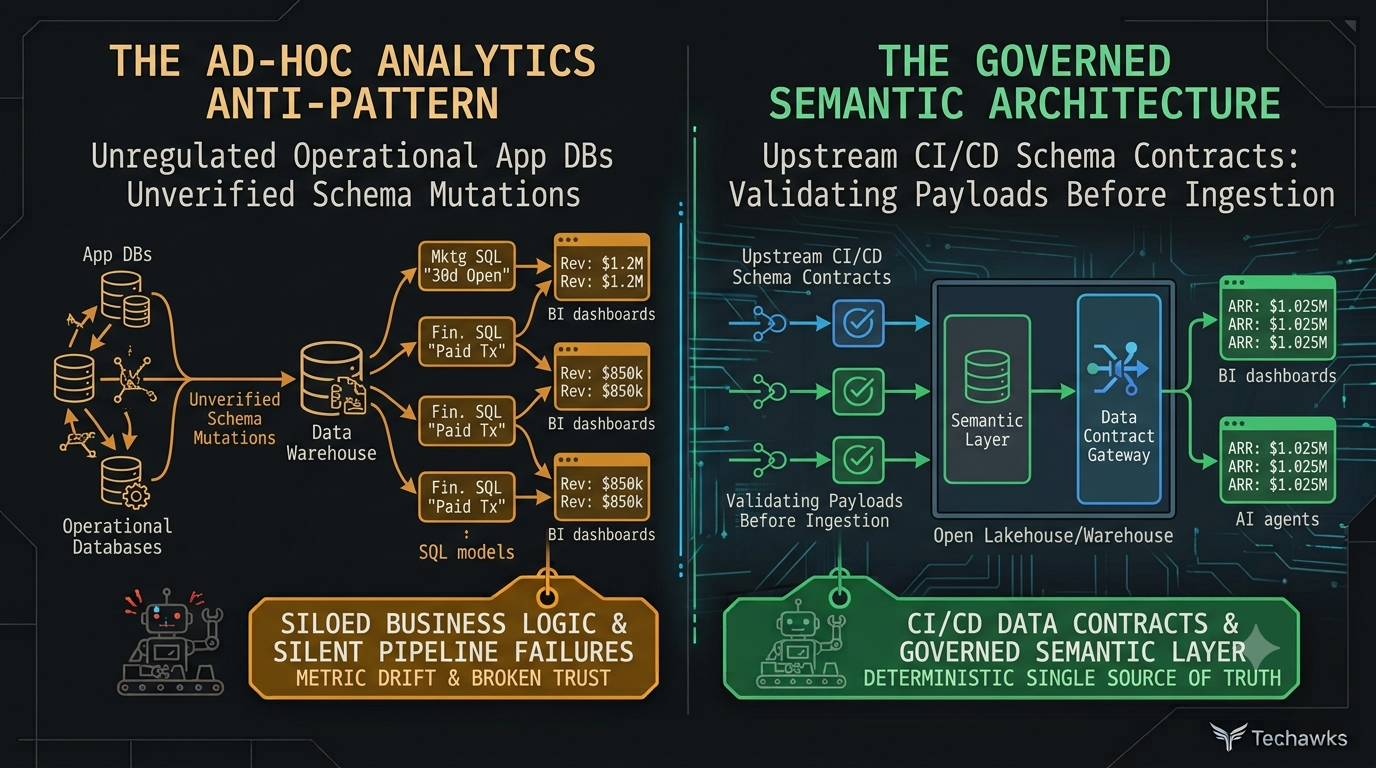
The result is Metric Drift & Upstream Schema Chaos:
A software engineer renames a column in an operational database, silently breaking downstream dbt models and dashboard extracts.
Marketing defines an "active customer" as someone who opened an email within 30 days, while Finance defines it as someone who completed a paid transaction in the last quarter.
When AI query agents or executive dashboards read from conflicting transformation tables, hallucinations and misaligned business decisions multiply.
To build trustworthy analytics, high-performing data teams are deprecating ad-hoc warehouse SQL and adopting Upstream Data Contracts paired with a Governed Semantic Layer.
The Two Pillars of Architectural Data Integrity:
Shift Left: Enforce Upstream Data Contracts
Treat data as a production API contract between software engineers producing data and data teams consuming it.
Define schemas, freshness guarantees, and nullability constraints in version-controlled declarations (YAML/Protobuf) at the service boundary.
Run schema change checks inside CI/CD pipelines. If a software deploy breaks a declared downstream contract, the deployment fails before it corrupts your data lakehouse.
Decouple Metric Logic from the BI Dashboard (The Semantic Layer)
Never calculate core KPIs inside proprietary BI tools or isolated SQL scripts.
Define dimension relationships, aggregations, and business metrics (e.g., Net Churn, ARR, Customer Lifetime Value) once in a unified, version-controlled semantic layer.
Whether an analyst queries via Tableau, a software engineer hits an API, or an AI agent queries via natural language, every tool points to the identical semantic abstraction.
Pipelines transport data, but data contracts and semantic definitions ensure that data actually means what you think it means.
Discussion Question
For data engineers and analytics leads: Where is your biggest architectural headache right now—upstream source schema changes breaking your ingestion pipelines, or metric definitions diverging across BI tools and AI agents? How are you enforcing consistency?
CTA
Ready to build reliable data architectures, robust pipelines, and production-grade analytics?
👉 Join the Techawks Data Science & Analytics Community to exchange lakehouse design patterns, discuss data modeling, and master the modern data stack alongside industry practitioners.
For years, data engineering prioritized raw pipeline speed and warehouse centralization: ingest raw data as fast as possible via ELT, dump it into the lakehouse or warehouse, and let downstream analysts write custom transformation logic.
The result is Metric Drift & Upstream Schema Chaos:
A software engineer renames a column in an operational database, silently breaking downstream dbt models and dashboard extracts.
Marketing defines an "active customer" as someone who opened an email within 30 days, while Finance defines it as someone who completed a paid transaction in the last quarter.
When AI query agents or executive dashboards read from conflicting transformation tables, hallucinations and misaligned business decisions multiply.
To build trustworthy analytics, high-performing data teams are deprecating ad-hoc warehouse SQL and adopting Upstream Data Contracts paired with a Governed Semantic Layer.
The Two Pillars of Architectural Data Integrity:
Shift Left: Enforce Upstream Data Contracts
Treat data as a production API contract between software engineers producing data and data teams consuming it.
Define schemas, freshness guarantees, and nullability constraints in version-controlled declarations (YAML/Protobuf) at the service boundary.
Run schema change checks inside CI/CD pipelines. If a software deploy breaks a declared downstream contract, the deployment fails before it corrupts your data lakehouse.
Decouple Metric Logic from the BI Dashboard (The Semantic Layer)
Never calculate core KPIs inside proprietary BI tools or isolated SQL scripts.
Define dimension relationships, aggregations, and business metrics (e.g., Net Churn, ARR, Customer Lifetime Value) once in a unified, version-controlled semantic layer.
Whether an analyst queries via Tableau, a software engineer hits an API, or an AI agent queries via natural language, every tool points to the identical semantic abstraction.
Pipelines transport data, but data contracts and semantic definitions ensure that data actually means what you think it means.
Discussion Question
For data engineers and analytics leads: Where is your biggest architectural headache right now—upstream source schema changes breaking your ingestion pipelines, or metric definitions diverging across BI tools and AI agents? How are you enforcing consistency?
CTA
Ready to build reliable data architectures, robust pipelines, and production-grade analytics?
👉 Join the Techawks Data Science & Analytics Community to exchange lakehouse design patterns, discuss data modeling, and master the modern data stack alongside industry practitioners.
The Metric Discrepancy Trap: Why the Modern Data Stack Replaced Warehouse SQL with Data Contracts and Semantic Layers
For years, data engineering prioritized raw pipeline speed and warehouse centralization: ingest raw data as fast as possible via ELT, dump it into the lakehouse or warehouse, and let downstream analysts write custom transformation logic.
The result is Metric Drift & Upstream Schema Chaos:
A software engineer renames a column in an operational database, silently breaking downstream dbt models and dashboard extracts.
Marketing defines an "active customer" as someone who opened an email within 30 days, while Finance defines it as someone who completed a paid transaction in the last quarter.
When AI query agents or executive dashboards read from conflicting transformation tables, hallucinations and misaligned business decisions multiply.
To build trustworthy analytics, high-performing data teams are deprecating ad-hoc warehouse SQL and adopting Upstream Data Contracts paired with a Governed Semantic Layer.
The Two Pillars of Architectural Data Integrity:
Shift Left: Enforce Upstream Data Contracts
Treat data as a production API contract between software engineers producing data and data teams consuming it.
Define schemas, freshness guarantees, and nullability constraints in version-controlled declarations (YAML/Protobuf) at the service boundary.
Run schema change checks inside CI/CD pipelines. If a software deploy breaks a declared downstream contract, the deployment fails before it corrupts your data lakehouse.
Decouple Metric Logic from the BI Dashboard (The Semantic Layer)
Never calculate core KPIs inside proprietary BI tools or isolated SQL scripts.
Define dimension relationships, aggregations, and business metrics (e.g., Net Churn, ARR, Customer Lifetime Value) once in a unified, version-controlled semantic layer.
Whether an analyst queries via Tableau, a software engineer hits an API, or an AI agent queries via natural language, every tool points to the identical semantic abstraction.
Pipelines transport data, but data contracts and semantic definitions ensure that data actually means what you think it means.
Discussion Question
For data engineers and analytics leads: Where is your biggest architectural headache right now—upstream source schema changes breaking your ingestion pipelines, or metric definitions diverging across BI tools and AI agents? How are you enforcing consistency?
CTA
Ready to build reliable data architectures, robust pipelines, and production-grade analytics?
👉 Join the Techawks Data Science & Analytics Community to exchange lakehouse design patterns, discuss data modeling, and master the modern data stack alongside industry practitioners.

 Arabic
 French
 Spanish
 Portuguese
 Deutsch
 Turkish
 Dutch
Dutch
 Italiano
 Russian
 Romaian
 Portuguese (Brazil)
 Greek
Greek