


Stop Stuffing 1M Tokens: Why "Context Compaction" Is the Real Production Benchmark
When million-token context windows landed, the default instinct for many developers was simple: dump conversation transcripts, vector chunks, and system instructions directly into prompt memory and let attention mechanisms sort it out.
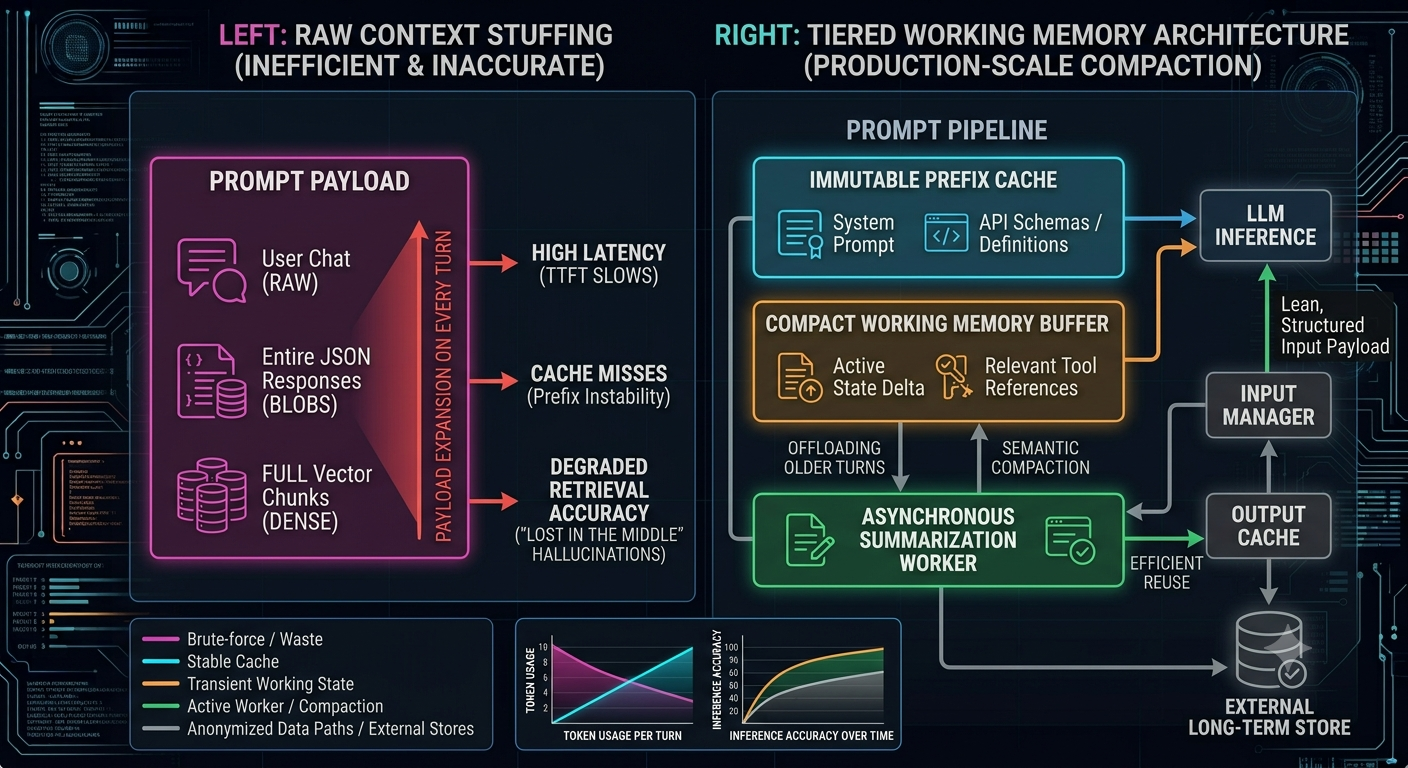
In production, brute-force context stuffing hits hard mechanical ceilings:
The "Lost in the Middle" Degradation: Attention accuracy flattens out across massive context spans, leading to hallucinations or missed instructions during complex reasoning loops.
Latency Inflation: Time-to-first-token (TTFT) climbs rapidly when passing dense raw payloads on every turn.
Cost Inefficiency: Context caching mitigates static prompt costs, but dynamic multi-agent discussions still re-tokenize growing context on every state change.
High-leverage AI builders are moving from raw prompt stuffing to Tiered Context Compaction & Working Memory Architecture:
Episodic vs. Working Memory Separation
Stop passing the whole session history. Split runtime memory into two layers:
Working Memory: Contains the active task definition, user constraints, and the immediate preceding step.
Episodic Graph/Vector Store: Cold historical steps and tool outputs stored externally, dynamically retrieved only when referenced by explicit entities or intent shifts.
Recursive Semantic Compaction
Instead of naive sliding windows that slice off older tokens by character count, run an asynchronous compaction job when context depth reaches a watermark:
Summarize previous action sequences into an immutable state delta (e.g., State: { Auth: Verified, SelectedPlan: Enterprise, Blockers: None }).
Prune repetitive tool outputs (like lengthy API JSON blobs) down to the essential keys before injecting them back into subsequent turns.
Prefix Stability for Cache Maximization
Model providers heavily discount cached input prefixes, but caching invalidates the moment a single token shifts early in the prompt. Place static system instructions and invariant schemas at the exact head of the prompt. Dynamic state, tool definitions, and user inputs must always trail at the tail.
Prompt engineering got models running; context engineering is what keeps production systems fast, reliable, and economically sustainable.
Discussion Question
How does your team handle long-running agent state? Are you relying on large context windows and provider caching, or have you implemented an automated summarization and compaction layer in your pipelines?
CTA
Drop your production patterns and trade-offs below! Share what has actually kept your tokens lean and your agents accurate in production.
When million-token context windows landed, the default instinct for many developers was simple: dump conversation transcripts, vector chunks, and system instructions directly into prompt memory and let attention mechanisms sort it out.
In production, brute-force context stuffing hits hard mechanical ceilings:
The "Lost in the Middle" Degradation: Attention accuracy flattens out across massive context spans, leading to hallucinations or missed instructions during complex reasoning loops.
Latency Inflation: Time-to-first-token (TTFT) climbs rapidly when passing dense raw payloads on every turn.
Cost Inefficiency: Context caching mitigates static prompt costs, but dynamic multi-agent discussions still re-tokenize growing context on every state change.
High-leverage AI builders are moving from raw prompt stuffing to Tiered Context Compaction & Working Memory Architecture:
Episodic vs. Working Memory Separation
Stop passing the whole session history. Split runtime memory into two layers:
Working Memory: Contains the active task definition, user constraints, and the immediate preceding step.
Episodic Graph/Vector Store: Cold historical steps and tool outputs stored externally, dynamically retrieved only when referenced by explicit entities or intent shifts.
Recursive Semantic Compaction
Instead of naive sliding windows that slice off older tokens by character count, run an asynchronous compaction job when context depth reaches a watermark:
Summarize previous action sequences into an immutable state delta (e.g., State: { Auth: Verified, SelectedPlan: Enterprise, Blockers: None }).
Prune repetitive tool outputs (like lengthy API JSON blobs) down to the essential keys before injecting them back into subsequent turns.
Prefix Stability for Cache Maximization
Model providers heavily discount cached input prefixes, but caching invalidates the moment a single token shifts early in the prompt. Place static system instructions and invariant schemas at the exact head of the prompt. Dynamic state, tool definitions, and user inputs must always trail at the tail.
Prompt engineering got models running; context engineering is what keeps production systems fast, reliable, and economically sustainable.
Discussion Question
How does your team handle long-running agent state? Are you relying on large context windows and provider caching, or have you implemented an automated summarization and compaction layer in your pipelines?
CTA
Drop your production patterns and trade-offs below! Share what has actually kept your tokens lean and your agents accurate in production.
Stop Stuffing 1M Tokens: Why "Context Compaction" Is the Real Production Benchmark
When million-token context windows landed, the default instinct for many developers was simple: dump conversation transcripts, vector chunks, and system instructions directly into prompt memory and let attention mechanisms sort it out.
In production, brute-force context stuffing hits hard mechanical ceilings:
The "Lost in the Middle" Degradation: Attention accuracy flattens out across massive context spans, leading to hallucinations or missed instructions during complex reasoning loops.
Latency Inflation: Time-to-first-token (TTFT) climbs rapidly when passing dense raw payloads on every turn.
Cost Inefficiency: Context caching mitigates static prompt costs, but dynamic multi-agent discussions still re-tokenize growing context on every state change.
High-leverage AI builders are moving from raw prompt stuffing to Tiered Context Compaction & Working Memory Architecture:
Episodic vs. Working Memory Separation
Stop passing the whole session history. Split runtime memory into two layers:
Working Memory: Contains the active task definition, user constraints, and the immediate preceding step.
Episodic Graph/Vector Store: Cold historical steps and tool outputs stored externally, dynamically retrieved only when referenced by explicit entities or intent shifts.
Recursive Semantic Compaction
Instead of naive sliding windows that slice off older tokens by character count, run an asynchronous compaction job when context depth reaches a watermark:
Summarize previous action sequences into an immutable state delta (e.g., State: { Auth: Verified, SelectedPlan: Enterprise, Blockers: None }).
Prune repetitive tool outputs (like lengthy API JSON blobs) down to the essential keys before injecting them back into subsequent turns.
Prefix Stability for Cache Maximization
Model providers heavily discount cached input prefixes, but caching invalidates the moment a single token shifts early in the prompt. Place static system instructions and invariant schemas at the exact head of the prompt. Dynamic state, tool definitions, and user inputs must always trail at the tail.
Prompt engineering got models running; context engineering is what keeps production systems fast, reliable, and economically sustainable.
Discussion Question
How does your team handle long-running agent state? Are you relying on large context windows and provider caching, or have you implemented an automated summarization and compaction layer in your pipelines?
CTA
Drop your production patterns and trade-offs below! Share what has actually kept your tokens lean and your agents accurate in production.

 English
 Arabic
 French
 Spanish
 Portuguese
 Deutsch
 Dutch
Dutch
 Italiano
 Russian
 Romaian
 Portuguese (Brazil)
 Greek
Greek