


The Golden Dataset Fallacy: Why Static Evaluation Is Silently Breaking Production AI
As engineering teams transition from classical tabular models to production RAG pipelines and conversational analytics agents, an uncomfortable truth has emerged across modern data platforms: static evaluation benchmarks actively lie over time.
Most data and ML teams test pipelines against a "golden dataset" established at launch. In classical predictive modeling, covariate shift is easily identified with statistical metrics like Population Stability Index (PSI) or Kolmogorov-Smirnov (KS) tests. However, in generative analytics and semantic query systems, data drift is multifaceted and insidious:
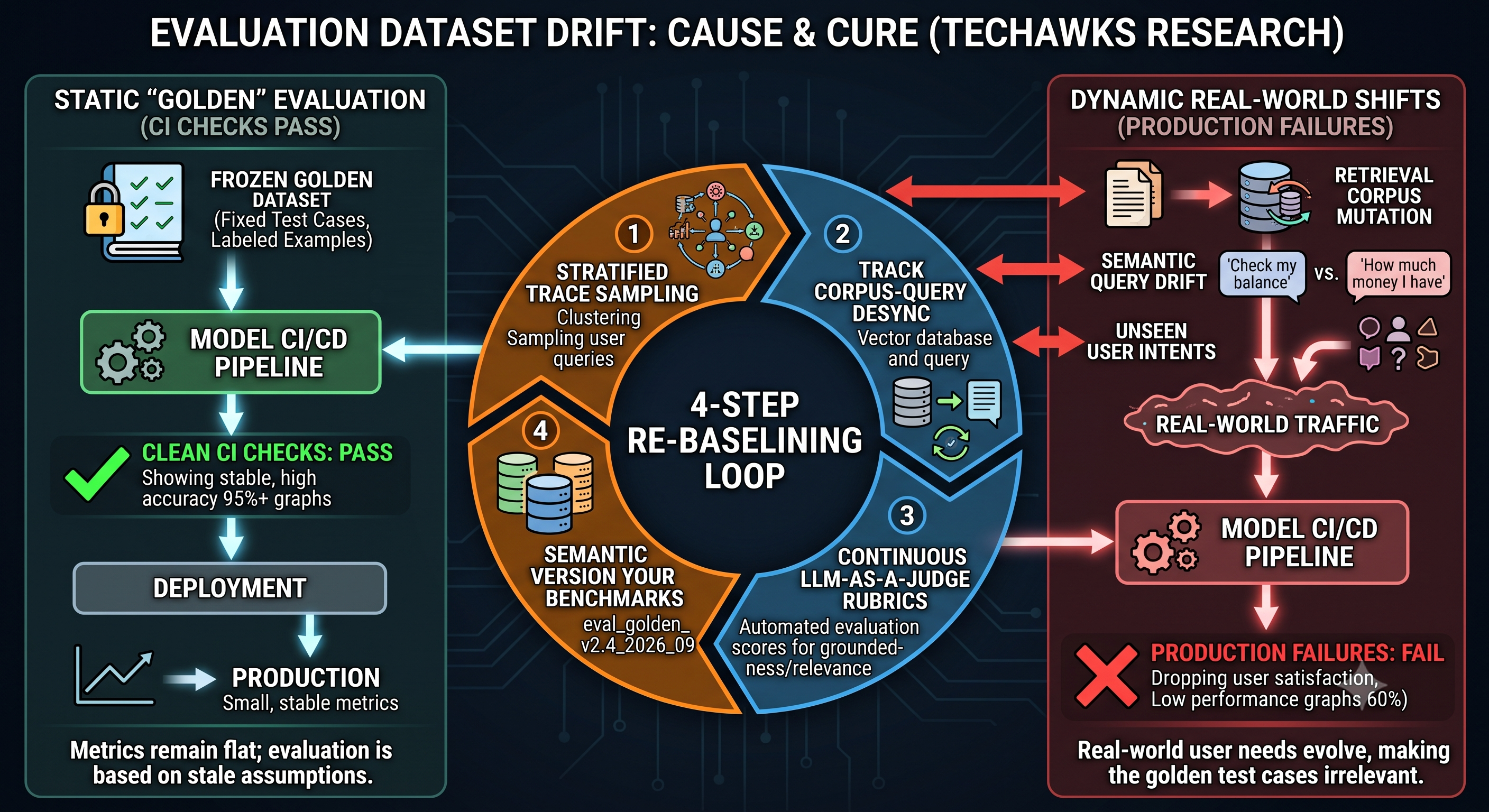
Retrieval-Corpus Drift: The production vector database updates continuously as enterprise data changes, but the benchmark queries still test against the baseline assumptions of day one.
Input Persona & Intent Drift: Real-world users phrase queries, edge cases, and analytical constraints entirely differently from the synthetic or curated test sets generated during development.
Prompt & Schema Mutation: Upstream database schema changes or subtle prompt adjustments subtly alter how SQL queries or answers are generated, bypassing baseline unit checks without triggering formal assertion errors.
When your CI/CD pipeline runs against an unversioned, frozen evaluation set, the score stays artificially flat while production utility rapidly decays.
Practical Resource: A 4-Step Eval-Drift Auditing Workflow
Stratified Trace Sampling: Sample 200–500 production queries across rolling 14-to-28-day windows. Cluster queries using semantic embeddings (e.g., HDBSCAN over prompt embeddings) to uncover unmapped customer intents that never existed in the original test suite.
Track Corpus-Query Desync: Ensure golden test cases explicitly log the vector corpus hash and chunk IDs retrieved during the test. If high-performing queries start fetching entirely different chunks in production, flag them for retrieval recalibration.
Continuous LLM-as-a-Judge Rubrics: Run automated evaluation runs scored on specific unit axes—Context Precision, Faithfulness/Groundedness, and Semantic Answer Relevance—rather than simple string matching or token similarity (ROUGE/BLEU).
Semantic Version Your Benchmarks: Treat test sets like production code (eval_golden_v2.4_2026_09). When a score drops after a dataset update, measure the variance to distinguish between true model regression and alignment with evolving real-world traffic.
Discussion Question
How frequently does your team refresh and re-baseline your evaluation datasets, and how do you separate true model degradation from underlying test-corpus drift?
CTA (Invite analysis and opinions)
Share your evaluation pipelines and drift-monitoring setups below. Let’s break down the best metrics for keeping validation suites honest against real-world production drift.
As engineering teams transition from classical tabular models to production RAG pipelines and conversational analytics agents, an uncomfortable truth has emerged across modern data platforms: static evaluation benchmarks actively lie over time.
Most data and ML teams test pipelines against a "golden dataset" established at launch. In classical predictive modeling, covariate shift is easily identified with statistical metrics like Population Stability Index (PSI) or Kolmogorov-Smirnov (KS) tests. However, in generative analytics and semantic query systems, data drift is multifaceted and insidious:
Retrieval-Corpus Drift: The production vector database updates continuously as enterprise data changes, but the benchmark queries still test against the baseline assumptions of day one.
Input Persona & Intent Drift: Real-world users phrase queries, edge cases, and analytical constraints entirely differently from the synthetic or curated test sets generated during development.
Prompt & Schema Mutation: Upstream database schema changes or subtle prompt adjustments subtly alter how SQL queries or answers are generated, bypassing baseline unit checks without triggering formal assertion errors.
When your CI/CD pipeline runs against an unversioned, frozen evaluation set, the score stays artificially flat while production utility rapidly decays.
Practical Resource: A 4-Step Eval-Drift Auditing Workflow
Stratified Trace Sampling: Sample 200–500 production queries across rolling 14-to-28-day windows. Cluster queries using semantic embeddings (e.g., HDBSCAN over prompt embeddings) to uncover unmapped customer intents that never existed in the original test suite.
Track Corpus-Query Desync: Ensure golden test cases explicitly log the vector corpus hash and chunk IDs retrieved during the test. If high-performing queries start fetching entirely different chunks in production, flag them for retrieval recalibration.
Continuous LLM-as-a-Judge Rubrics: Run automated evaluation runs scored on specific unit axes—Context Precision, Faithfulness/Groundedness, and Semantic Answer Relevance—rather than simple string matching or token similarity (ROUGE/BLEU).
Semantic Version Your Benchmarks: Treat test sets like production code (eval_golden_v2.4_2026_09). When a score drops after a dataset update, measure the variance to distinguish between true model regression and alignment with evolving real-world traffic.
Discussion Question
How frequently does your team refresh and re-baseline your evaluation datasets, and how do you separate true model degradation from underlying test-corpus drift?
CTA (Invite analysis and opinions)
Share your evaluation pipelines and drift-monitoring setups below. Let’s break down the best metrics for keeping validation suites honest against real-world production drift.
The Golden Dataset Fallacy: Why Static Evaluation Is Silently Breaking Production AI
As engineering teams transition from classical tabular models to production RAG pipelines and conversational analytics agents, an uncomfortable truth has emerged across modern data platforms: static evaluation benchmarks actively lie over time.
Most data and ML teams test pipelines against a "golden dataset" established at launch. In classical predictive modeling, covariate shift is easily identified with statistical metrics like Population Stability Index (PSI) or Kolmogorov-Smirnov (KS) tests. However, in generative analytics and semantic query systems, data drift is multifaceted and insidious:
Retrieval-Corpus Drift: The production vector database updates continuously as enterprise data changes, but the benchmark queries still test against the baseline assumptions of day one.
Input Persona & Intent Drift: Real-world users phrase queries, edge cases, and analytical constraints entirely differently from the synthetic or curated test sets generated during development.
Prompt & Schema Mutation: Upstream database schema changes or subtle prompt adjustments subtly alter how SQL queries or answers are generated, bypassing baseline unit checks without triggering formal assertion errors.
When your CI/CD pipeline runs against an unversioned, frozen evaluation set, the score stays artificially flat while production utility rapidly decays.
Practical Resource: A 4-Step Eval-Drift Auditing Workflow
Stratified Trace Sampling: Sample 200–500 production queries across rolling 14-to-28-day windows. Cluster queries using semantic embeddings (e.g., HDBSCAN over prompt embeddings) to uncover unmapped customer intents that never existed in the original test suite.
Track Corpus-Query Desync: Ensure golden test cases explicitly log the vector corpus hash and chunk IDs retrieved during the test. If high-performing queries start fetching entirely different chunks in production, flag them for retrieval recalibration.
Continuous LLM-as-a-Judge Rubrics: Run automated evaluation runs scored on specific unit axes—Context Precision, Faithfulness/Groundedness, and Semantic Answer Relevance—rather than simple string matching or token similarity (ROUGE/BLEU).
Semantic Version Your Benchmarks: Treat test sets like production code (eval_golden_v2.4_2026_09). When a score drops after a dataset update, measure the variance to distinguish between true model regression and alignment with evolving real-world traffic.
Discussion Question
How frequently does your team refresh and re-baseline your evaluation datasets, and how do you separate true model degradation from underlying test-corpus drift?
CTA (Invite analysis and opinions)
Share your evaluation pipelines and drift-monitoring setups below. Let’s break down the best metrics for keeping validation suites honest against real-world production drift.

 English
 Arabic
 French
 Spanish
 Portuguese
 Deutsch
 Turkish
 Dutch
Dutch
 Russian
 Romaian
 Portuguese (Brazil)
 Greek
Greek