


The 4-Step Governance Checklist for Deploying Autonomous AI Agents in Production
As organizations scale their use of artificial intelligence, the bottleneck has shifted from simple model adoption to managing autonomous execution and deep system integration. When AI agents can autonomously invoke APIs, alter datasets, and drive decisions, traditional security perimeters are no longer enough.
To protect your infrastructure while unlocking productivity, use this AI Agent Production Readiness Checklist:
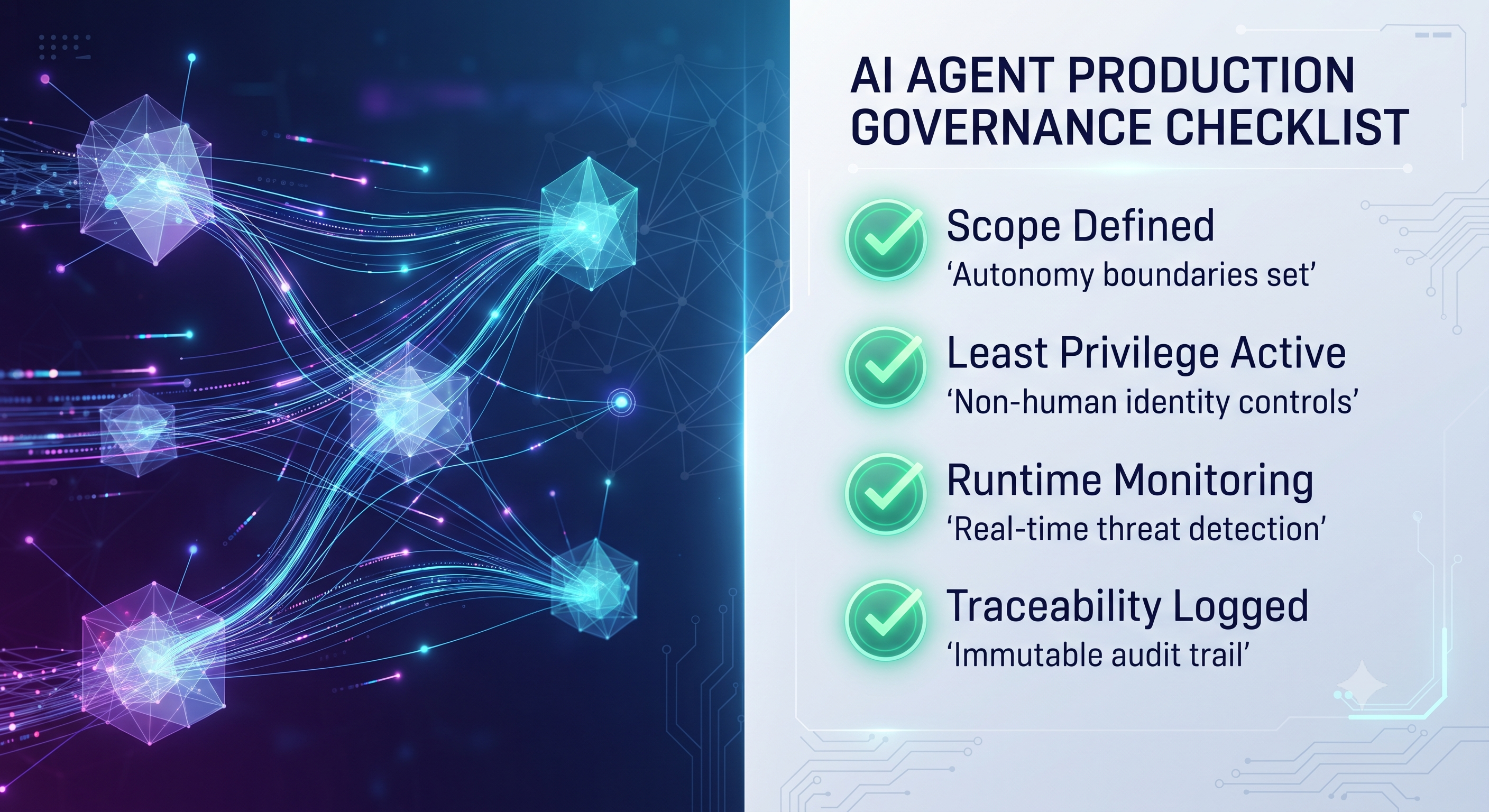
1. Define Scope of Autonomy: Explicitly outline what operations an agent can perform independently versus what requires human authorization. Never grant blanket write or execute permissions
2. Implement Identity-First Access Control: Treat AI systems as non-human users. Assign distinct machine identities adhering to the principle of least privilege across all integrated environments.
3. Establish Continuous Exposure Management: Move away from static vulnerability scans. Deploy runtime monitoring to track prompt injections, data leakage, and unexpected behavioral drifts in real time.
4. Enforce Audit Traceability: Maintain an immutable log of every decision path, tool call, and generated artifact so that accountability always traces back to a clear operational owner.
Engineering reliable systems means building boundaries that allow innovation to move fast safely.
Discussion Question
What is the biggest operational hurdle your team faces when trying to balance AI autonomy with enterprise security compliance? Drop your thoughts below!
CTA (Join Techawks General Community)
Want to stay ahead of the curve with deep-dive architectural breakdowns and peer-to-peer tech strategy? Join the Techawks General Community today to connect with builders and technology leaders worldwide!
As organizations scale their use of artificial intelligence, the bottleneck has shifted from simple model adoption to managing autonomous execution and deep system integration. When AI agents can autonomously invoke APIs, alter datasets, and drive decisions, traditional security perimeters are no longer enough.
To protect your infrastructure while unlocking productivity, use this AI Agent Production Readiness Checklist:
1. Define Scope of Autonomy: Explicitly outline what operations an agent can perform independently versus what requires human authorization. Never grant blanket write or execute permissions
2. Implement Identity-First Access Control: Treat AI systems as non-human users. Assign distinct machine identities adhering to the principle of least privilege across all integrated environments.
3. Establish Continuous Exposure Management: Move away from static vulnerability scans. Deploy runtime monitoring to track prompt injections, data leakage, and unexpected behavioral drifts in real time.
4. Enforce Audit Traceability: Maintain an immutable log of every decision path, tool call, and generated artifact so that accountability always traces back to a clear operational owner.
Engineering reliable systems means building boundaries that allow innovation to move fast safely.
Discussion Question
What is the biggest operational hurdle your team faces when trying to balance AI autonomy with enterprise security compliance? Drop your thoughts below!
CTA (Join Techawks General Community)
Want to stay ahead of the curve with deep-dive architectural breakdowns and peer-to-peer tech strategy? Join the Techawks General Community today to connect with builders and technology leaders worldwide!
The 4-Step Governance Checklist for Deploying Autonomous AI Agents in Production
As organizations scale their use of artificial intelligence, the bottleneck has shifted from simple model adoption to managing autonomous execution and deep system integration. When AI agents can autonomously invoke APIs, alter datasets, and drive decisions, traditional security perimeters are no longer enough.
To protect your infrastructure while unlocking productivity, use this AI Agent Production Readiness Checklist:
1. Define Scope of Autonomy: Explicitly outline what operations an agent can perform independently versus what requires human authorization. Never grant blanket write or execute permissions
2. Implement Identity-First Access Control: Treat AI systems as non-human users. Assign distinct machine identities adhering to the principle of least privilege across all integrated environments.
3. Establish Continuous Exposure Management: Move away from static vulnerability scans. Deploy runtime monitoring to track prompt injections, data leakage, and unexpected behavioral drifts in real time.
4. Enforce Audit Traceability: Maintain an immutable log of every decision path, tool call, and generated artifact so that accountability always traces back to a clear operational owner.
Engineering reliable systems means building boundaries that allow innovation to move fast safely.
Discussion Question
What is the biggest operational hurdle your team faces when trying to balance AI autonomy with enterprise security compliance? Drop your thoughts below!
CTA (Join Techawks General Community)
Want to stay ahead of the curve with deep-dive architectural breakdowns and peer-to-peer tech strategy? Join the Techawks General Community today to connect with builders and technology leaders worldwide!

 English
 Arabic
 French
 Spanish
 Portuguese
 Deutsch
 Turkish
 Dutch
Dutch
 Italiano
 Russian
 Romaian
 Portuguese (Brazil)