


Headline: Beyond LeetCode: The 4-Step Technical Portfolio Checklist for Students Landing Tech Internships
The traditional path of relying purely on a college GPA and a list of textbook projects is losing its edge. Modern hiring managers look for evidence of execution—how well you handle APIs, integrate cloud tools, manage data, and solve unstructured engineering problems.
To bridge the gap between classroom theory and industry expectations, use this actionable checklist to upgrade your student portfolio before applications open:
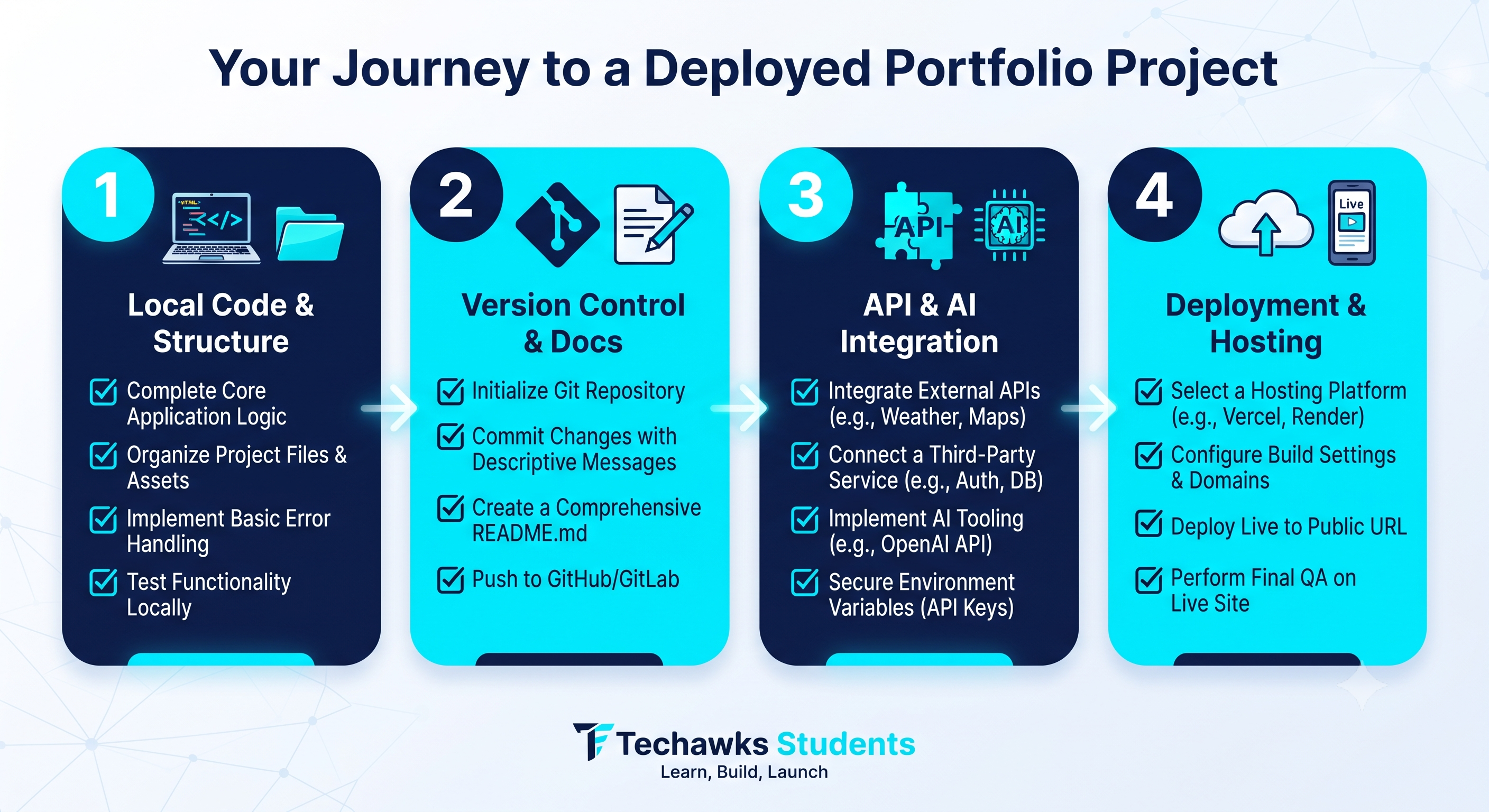
Build End-to-End Applications, Not Just Scripts: Move past isolated algorithm solutions. Build full-stack or data-driven applications that solve a tangible problem, featuring a clean frontend, a functional backend, and an active database.
Integrate Modern APIs & AI Tooling: Show recruiters you aren't living in the past. Leverage third-party APIs (like OpenAI, payment gateways, or cloud services) to give your student projects real-world utility.
Master Version Control & Clean Documentation: Your GitHub repository is your real resume. Keep your code well-documented with clear README files, proper commit histories, and setup instructions so anyone can run your project instantly.
Deploy and Host Publicly: Code that only lives on your local machine doesn't count. Use free tier platforms (like Vercel, Render, or AWS) to deploy your projects live so interviewers can interact with your work in one click.
Discussion Question: What has been your biggest obstacle when building student projects—coming up with a unique project idea, figuring out deployment, or balancing it with coursework? Let us know below!
CTA (Join Students in Tech): Want to land your dream tech internship? Join Students in Tech to access peer mentorship, resume teardowns, and exclusive student-friendly job openings.
The traditional path of relying purely on a college GPA and a list of textbook projects is losing its edge. Modern hiring managers look for evidence of execution—how well you handle APIs, integrate cloud tools, manage data, and solve unstructured engineering problems.
To bridge the gap between classroom theory and industry expectations, use this actionable checklist to upgrade your student portfolio before applications open:
Build End-to-End Applications, Not Just Scripts: Move past isolated algorithm solutions. Build full-stack or data-driven applications that solve a tangible problem, featuring a clean frontend, a functional backend, and an active database.
Integrate Modern APIs & AI Tooling: Show recruiters you aren't living in the past. Leverage third-party APIs (like OpenAI, payment gateways, or cloud services) to give your student projects real-world utility.
Master Version Control & Clean Documentation: Your GitHub repository is your real resume. Keep your code well-documented with clear README files, proper commit histories, and setup instructions so anyone can run your project instantly.
Deploy and Host Publicly: Code that only lives on your local machine doesn't count. Use free tier platforms (like Vercel, Render, or AWS) to deploy your projects live so interviewers can interact with your work in one click.
Discussion Question: What has been your biggest obstacle when building student projects—coming up with a unique project idea, figuring out deployment, or balancing it with coursework? Let us know below!
CTA (Join Students in Tech): Want to land your dream tech internship? Join Students in Tech to access peer mentorship, resume teardowns, and exclusive student-friendly job openings.
Headline: Beyond LeetCode: The 4-Step Technical Portfolio Checklist for Students Landing Tech Internships
The traditional path of relying purely on a college GPA and a list of textbook projects is losing its edge. Modern hiring managers look for evidence of execution—how well you handle APIs, integrate cloud tools, manage data, and solve unstructured engineering problems.
To bridge the gap between classroom theory and industry expectations, use this actionable checklist to upgrade your student portfolio before applications open:
Build End-to-End Applications, Not Just Scripts: Move past isolated algorithm solutions. Build full-stack or data-driven applications that solve a tangible problem, featuring a clean frontend, a functional backend, and an active database.
Integrate Modern APIs & AI Tooling: Show recruiters you aren't living in the past. Leverage third-party APIs (like OpenAI, payment gateways, or cloud services) to give your student projects real-world utility.
Master Version Control & Clean Documentation: Your GitHub repository is your real resume. Keep your code well-documented with clear README files, proper commit histories, and setup instructions so anyone can run your project instantly.
Deploy and Host Publicly: Code that only lives on your local machine doesn't count. Use free tier platforms (like Vercel, Render, or AWS) to deploy your projects live so interviewers can interact with your work in one click.
Discussion Question: What has been your biggest obstacle when building student projects—coming up with a unique project idea, figuring out deployment, or balancing it with coursework? Let us know below!
CTA (Join Students in Tech): Want to land your dream tech internship? Join Students in Tech to access peer mentorship, resume teardowns, and exclusive student-friendly job openings.

 English
 Arabic
 French
 Portuguese
 Deutsch
 Turkish
 Dutch
Dutch
 Italiano
 Russian
 Romaian
 Portuguese (Brazil)
 Greek
Greek