


Where do most real-world data science projects actually stall out?
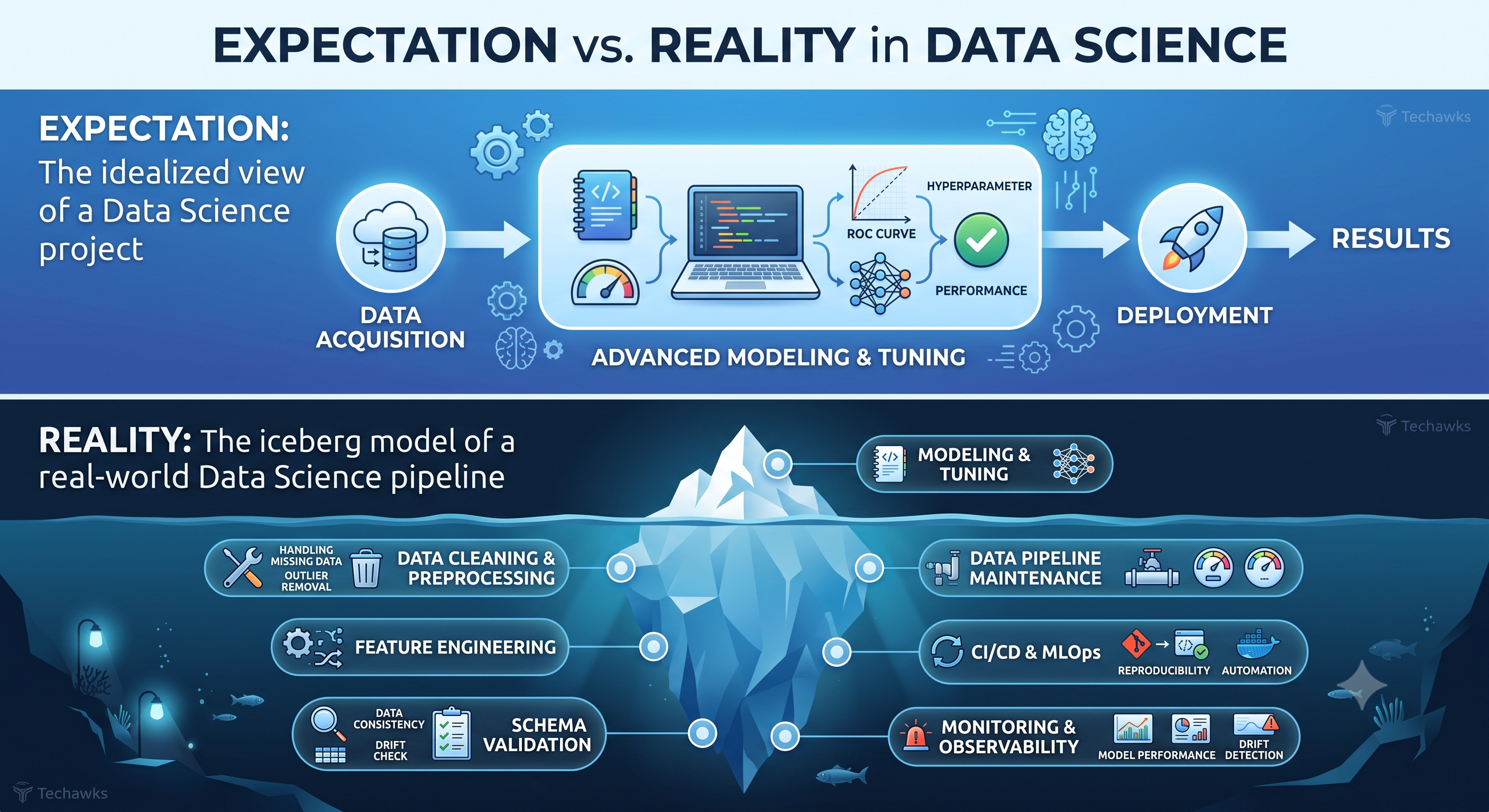
Building a high-performing model in a notebook is rarely the hardest part of delivering business value. The friction almost always emerges when bridging raw, messy source data to a reliable, monitored production environment.
Cast your vote below on the single biggest bottleneck you encounter in your data pipeline lifecycle:
A) Fragmented data quality & schema drift (upstream changes breaking pipelines silently)
B) Ambiguous business metrics (stakeholders cannot define a measurable objective function)
C) Feature store & deployment drift (training/serving skew and operational MLOps debt)
D) Organizational buy-in & adoption (a 95% accurate model that nobody trusts or integrates)
Select your vote above, then head to the comments. If you could eliminate just one of these hurdles from your daily workflow, which would yield the highest ROI for your team?
Key Takeaways
Data pipelines outweigh modeling: Robust data validation frameworks often generate higher business impact than incremental model accuracy gains.
Alignment prevents rework: A model optimized for the wrong KPI is dead on arrival, no matter how complex the architecture.
Serving requires dedicated observability: Monitoring for concept drift and distribution shifts is essential to keep production systems reliable over time.
CTA
Let’s hear your analysis: How is your team currently tackling silent pipeline failures and schema drift? Drop your battle-tested tools, automated validation strategies, or hardest lessons learned below.
Building a high-performing model in a notebook is rarely the hardest part of delivering business value. The friction almost always emerges when bridging raw, messy source data to a reliable, monitored production environment.
Cast your vote below on the single biggest bottleneck you encounter in your data pipeline lifecycle:
A) Fragmented data quality & schema drift (upstream changes breaking pipelines silently)
B) Ambiguous business metrics (stakeholders cannot define a measurable objective function)
C) Feature store & deployment drift (training/serving skew and operational MLOps debt)
D) Organizational buy-in & adoption (a 95% accurate model that nobody trusts or integrates)
Select your vote above, then head to the comments. If you could eliminate just one of these hurdles from your daily workflow, which would yield the highest ROI for your team?
Key Takeaways
Data pipelines outweigh modeling: Robust data validation frameworks often generate higher business impact than incremental model accuracy gains.
Alignment prevents rework: A model optimized for the wrong KPI is dead on arrival, no matter how complex the architecture.
Serving requires dedicated observability: Monitoring for concept drift and distribution shifts is essential to keep production systems reliable over time.
CTA
Let’s hear your analysis: How is your team currently tackling silent pipeline failures and schema drift? Drop your battle-tested tools, automated validation strategies, or hardest lessons learned below.
Where do most real-world data science projects actually stall out?
Building a high-performing model in a notebook is rarely the hardest part of delivering business value. The friction almost always emerges when bridging raw, messy source data to a reliable, monitored production environment.
Cast your vote below on the single biggest bottleneck you encounter in your data pipeline lifecycle:
A) Fragmented data quality & schema drift (upstream changes breaking pipelines silently)
B) Ambiguous business metrics (stakeholders cannot define a measurable objective function)
C) Feature store & deployment drift (training/serving skew and operational MLOps debt)
D) Organizational buy-in & adoption (a 95% accurate model that nobody trusts or integrates)
Select your vote above, then head to the comments. If you could eliminate just one of these hurdles from your daily workflow, which would yield the highest ROI for your team?
Key Takeaways
Data pipelines outweigh modeling: Robust data validation frameworks often generate higher business impact than incremental model accuracy gains.
Alignment prevents rework: A model optimized for the wrong KPI is dead on arrival, no matter how complex the architecture.
Serving requires dedicated observability: Monitoring for concept drift and distribution shifts is essential to keep production systems reliable over time.
CTA
Let’s hear your analysis: How is your team currently tackling silent pipeline failures and schema drift? Drop your battle-tested tools, automated validation strategies, or hardest lessons learned below.

 Arabic
 French
 Spanish
 Portuguese
 Deutsch
 Turkish
 Dutch
Dutch
 Italiano
 Russian
 Romaian
 Portuguese (Brazil)
 Greek
Greek