


SQL Challenge: Can You Spot the Hidden Data Leak? 🔍
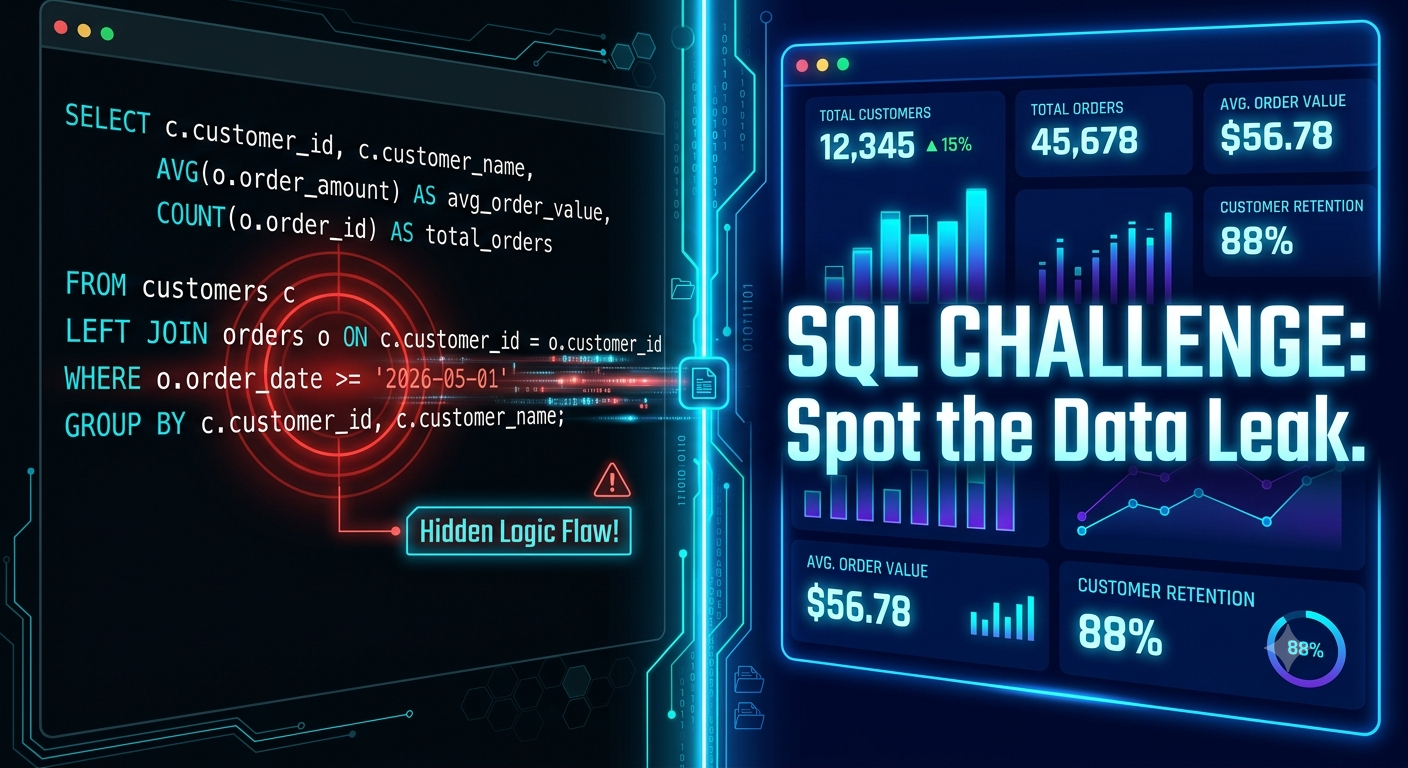
Below is a common SQL query designed to calculate Average Order Value (AOV) per customer over the last quarter. At first glance, it runs smoothly and returns a result. But there is a subtle, critical logic flaw hiding in plain sight that distorts the business metrics.
SELECT
c.customer_id,
c.customer_name,
AVG(o.order_amount) AS avg_order_value,
COUNT(o.order_id) AS total_orders
FROM customers c
LEFT JOIN orders o
ON c.customer_id = o.customer_id
WHERE o.order_date >= '2026-05-01'
GROUP BY c.customer_id, c.customer_name;
🛠️ The Challenge
Can you identify why this query produces inaccurate business reporting?
💡 Hint & Solution Breakdown
The Hidden Flaw: Using WHERE o.order_date >= ... on a LEFT JOIN table implicitly converts your query into an INNER JOIN!
Why it breaks: Any customer who made 0 orders in that timeframe will have a NULL order_date. The WHERE clause filters out those NULL rows entirely instead of keeping the customer in the result set with 0 orders.
The Impact: Your report will completely exclude inactive customers, artificially inflating your overall engagement metrics!
✅ The Fixed Query
To preserve your LEFT JOIN and retain all customers (even those with zero orders), move the date filter directly into the ON clause:
SELECT
c.customer_id,
c.customer_name,
COALESCE(AVG(o.order_amount), 0) AS avg_order_value,
COUNT(o.order_id) AS total_orders
FROM customers c
LEFT JOIN orders o
ON c.customer_id = o.customer_id
AND o.order_date >= '2026-05-01'
GROUP BY c.customer_id, c.customer_name;
Key Takeaways
Watch Where You Filter: Filtering a LEFT JOIN table in the WHERE clause converts it to an INNER JOIN.
Preserve Inactive Records: Move conditional logic for joined tables into the ON clause to keep zero-count or inactive entities.
Wrap Nulls Safely: Always use COALESCE() on aggregated fields to avoid returning empty NULL values to business dashboards.
CTA
Ready to sharpen your SQL logic, master data modeling, and solve complex real-world analytics problems?
Join the Techawks Data Science & Analytics Program today to build production-grade projects and elevate your data career! 🚀
Below is a common SQL query designed to calculate Average Order Value (AOV) per customer over the last quarter. At first glance, it runs smoothly and returns a result. But there is a subtle, critical logic flaw hiding in plain sight that distorts the business metrics.
SELECT
c.customer_id,
c.customer_name,
AVG(o.order_amount) AS avg_order_value,
COUNT(o.order_id) AS total_orders
FROM customers c
LEFT JOIN orders o
ON c.customer_id = o.customer_id
WHERE o.order_date >= '2026-05-01'
GROUP BY c.customer_id, c.customer_name;
🛠️ The Challenge
Can you identify why this query produces inaccurate business reporting?
💡 Hint & Solution Breakdown
The Hidden Flaw: Using WHERE o.order_date >= ... on a LEFT JOIN table implicitly converts your query into an INNER JOIN!
Why it breaks: Any customer who made 0 orders in that timeframe will have a NULL order_date. The WHERE clause filters out those NULL rows entirely instead of keeping the customer in the result set with 0 orders.
The Impact: Your report will completely exclude inactive customers, artificially inflating your overall engagement metrics!
✅ The Fixed Query
To preserve your LEFT JOIN and retain all customers (even those with zero orders), move the date filter directly into the ON clause:
SELECT
c.customer_id,
c.customer_name,
COALESCE(AVG(o.order_amount), 0) AS avg_order_value,
COUNT(o.order_id) AS total_orders
FROM customers c
LEFT JOIN orders o
ON c.customer_id = o.customer_id
AND o.order_date >= '2026-05-01'
GROUP BY c.customer_id, c.customer_name;
Key Takeaways
Watch Where You Filter: Filtering a LEFT JOIN table in the WHERE clause converts it to an INNER JOIN.
Preserve Inactive Records: Move conditional logic for joined tables into the ON clause to keep zero-count or inactive entities.
Wrap Nulls Safely: Always use COALESCE() on aggregated fields to avoid returning empty NULL values to business dashboards.
CTA
Ready to sharpen your SQL logic, master data modeling, and solve complex real-world analytics problems?
Join the Techawks Data Science & Analytics Program today to build production-grade projects and elevate your data career! 🚀
SQL Challenge: Can You Spot the Hidden Data Leak? 🔍
Below is a common SQL query designed to calculate Average Order Value (AOV) per customer over the last quarter. At first glance, it runs smoothly and returns a result. But there is a subtle, critical logic flaw hiding in plain sight that distorts the business metrics.
SELECT
c.customer_id,
c.customer_name,
AVG(o.order_amount) AS avg_order_value,
COUNT(o.order_id) AS total_orders
FROM customers c
LEFT JOIN orders o
ON c.customer_id = o.customer_id
WHERE o.order_date >= '2026-05-01'
GROUP BY c.customer_id, c.customer_name;
🛠️ The Challenge
Can you identify why this query produces inaccurate business reporting?
💡 Hint & Solution Breakdown
The Hidden Flaw: Using WHERE o.order_date >= ... on a LEFT JOIN table implicitly converts your query into an INNER JOIN!
Why it breaks: Any customer who made 0 orders in that timeframe will have a NULL order_date. The WHERE clause filters out those NULL rows entirely instead of keeping the customer in the result set with 0 orders.
The Impact: Your report will completely exclude inactive customers, artificially inflating your overall engagement metrics!
✅ The Fixed Query
To preserve your LEFT JOIN and retain all customers (even those with zero orders), move the date filter directly into the ON clause:
SELECT
c.customer_id,
c.customer_name,
COALESCE(AVG(o.order_amount), 0) AS avg_order_value,
COUNT(o.order_id) AS total_orders
FROM customers c
LEFT JOIN orders o
ON c.customer_id = o.customer_id
AND o.order_date >= '2026-05-01'
GROUP BY c.customer_id, c.customer_name;
Key Takeaways
Watch Where You Filter: Filtering a LEFT JOIN table in the WHERE clause converts it to an INNER JOIN.
Preserve Inactive Records: Move conditional logic for joined tables into the ON clause to keep zero-count or inactive entities.
Wrap Nulls Safely: Always use COALESCE() on aggregated fields to avoid returning empty NULL values to business dashboards.
CTA
Ready to sharpen your SQL logic, master data modeling, and solve complex real-world analytics problems?
Join the Techawks Data Science & Analytics Program today to build production-grade projects and elevate your data career! 🚀

 English
 Arabic
 French
 Spanish
 Portuguese
 Turkish
 Dutch
Dutch
 Italiano
 Russian
 Romaian
 Portuguese (Brazil)
 Greek
Greek