


Stop Splitting Your Backend Into Microservices Before You Hit 100k Users
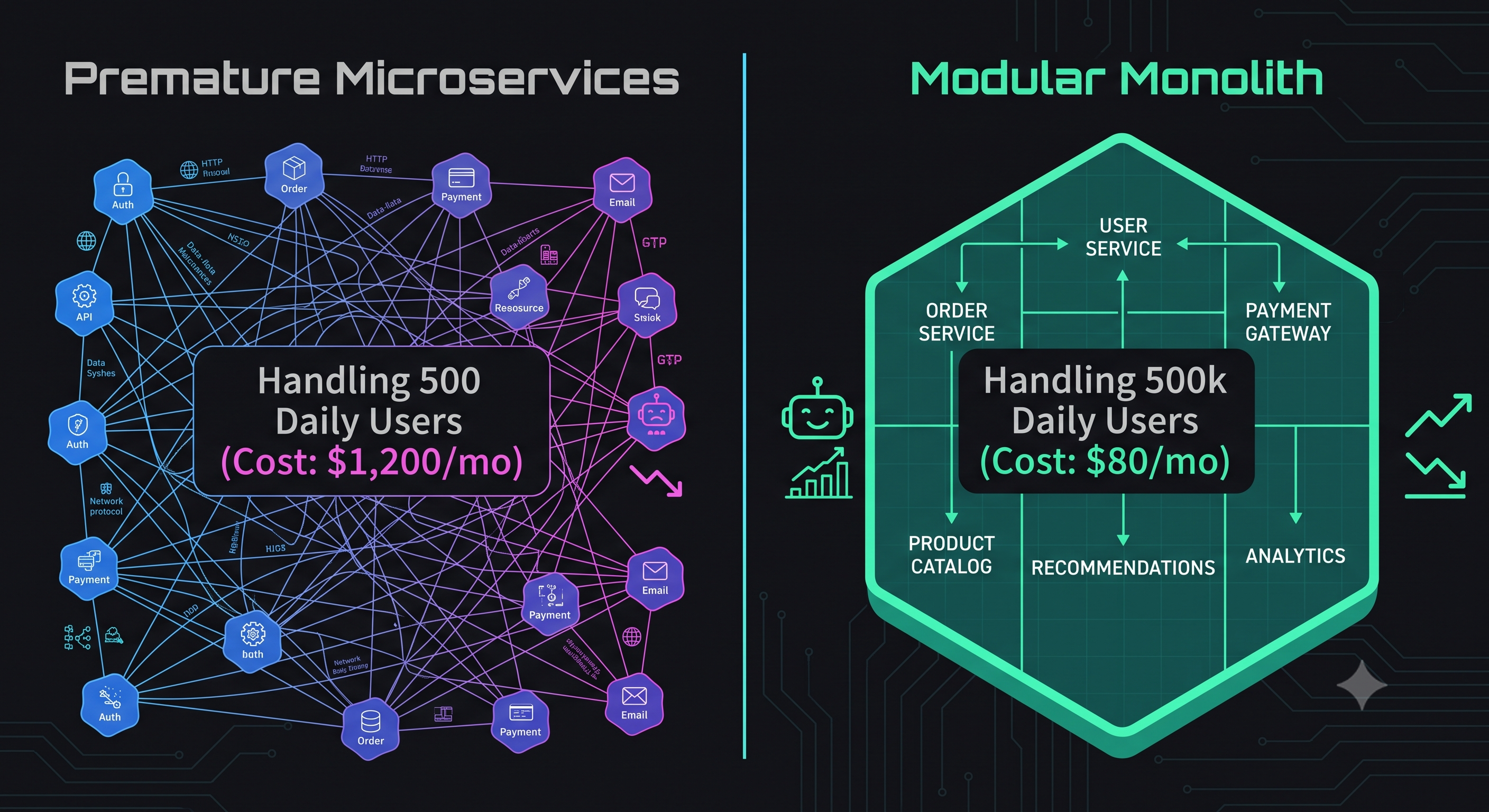
Every engineering team wants to design like Netflix on day one. You draw twelve microservices on a Miro board, spin up Kubernetes clusters, configure service meshes, and spend three weeks debugging distributed tracing—all for an app serving 40 active users.
Here is the truth: premature distribution is technical debt disguised as good architecture.
When you split an early-stage system into distributed services:
Refactoring becomes network calls: Changing a schema now requires three PRs, cross-team coordination, and API versioning.
Transactions become nightmares: Instead of an ACID transaction in a single database, you are wrestling with eventual consistency and the Saga pattern.
Latency increases: In-memory function calls are replaced by HTTP/gRPC overhead and network jitter.
Build a modular monolith first.
Write clean boundaries inside a single repository and deploy a single artifact. Group features by domain modules with explicit interfaces. When—and only when—a single module has fundamentally distinct scaling requirements or team ownership boundaries, carve it out.
Until your database CPU is melting despite solid indexing and read replicas, keep it under one roof.
Key Takeaways
Distributed systems solve organizational scaling bottlenecks, not basic code organization.
A well-structured monolith scales to millions of requests when paired with proper caching and optimized database queries.
Design strict internal domain boundaries now so splitting services later takes days, not months of emergency refactoring.
CTA
Tired of over-engineered tech stacks and hype-driven development?
👉 Join the Techawks Community to connect with pragmatic engineers, challenge standard industry dogma, and build software that actually ships:
Every engineering team wants to design like Netflix on day one. You draw twelve microservices on a Miro board, spin up Kubernetes clusters, configure service meshes, and spend three weeks debugging distributed tracing—all for an app serving 40 active users.
Here is the truth: premature distribution is technical debt disguised as good architecture.
When you split an early-stage system into distributed services:
Refactoring becomes network calls: Changing a schema now requires three PRs, cross-team coordination, and API versioning.
Transactions become nightmares: Instead of an ACID transaction in a single database, you are wrestling with eventual consistency and the Saga pattern.
Latency increases: In-memory function calls are replaced by HTTP/gRPC overhead and network jitter.
Build a modular monolith first.
Write clean boundaries inside a single repository and deploy a single artifact. Group features by domain modules with explicit interfaces. When—and only when—a single module has fundamentally distinct scaling requirements or team ownership boundaries, carve it out.
Until your database CPU is melting despite solid indexing and read replicas, keep it under one roof.
Key Takeaways
Distributed systems solve organizational scaling bottlenecks, not basic code organization.
A well-structured monolith scales to millions of requests when paired with proper caching and optimized database queries.
Design strict internal domain boundaries now so splitting services later takes days, not months of emergency refactoring.
CTA
Tired of over-engineered tech stacks and hype-driven development?
👉 Join the Techawks Community to connect with pragmatic engineers, challenge standard industry dogma, and build software that actually ships:
Stop Splitting Your Backend Into Microservices Before You Hit 100k Users
Every engineering team wants to design like Netflix on day one. You draw twelve microservices on a Miro board, spin up Kubernetes clusters, configure service meshes, and spend three weeks debugging distributed tracing—all for an app serving 40 active users.
Here is the truth: premature distribution is technical debt disguised as good architecture.
When you split an early-stage system into distributed services:
Refactoring becomes network calls: Changing a schema now requires three PRs, cross-team coordination, and API versioning.
Transactions become nightmares: Instead of an ACID transaction in a single database, you are wrestling with eventual consistency and the Saga pattern.
Latency increases: In-memory function calls are replaced by HTTP/gRPC overhead and network jitter.
Build a modular monolith first.
Write clean boundaries inside a single repository and deploy a single artifact. Group features by domain modules with explicit interfaces. When—and only when—a single module has fundamentally distinct scaling requirements or team ownership boundaries, carve it out.
Until your database CPU is melting despite solid indexing and read replicas, keep it under one roof.
Key Takeaways
Distributed systems solve organizational scaling bottlenecks, not basic code organization.
A well-structured monolith scales to millions of requests when paired with proper caching and optimized database queries.
Design strict internal domain boundaries now so splitting services later takes days, not months of emergency refactoring.
CTA
Tired of over-engineered tech stacks and hype-driven development?
👉 Join the Techawks Community to connect with pragmatic engineers, challenge standard industry dogma, and build software that actually ships:

 English
 Arabic
 French
 Spanish
 Portuguese
 Deutsch
 Turkish
 Dutch
Dutch
 Italiano
 Russian
 Romaian
 Portuguese (Brazil)