


The Illusion of Competence: Why Passing Tests with AI Is Making You a Weaker Engineer
Over 90% of computer science students use generative AI tools to complete programming assignments and lab coursework. Assignments that used to take an entire weekend of grueling debugging now compile in thirty seconds.
Getting a green checkmark on a homework portal feels like mastery. It isn’t.
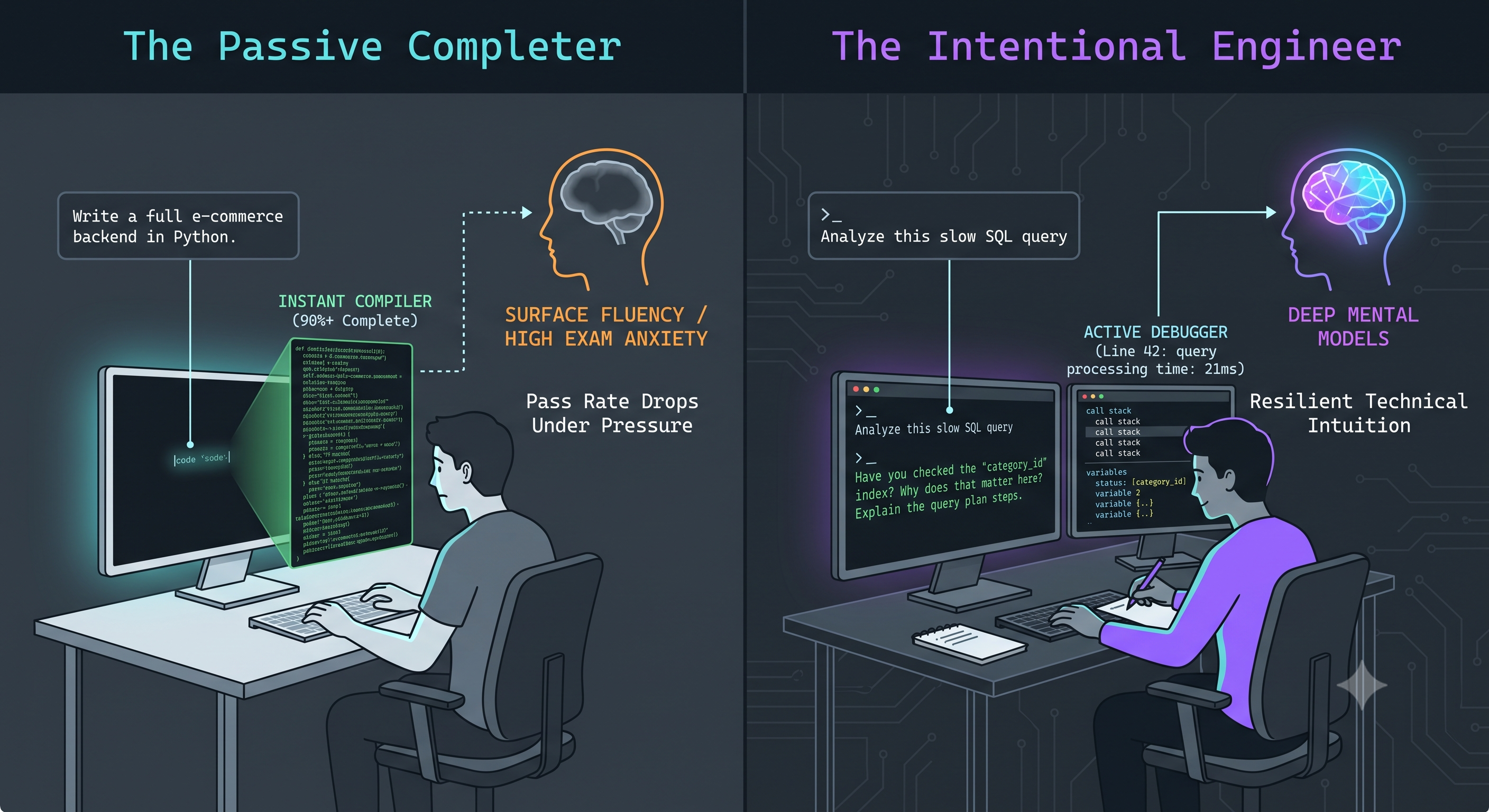
Cognitive science calls this the fluency heuristic: because the AI generates syntactically clean code instantly, your brain tricks itself into believing you understand the underlying concepts. But the moment you face an offline technical whiteboard, an unpredictable edge case, or an architectural bug in an internship, that illusion collapses.
Real engineering intuition isn't formed when code works; it is formed during the painful two hours you spend tracing a memory leak, resolving an off-by-one index error, or figuring out why a recursive call blew up the stack.
When you outsource the struggle, you outsource the learning.
To build durable engineering leverage in school, switch from passive completion to deliberate interrogation:
Use the "Rubber Duck Inversion": Don't ask AI to write the solution. Write your own naive implementation first. If you get stuck, paste your code and prompt: "Ask me three guiding diagnostic questions to help me spot my logic bug without giving me the code."
Conduct Line-by-Line Code Interrogations: If an assistant generates an implementation for you, you must be able to trace state mutations manually. Pick three random variables and write down their exact values across iterations 1, 2, and n
Audit for Failure, Not Success: Prompt the model to generate three adversarial unit tests designed specifically to break the code it just gave you. Learning how systems fail is what transforms a student into an engineer.
Anyone can prompt an answer. The industry only pays top dollar to people who know when the answer is quietly wrong.
Discussion Question
When tackling difficult lab work or project bugs, do you use AI as a collaborator that quizzes your logic, or as a fast-forward button to get to the submission screen?
CTA (Join Students in Tech)
Want to build deep technical fundamentals and stand out beyond basic homework solutions?
👉 Join the Techawks Students in Tech Community to collaborate on challenging side projects, master core CS fundamentals, and prepare for high-impact engineering careers:.
Over 90% of computer science students use generative AI tools to complete programming assignments and lab coursework. Assignments that used to take an entire weekend of grueling debugging now compile in thirty seconds.
Getting a green checkmark on a homework portal feels like mastery. It isn’t.
Cognitive science calls this the fluency heuristic: because the AI generates syntactically clean code instantly, your brain tricks itself into believing you understand the underlying concepts. But the moment you face an offline technical whiteboard, an unpredictable edge case, or an architectural bug in an internship, that illusion collapses.
Real engineering intuition isn't formed when code works; it is formed during the painful two hours you spend tracing a memory leak, resolving an off-by-one index error, or figuring out why a recursive call blew up the stack.
When you outsource the struggle, you outsource the learning.
To build durable engineering leverage in school, switch from passive completion to deliberate interrogation:
Use the "Rubber Duck Inversion": Don't ask AI to write the solution. Write your own naive implementation first. If you get stuck, paste your code and prompt: "Ask me three guiding diagnostic questions to help me spot my logic bug without giving me the code."
Conduct Line-by-Line Code Interrogations: If an assistant generates an implementation for you, you must be able to trace state mutations manually. Pick three random variables and write down their exact values across iterations 1, 2, and n
Audit for Failure, Not Success: Prompt the model to generate three adversarial unit tests designed specifically to break the code it just gave you. Learning how systems fail is what transforms a student into an engineer.
Anyone can prompt an answer. The industry only pays top dollar to people who know when the answer is quietly wrong.
Discussion Question
When tackling difficult lab work or project bugs, do you use AI as a collaborator that quizzes your logic, or as a fast-forward button to get to the submission screen?
CTA (Join Students in Tech)
Want to build deep technical fundamentals and stand out beyond basic homework solutions?
👉 Join the Techawks Students in Tech Community to collaborate on challenging side projects, master core CS fundamentals, and prepare for high-impact engineering careers:.
The Illusion of Competence: Why Passing Tests with AI Is Making You a Weaker Engineer
Over 90% of computer science students use generative AI tools to complete programming assignments and lab coursework. Assignments that used to take an entire weekend of grueling debugging now compile in thirty seconds.
Getting a green checkmark on a homework portal feels like mastery. It isn’t.
Cognitive science calls this the fluency heuristic: because the AI generates syntactically clean code instantly, your brain tricks itself into believing you understand the underlying concepts. But the moment you face an offline technical whiteboard, an unpredictable edge case, or an architectural bug in an internship, that illusion collapses.
Real engineering intuition isn't formed when code works; it is formed during the painful two hours you spend tracing a memory leak, resolving an off-by-one index error, or figuring out why a recursive call blew up the stack.
When you outsource the struggle, you outsource the learning.
To build durable engineering leverage in school, switch from passive completion to deliberate interrogation:
Use the "Rubber Duck Inversion": Don't ask AI to write the solution. Write your own naive implementation first. If you get stuck, paste your code and prompt: "Ask me three guiding diagnostic questions to help me spot my logic bug without giving me the code."
Conduct Line-by-Line Code Interrogations: If an assistant generates an implementation for you, you must be able to trace state mutations manually. Pick three random variables and write down their exact values across iterations 1, 2, and n
Audit for Failure, Not Success: Prompt the model to generate three adversarial unit tests designed specifically to break the code it just gave you. Learning how systems fail is what transforms a student into an engineer.
Anyone can prompt an answer. The industry only pays top dollar to people who know when the answer is quietly wrong.
Discussion Question
When tackling difficult lab work or project bugs, do you use AI as a collaborator that quizzes your logic, or as a fast-forward button to get to the submission screen?
CTA (Join Students in Tech)
Want to build deep technical fundamentals and stand out beyond basic homework solutions?
👉 Join the Techawks Students in Tech Community to collaborate on challenging side projects, master core CS fundamentals, and prepare for high-impact engineering careers:.

 English
 French
 Spanish
 Portuguese
 Deutsch
 Turkish
 Dutch
Dutch
 Italiano
 Russian
 Romaian
 Portuguese (Brazil)
 Greek
Greek