


MFA Won't Save You: The Dangerous Blind Spot of OAuth Device Code Phishing
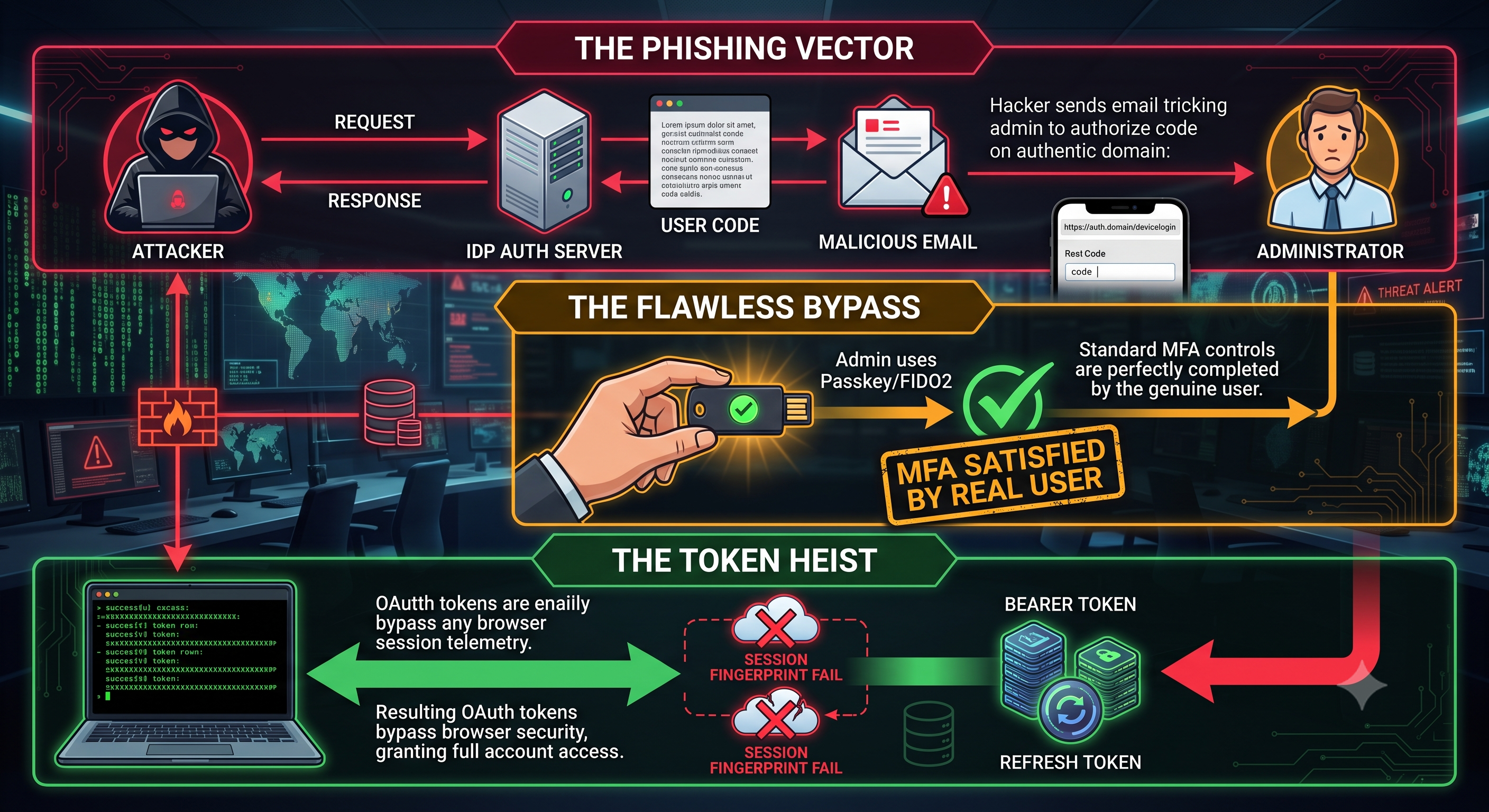
Cybersecurity learners spend months mastering credential stuffing, brute force, and traditional AiTM (Adversary-in-the-Middle) proxy setups. Meanwhile, modern threat actors have industrialized an identity vector that bypasses multi-factor authentication entirely without requiring a fake login page: OAuth Device Authorization Grant abuse (Device Code Phishing).
Originally designed for input-constrained devices (like smart TVs or CLI developer tools), the device authorization flow works by generating a short alphanumeric code on a secondary device, prompting the user to visit an authentic identity provider URL (e.g., [microsoft.com/devicelogin](https://microsoft.com/devicelogin)), and entering the code to grant authorization.
Here is why this vector shatters classical perimeter thinking:
The Victim Uses Real Infrastructure: The target signs into the authentic identity provider domain over a valid SSL certificate. There are no suspicious typo-squatted URLs or reverse-proxy certificates to trigger browser warnings.
Passkeys and MFA Are Rendered Irrelevant: Because the victim authenticates legitimately on their own trusted device, they successfully complete whatever MFA challenge is presented (FIDO2 keys, biometric passkeys, or authenticator apps). The session and refresh tokens, however, are immediately issued to the attacker’s client ID.
Privilege Inheritance: Once the attacker receives the primary refresh token (PRT) or OAuth access token, they can replay it through command-line utilities to harvest data, register backdoor credentials, or pivot across connected enterprise SaaS platforms.
How to Defend and Hunt for It:
Enforce Strict Conditional Access on Device Code Flows: Block the device code authentication flow globally across your identity tenant unless a specific user group or machine explicitly requires it for headless CLI environments.
Bind Tokens via Continuous Access Evaluation (CAE): Implement continuous session verification and client certificate binding (DPoP - Demonstrating Proof-of-Possession) so tokens stolen from an authentication exchange cannot be replayed from an unauthorized IP, ASN, or unrecognized device posture.
Audit Identity Provider Logs: Flag unexpected interactive device code authorizations originating from unmanaged IP ranges or non-standard user agents.
Authentication is only the front door. If your security model assumes a valid token always belongs to the user who requested it, your perimeter is already compromised.
Discussion Question
Has your security lab or enterprise SOC disabled the OAuth Device Authorization Grant, or is it still an open, unmonitored default in your identity tenant?
CTA (Join Cybersecurity & Ethical Hacking)
Ready to look beyond textbook attack vectors and master defensive architecture against real-world identity exploits?
👉 Join the Techawks Cybersecurity & Ethical Hacking Community to analyze emerging threat vectors, dissect offensive labs, and sharpen your defensive edge:
Cybersecurity learners spend months mastering credential stuffing, brute force, and traditional AiTM (Adversary-in-the-Middle) proxy setups. Meanwhile, modern threat actors have industrialized an identity vector that bypasses multi-factor authentication entirely without requiring a fake login page: OAuth Device Authorization Grant abuse (Device Code Phishing).
Originally designed for input-constrained devices (like smart TVs or CLI developer tools), the device authorization flow works by generating a short alphanumeric code on a secondary device, prompting the user to visit an authentic identity provider URL (e.g., [microsoft.com/devicelogin](https://microsoft.com/devicelogin)), and entering the code to grant authorization.
Here is why this vector shatters classical perimeter thinking:
The Victim Uses Real Infrastructure: The target signs into the authentic identity provider domain over a valid SSL certificate. There are no suspicious typo-squatted URLs or reverse-proxy certificates to trigger browser warnings.
Passkeys and MFA Are Rendered Irrelevant: Because the victim authenticates legitimately on their own trusted device, they successfully complete whatever MFA challenge is presented (FIDO2 keys, biometric passkeys, or authenticator apps). The session and refresh tokens, however, are immediately issued to the attacker’s client ID.
Privilege Inheritance: Once the attacker receives the primary refresh token (PRT) or OAuth access token, they can replay it through command-line utilities to harvest data, register backdoor credentials, or pivot across connected enterprise SaaS platforms.
How to Defend and Hunt for It:
Enforce Strict Conditional Access on Device Code Flows: Block the device code authentication flow globally across your identity tenant unless a specific user group or machine explicitly requires it for headless CLI environments.
Bind Tokens via Continuous Access Evaluation (CAE): Implement continuous session verification and client certificate binding (DPoP - Demonstrating Proof-of-Possession) so tokens stolen from an authentication exchange cannot be replayed from an unauthorized IP, ASN, or unrecognized device posture.
Audit Identity Provider Logs: Flag unexpected interactive device code authorizations originating from unmanaged IP ranges or non-standard user agents.
Authentication is only the front door. If your security model assumes a valid token always belongs to the user who requested it, your perimeter is already compromised.
Discussion Question
Has your security lab or enterprise SOC disabled the OAuth Device Authorization Grant, or is it still an open, unmonitored default in your identity tenant?
CTA (Join Cybersecurity & Ethical Hacking)
Ready to look beyond textbook attack vectors and master defensive architecture against real-world identity exploits?
👉 Join the Techawks Cybersecurity & Ethical Hacking Community to analyze emerging threat vectors, dissect offensive labs, and sharpen your defensive edge:
MFA Won't Save You: The Dangerous Blind Spot of OAuth Device Code Phishing
Cybersecurity learners spend months mastering credential stuffing, brute force, and traditional AiTM (Adversary-in-the-Middle) proxy setups. Meanwhile, modern threat actors have industrialized an identity vector that bypasses multi-factor authentication entirely without requiring a fake login page: OAuth Device Authorization Grant abuse (Device Code Phishing).
Originally designed for input-constrained devices (like smart TVs or CLI developer tools), the device authorization flow works by generating a short alphanumeric code on a secondary device, prompting the user to visit an authentic identity provider URL (e.g., [microsoft.com/devicelogin](https://microsoft.com/devicelogin)), and entering the code to grant authorization.
Here is why this vector shatters classical perimeter thinking:
The Victim Uses Real Infrastructure: The target signs into the authentic identity provider domain over a valid SSL certificate. There are no suspicious typo-squatted URLs or reverse-proxy certificates to trigger browser warnings.
Passkeys and MFA Are Rendered Irrelevant: Because the victim authenticates legitimately on their own trusted device, they successfully complete whatever MFA challenge is presented (FIDO2 keys, biometric passkeys, or authenticator apps). The session and refresh tokens, however, are immediately issued to the attacker’s client ID.
Privilege Inheritance: Once the attacker receives the primary refresh token (PRT) or OAuth access token, they can replay it through command-line utilities to harvest data, register backdoor credentials, or pivot across connected enterprise SaaS platforms.
How to Defend and Hunt for It:
Enforce Strict Conditional Access on Device Code Flows: Block the device code authentication flow globally across your identity tenant unless a specific user group or machine explicitly requires it for headless CLI environments.
Bind Tokens via Continuous Access Evaluation (CAE): Implement continuous session verification and client certificate binding (DPoP - Demonstrating Proof-of-Possession) so tokens stolen from an authentication exchange cannot be replayed from an unauthorized IP, ASN, or unrecognized device posture.
Audit Identity Provider Logs: Flag unexpected interactive device code authorizations originating from unmanaged IP ranges or non-standard user agents.
Authentication is only the front door. If your security model assumes a valid token always belongs to the user who requested it, your perimeter is already compromised.
Discussion Question
Has your security lab or enterprise SOC disabled the OAuth Device Authorization Grant, or is it still an open, unmonitored default in your identity tenant?
CTA (Join Cybersecurity & Ethical Hacking)
Ready to look beyond textbook attack vectors and master defensive architecture against real-world identity exploits?
👉 Join the Techawks Cybersecurity & Ethical Hacking Community to analyze emerging threat vectors, dissect offensive labs, and sharpen your defensive edge:

 Arabic
 French
 Spanish
 Portuguese
 Deutsch
 Turkish
 Dutch
Dutch
 Italiano
 Russian
 Romaian
 Portuguese (Brazil)
 Greek
Greek