


Your LLM Writes Flawless SQL—and Completely Fabricates Your Business Numbers
Data teams are rushing to bolt conversational AI interfaces directly onto their raw data lakehouses. The executive pitch sounds like a dream: non-technical operators can query data warehouses using plain English, skipping dashboard bottlenecks entirely.
Here is the production reality: the queries compile perfectly, return clean tabular data, and are catastrophically wrong.
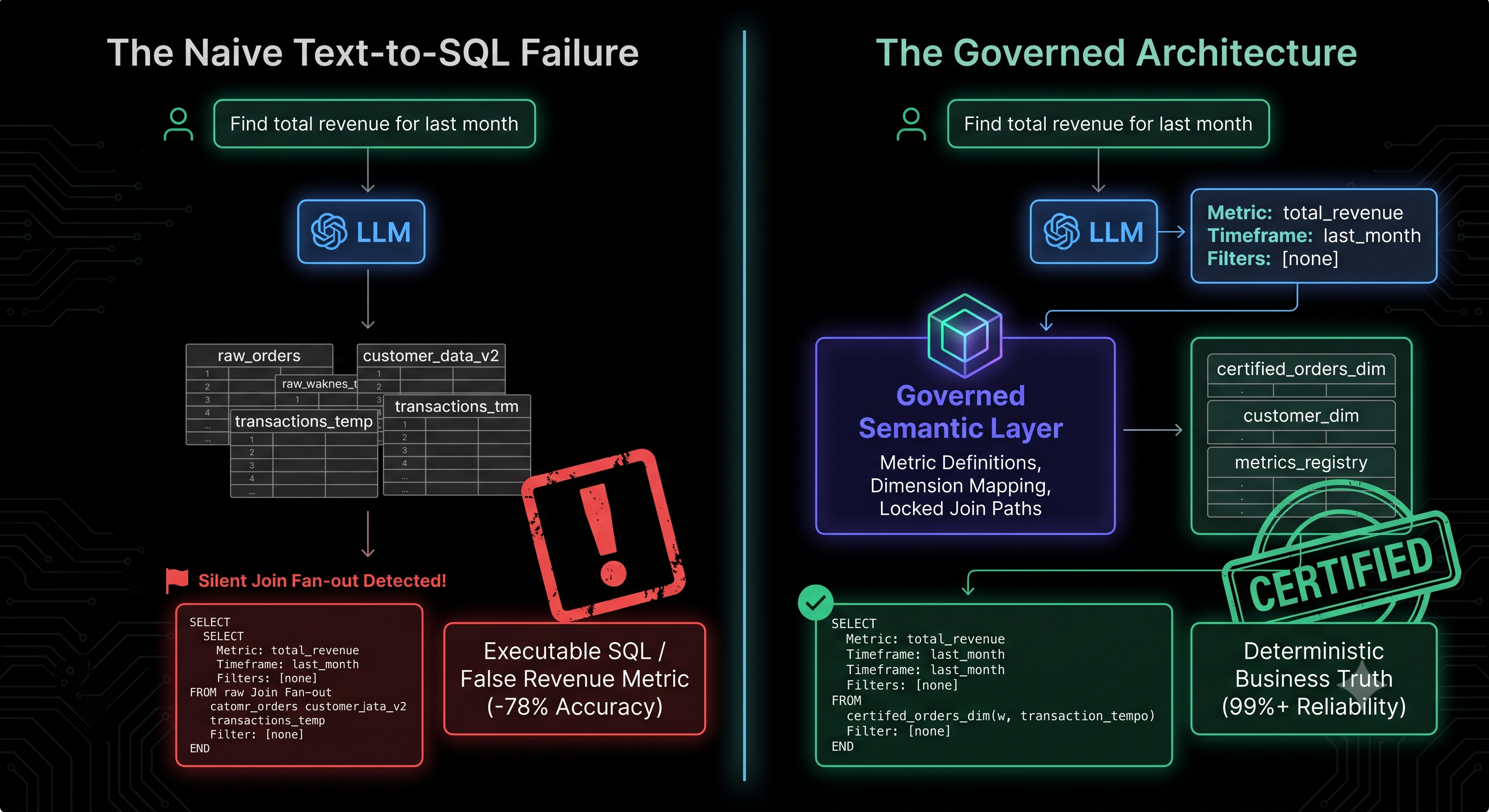
Text-to-SQL does not fail because models lack SQL syntax skills; it fails because database schemas possess zero business semantics. A PostgreSQL catalog or Snowflake information schema cannot tell an LLM:
Which of five distinct revenue columns accounts for customer refunds, churn credits, or tax deferrals.
Whether "Q3 Sales" is measured by order timestamp, warehouse dispatch, or cash settlement date.
Which join path triggers many-to-many fan-outs and silently inflates financial metrics by3\X
When you feed raw table schemas directly into an LLM prompt, you aren't doing analytics—you are letting a statistical model hallucinate corporate accounting logic.
The Real Architecture: LLM Chooses, Semantic Engine Executes
To deploy reliable AI data access, separate semantic intent from query execution:
Kill Direct Raw-Table Access: Never give an LLM prompt raw DDL access across uncurated warehouse tables. If a table isn't governed in an explicit data mart, the model shouldn't see it.
Decouple Metric Calculation from Natural Language: The LLM's job is simply to map the user's intent to certified dimensions and standardized metrics (e.g., metric: net_mrr, dimension: cohort_month).
Let the Semantic Layer Compile the SQL: Pass those parsed parameters to a deterministic semantic engine (such as dbt Semantic Layer, Cube, or governed BI models). The semantic layer resolves table joins, fan-outs, and business filters deterministically.
If your company's revenue definitions aren't unified in code, an AI query interface will only automate the spread of bad data.
Discussion Question
Has your analytics team integrated a governed semantic layer between your AI query assistants and warehouse tables, or is your LLM still free-handing raw SQL against your databases?
CTA (Join Data Science & Analytics)
Tired of fragile dashboards and hallucinated metric queries?
👉 Join the Techawks Data Science & Analytics Community to master governed semantic layers, robust data engineering architectures, and production-grade data pipelines:
Data teams are rushing to bolt conversational AI interfaces directly onto their raw data lakehouses. The executive pitch sounds like a dream: non-technical operators can query data warehouses using plain English, skipping dashboard bottlenecks entirely.
Here is the production reality: the queries compile perfectly, return clean tabular data, and are catastrophically wrong.
Text-to-SQL does not fail because models lack SQL syntax skills; it fails because database schemas possess zero business semantics. A PostgreSQL catalog or Snowflake information schema cannot tell an LLM:
Which of five distinct revenue columns accounts for customer refunds, churn credits, or tax deferrals.
Whether "Q3 Sales" is measured by order timestamp, warehouse dispatch, or cash settlement date.
Which join path triggers many-to-many fan-outs and silently inflates financial metrics by3\X
When you feed raw table schemas directly into an LLM prompt, you aren't doing analytics—you are letting a statistical model hallucinate corporate accounting logic.
The Real Architecture: LLM Chooses, Semantic Engine Executes
To deploy reliable AI data access, separate semantic intent from query execution:
Kill Direct Raw-Table Access: Never give an LLM prompt raw DDL access across uncurated warehouse tables. If a table isn't governed in an explicit data mart, the model shouldn't see it.
Decouple Metric Calculation from Natural Language: The LLM's job is simply to map the user's intent to certified dimensions and standardized metrics (e.g., metric: net_mrr, dimension: cohort_month).
Let the Semantic Layer Compile the SQL: Pass those parsed parameters to a deterministic semantic engine (such as dbt Semantic Layer, Cube, or governed BI models). The semantic layer resolves table joins, fan-outs, and business filters deterministically.
If your company's revenue definitions aren't unified in code, an AI query interface will only automate the spread of bad data.
Discussion Question
Has your analytics team integrated a governed semantic layer between your AI query assistants and warehouse tables, or is your LLM still free-handing raw SQL against your databases?
CTA (Join Data Science & Analytics)
Tired of fragile dashboards and hallucinated metric queries?
👉 Join the Techawks Data Science & Analytics Community to master governed semantic layers, robust data engineering architectures, and production-grade data pipelines:
Your LLM Writes Flawless SQL—and Completely Fabricates Your Business Numbers
Data teams are rushing to bolt conversational AI interfaces directly onto their raw data lakehouses. The executive pitch sounds like a dream: non-technical operators can query data warehouses using plain English, skipping dashboard bottlenecks entirely.
Here is the production reality: the queries compile perfectly, return clean tabular data, and are catastrophically wrong.
Text-to-SQL does not fail because models lack SQL syntax skills; it fails because database schemas possess zero business semantics. A PostgreSQL catalog or Snowflake information schema cannot tell an LLM:
Which of five distinct revenue columns accounts for customer refunds, churn credits, or tax deferrals.
Whether "Q3 Sales" is measured by order timestamp, warehouse dispatch, or cash settlement date.
Which join path triggers many-to-many fan-outs and silently inflates financial metrics by3\X
When you feed raw table schemas directly into an LLM prompt, you aren't doing analytics—you are letting a statistical model hallucinate corporate accounting logic.
The Real Architecture: LLM Chooses, Semantic Engine Executes
To deploy reliable AI data access, separate semantic intent from query execution:
Kill Direct Raw-Table Access: Never give an LLM prompt raw DDL access across uncurated warehouse tables. If a table isn't governed in an explicit data mart, the model shouldn't see it.
Decouple Metric Calculation from Natural Language: The LLM's job is simply to map the user's intent to certified dimensions and standardized metrics (e.g., metric: net_mrr, dimension: cohort_month).
Let the Semantic Layer Compile the SQL: Pass those parsed parameters to a deterministic semantic engine (such as dbt Semantic Layer, Cube, or governed BI models). The semantic layer resolves table joins, fan-outs, and business filters deterministically.
If your company's revenue definitions aren't unified in code, an AI query interface will only automate the spread of bad data.
Discussion Question
Has your analytics team integrated a governed semantic layer between your AI query assistants and warehouse tables, or is your LLM still free-handing raw SQL against your databases?
CTA (Join Data Science & Analytics)
Tired of fragile dashboards and hallucinated metric queries?
👉 Join the Techawks Data Science & Analytics Community to master governed semantic layers, robust data engineering architectures, and production-grade data pipelines:

 Arabic
 French
 Spanish
 Portuguese
 Deutsch
 Turkish
 Dutch
Dutch
 Italiano
 Russian
 Romaian
 Portuguese (Brazil)
 Greek
Greek