


Sidecar Overkill: Why Your Kubernetes Service Mesh Is Burning 30% of Your Cluster Budget
When service meshes first gained widespread adoption, the sidecar pattern was a breakthrough. By attaching a lightweight proxy next to every workload, teams gained mutual TLS (mTLS), traffic telemetry, and L7 routing policies without changing application code.
Deploying thousands of sidecars at enterprise scale introduces real infrastructure bottlenecks:
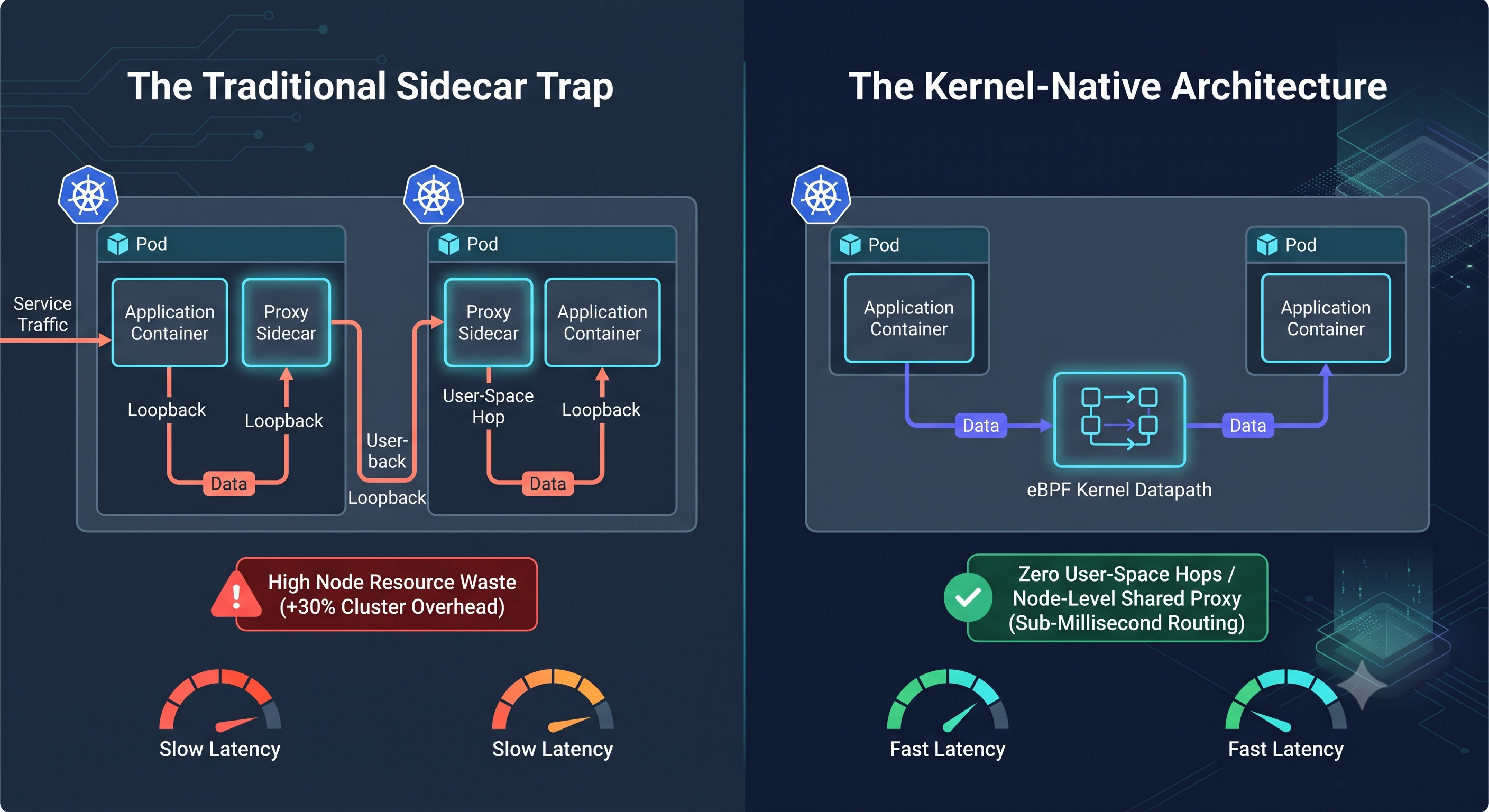
The "Sidecar Tax" Multiplies Fast: Running an independent proxy inside every pod incurs dedicated memory reservations and CPU overhead. In a cluster with 500 pods, reserving even 0.1 vCPU and 128MB RAM per sidecar quietly consumes 50 CPU cores and 64GB of memory solely to shuttle local TCP packets back and forth.
TCP Stack Traversal Latency: Every service-to-service call hops through multiple network namespaces: application container >>> loopback >>>>sidecar >>> node network stack >>> wire >>> remote host >>> sidecar >>> application container. That is four context switches and network stack traversals for a single internal RPC.
Lifecycle Synchronization Hell: Upgrades, rolling restarts, and graceful shutdowns frequently fail when application containers boot before their sidecar proxy initializes, or terminate while the proxy is still flushing outgoing traces.
The Architectural Shift: Move Networking to Kernel eBPF
Modern cloud infrastructure is replacing user-space sidecar duplication with kernel-native datapaths (like Cilium and Ambient mesh models):
Enforce L3/L4 Security at the Kernel Layer: Instead of intercepting every TCP packet in user space, utilize eBPF programs attached to Linux kernel sockets. Packets are evaluated and routed at the kernel layer with O(1) lookup time, completely bypassing sequential iptables rules and eliminating per-pod proxy overhead.
Decouple L7 Policy from Pod Boundaries: For advanced Layer 7 routing, traffic splitting, or header injection, deploy a shared, node-level proxy or utilize native Gateway API controllers rather than spawning hundreds of redundant proxies per workload.
Streamline Cluster Zero Trust: Establish node-level cryptographic identity (via SPIFFE/SPIRE) so pods gain seamless mutual authentication without paying a latency penalty on every intra-node hop.
Infrastructure should disappear into the OS platform, not crowd your deployment manifests.
Discussion Question
Is your platform team still running dedicated sidecars on every single pod, or have you migrated toward eBPF-driven networking and sidecarless mesh architectures?
CTA (Join Cloud, DevOps & Open Source)
Looking to strip away cloud over-engineering, slash compute bills, and master modern platform design?
👉 Join the Techawks Cloud, DevOps & Open Source Community to dive deep into kernel networking, Kubernetes internals, and production cloud infrastructure:
When service meshes first gained widespread adoption, the sidecar pattern was a breakthrough. By attaching a lightweight proxy next to every workload, teams gained mutual TLS (mTLS), traffic telemetry, and L7 routing policies without changing application code.
Deploying thousands of sidecars at enterprise scale introduces real infrastructure bottlenecks:
The "Sidecar Tax" Multiplies Fast: Running an independent proxy inside every pod incurs dedicated memory reservations and CPU overhead. In a cluster with 500 pods, reserving even 0.1 vCPU and 128MB RAM per sidecar quietly consumes 50 CPU cores and 64GB of memory solely to shuttle local TCP packets back and forth.
TCP Stack Traversal Latency: Every service-to-service call hops through multiple network namespaces: application container >>> loopback >>>>sidecar >>> node network stack >>> wire >>> remote host >>> sidecar >>> application container. That is four context switches and network stack traversals for a single internal RPC.
Lifecycle Synchronization Hell: Upgrades, rolling restarts, and graceful shutdowns frequently fail when application containers boot before their sidecar proxy initializes, or terminate while the proxy is still flushing outgoing traces.
The Architectural Shift: Move Networking to Kernel eBPF
Modern cloud infrastructure is replacing user-space sidecar duplication with kernel-native datapaths (like Cilium and Ambient mesh models):
Enforce L3/L4 Security at the Kernel Layer: Instead of intercepting every TCP packet in user space, utilize eBPF programs attached to Linux kernel sockets. Packets are evaluated and routed at the kernel layer with O(1) lookup time, completely bypassing sequential iptables rules and eliminating per-pod proxy overhead.
Decouple L7 Policy from Pod Boundaries: For advanced Layer 7 routing, traffic splitting, or header injection, deploy a shared, node-level proxy or utilize native Gateway API controllers rather than spawning hundreds of redundant proxies per workload.
Streamline Cluster Zero Trust: Establish node-level cryptographic identity (via SPIFFE/SPIRE) so pods gain seamless mutual authentication without paying a latency penalty on every intra-node hop.
Infrastructure should disappear into the OS platform, not crowd your deployment manifests.
Discussion Question
Is your platform team still running dedicated sidecars on every single pod, or have you migrated toward eBPF-driven networking and sidecarless mesh architectures?
CTA (Join Cloud, DevOps & Open Source)
Looking to strip away cloud over-engineering, slash compute bills, and master modern platform design?
👉 Join the Techawks Cloud, DevOps & Open Source Community to dive deep into kernel networking, Kubernetes internals, and production cloud infrastructure:
Sidecar Overkill: Why Your Kubernetes Service Mesh Is Burning 30% of Your Cluster Budget
When service meshes first gained widespread adoption, the sidecar pattern was a breakthrough. By attaching a lightweight proxy next to every workload, teams gained mutual TLS (mTLS), traffic telemetry, and L7 routing policies without changing application code.
Deploying thousands of sidecars at enterprise scale introduces real infrastructure bottlenecks:
The "Sidecar Tax" Multiplies Fast: Running an independent proxy inside every pod incurs dedicated memory reservations and CPU overhead. In a cluster with 500 pods, reserving even 0.1 vCPU and 128MB RAM per sidecar quietly consumes 50 CPU cores and 64GB of memory solely to shuttle local TCP packets back and forth.
TCP Stack Traversal Latency: Every service-to-service call hops through multiple network namespaces: application container >>> loopback >>>>sidecar >>> node network stack >>> wire >>> remote host >>> sidecar >>> application container. That is four context switches and network stack traversals for a single internal RPC.
Lifecycle Synchronization Hell: Upgrades, rolling restarts, and graceful shutdowns frequently fail when application containers boot before their sidecar proxy initializes, or terminate while the proxy is still flushing outgoing traces.
The Architectural Shift: Move Networking to Kernel eBPF
Modern cloud infrastructure is replacing user-space sidecar duplication with kernel-native datapaths (like Cilium and Ambient mesh models):
Enforce L3/L4 Security at the Kernel Layer: Instead of intercepting every TCP packet in user space, utilize eBPF programs attached to Linux kernel sockets. Packets are evaluated and routed at the kernel layer with O(1) lookup time, completely bypassing sequential iptables rules and eliminating per-pod proxy overhead.
Decouple L7 Policy from Pod Boundaries: For advanced Layer 7 routing, traffic splitting, or header injection, deploy a shared, node-level proxy or utilize native Gateway API controllers rather than spawning hundreds of redundant proxies per workload.
Streamline Cluster Zero Trust: Establish node-level cryptographic identity (via SPIFFE/SPIRE) so pods gain seamless mutual authentication without paying a latency penalty on every intra-node hop.
Infrastructure should disappear into the OS platform, not crowd your deployment manifests.
Discussion Question
Is your platform team still running dedicated sidecars on every single pod, or have you migrated toward eBPF-driven networking and sidecarless mesh architectures?
CTA (Join Cloud, DevOps & Open Source)
Looking to strip away cloud over-engineering, slash compute bills, and master modern platform design?
👉 Join the Techawks Cloud, DevOps & Open Source Community to dive deep into kernel networking, Kubernetes internals, and production cloud infrastructure:

 English
 Arabic
 French
 Spanish
 Portuguese
 Deutsch
 Turkish
 Italiano
 Russian
 Romaian
 Portuguese (Brazil)
 Greek
Greek