


Tool Review: dbt (Data Build Tool) – The Secret Weapon for Modern Data Transformation ⚙️
What is dbt?
dbt (data build tool) is a transformation framework that lets data analysts and engineers write modular SQL models, test them automatically, and deploy them using software engineering best practices like version control (Git) and CI/CD.
Unlike traditional ETL tools that handle extraction and loading, dbt operates strictly on the "T" in ELT—transforming raw data that already lives inside modern cloud data warehouses like Snowflake, BigQuery, or Databricks.
Core Features That Make dbt Indispensable
🧱 Modular SQL (ref function): Instead of writing 1,000-line monolithic SQL queries, dbt allows you to reference other models modularly using {{ ref('stg_orders') }}. If an upstream logic changes, update it once and it propagates everywhere.
🧪 Native Testing & Data Quality: Write simple YAML configurations to automatically test for unique, not_null, foreign key integrity, or custom accepted values before production builds.
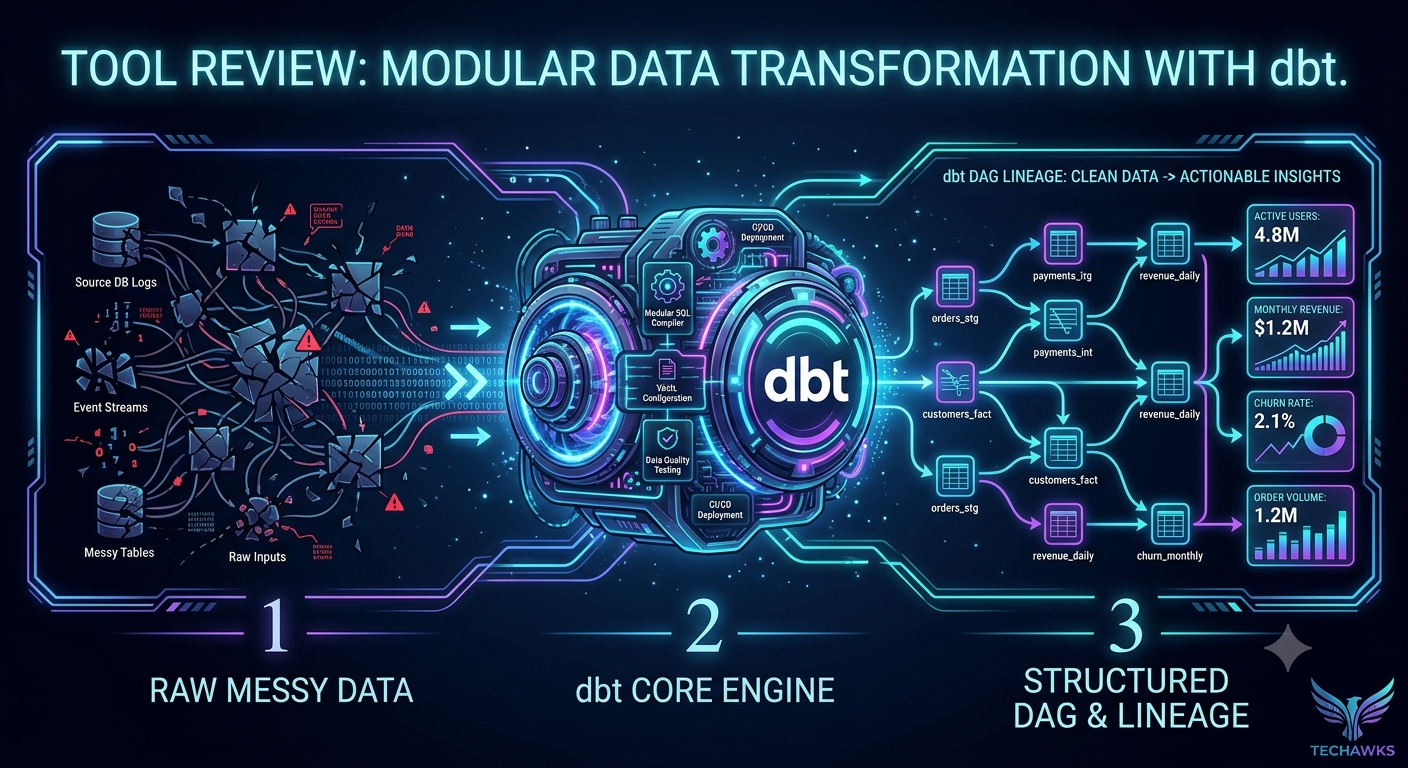
📚 Automated Documentation & Lineage Graphs: dbt automatically compiles line-by-line lineage graphs (DAGs) so you can visually trace raw source tables all the way to final BI dashboards.
⚙️ Version Control & Collaboration: Because dbt models are plain text SQL and YAML files, teams can use Git workflows, code reviews, and branch deployments seamlessly.
3 Steps to Implement dbt in Your Workflow
Structure Your Layers: Organize your project into Staging (cleaning raw fields), Intermediate (business logic joins), and Marts (final business-ready analytics tables).
Add Data Quality Tests: Start by applying not_null and unique assertions to primary keys in your staging layer.
Automate Documentation: Run dbt docs generate to auto-build an interactive data dictionary for your entire organization.
Key Takeaways
Shift to ELT: Perform transformations inside the data warehouse where compute power is optimized.
Treat Analytics as Software: Leverage modularity, Git version control, and automated testing for pipeline reliability.
Document Automatically: Eliminate ambiguity around metric definitions with auto-generated lineage DAGs.
CTA
Ready to master analytics engineering, build scalable data models, and deploy production-grade pipelines?
Join the Techawks Data Science & Analytics Program today to gain hands-on expertise with dbt, SQL, Python, and cloud data architecture! 🚀
What is dbt?
dbt (data build tool) is a transformation framework that lets data analysts and engineers write modular SQL models, test them automatically, and deploy them using software engineering best practices like version control (Git) and CI/CD.
Unlike traditional ETL tools that handle extraction and loading, dbt operates strictly on the "T" in ELT—transforming raw data that already lives inside modern cloud data warehouses like Snowflake, BigQuery, or Databricks.
Core Features That Make dbt Indispensable
🧱 Modular SQL (ref function): Instead of writing 1,000-line monolithic SQL queries, dbt allows you to reference other models modularly using {{ ref('stg_orders') }}. If an upstream logic changes, update it once and it propagates everywhere.
🧪 Native Testing & Data Quality: Write simple YAML configurations to automatically test for unique, not_null, foreign key integrity, or custom accepted values before production builds.
📚 Automated Documentation & Lineage Graphs: dbt automatically compiles line-by-line lineage graphs (DAGs) so you can visually trace raw source tables all the way to final BI dashboards.
⚙️ Version Control & Collaboration: Because dbt models are plain text SQL and YAML files, teams can use Git workflows, code reviews, and branch deployments seamlessly.
3 Steps to Implement dbt in Your Workflow
Structure Your Layers: Organize your project into Staging (cleaning raw fields), Intermediate (business logic joins), and Marts (final business-ready analytics tables).
Add Data Quality Tests: Start by applying not_null and unique assertions to primary keys in your staging layer.
Automate Documentation: Run dbt docs generate to auto-build an interactive data dictionary for your entire organization.
Key Takeaways
Shift to ELT: Perform transformations inside the data warehouse where compute power is optimized.
Treat Analytics as Software: Leverage modularity, Git version control, and automated testing for pipeline reliability.
Document Automatically: Eliminate ambiguity around metric definitions with auto-generated lineage DAGs.
CTA
Ready to master analytics engineering, build scalable data models, and deploy production-grade pipelines?
Join the Techawks Data Science & Analytics Program today to gain hands-on expertise with dbt, SQL, Python, and cloud data architecture! 🚀
Tool Review: dbt (Data Build Tool) – The Secret Weapon for Modern Data Transformation ⚙️
What is dbt?
dbt (data build tool) is a transformation framework that lets data analysts and engineers write modular SQL models, test them automatically, and deploy them using software engineering best practices like version control (Git) and CI/CD.
Unlike traditional ETL tools that handle extraction and loading, dbt operates strictly on the "T" in ELT—transforming raw data that already lives inside modern cloud data warehouses like Snowflake, BigQuery, or Databricks.
Core Features That Make dbt Indispensable
🧱 Modular SQL (ref function): Instead of writing 1,000-line monolithic SQL queries, dbt allows you to reference other models modularly using {{ ref('stg_orders') }}. If an upstream logic changes, update it once and it propagates everywhere.
🧪 Native Testing & Data Quality: Write simple YAML configurations to automatically test for unique, not_null, foreign key integrity, or custom accepted values before production builds.
📚 Automated Documentation & Lineage Graphs: dbt automatically compiles line-by-line lineage graphs (DAGs) so you can visually trace raw source tables all the way to final BI dashboards.
⚙️ Version Control & Collaboration: Because dbt models are plain text SQL and YAML files, teams can use Git workflows, code reviews, and branch deployments seamlessly.
3 Steps to Implement dbt in Your Workflow
Structure Your Layers: Organize your project into Staging (cleaning raw fields), Intermediate (business logic joins), and Marts (final business-ready analytics tables).
Add Data Quality Tests: Start by applying not_null and unique assertions to primary keys in your staging layer.
Automate Documentation: Run dbt docs generate to auto-build an interactive data dictionary for your entire organization.
Key Takeaways
Shift to ELT: Perform transformations inside the data warehouse where compute power is optimized.
Treat Analytics as Software: Leverage modularity, Git version control, and automated testing for pipeline reliability.
Document Automatically: Eliminate ambiguity around metric definitions with auto-generated lineage DAGs.
CTA
Ready to master analytics engineering, build scalable data models, and deploy production-grade pipelines?
Join the Techawks Data Science & Analytics Program today to gain hands-on expertise with dbt, SQL, Python, and cloud data architecture! 🚀

 English
 Arabic
 French
 Portuguese
 Deutsch
 Turkish
 Dutch
Dutch
 Italiano
 Russian
 Romaian
 Portuguese (Brazil)
 Greek
Greek