


Tool Review: Polars vs. Pandas—Is It Finally Time to Retire the Default DataFrame?
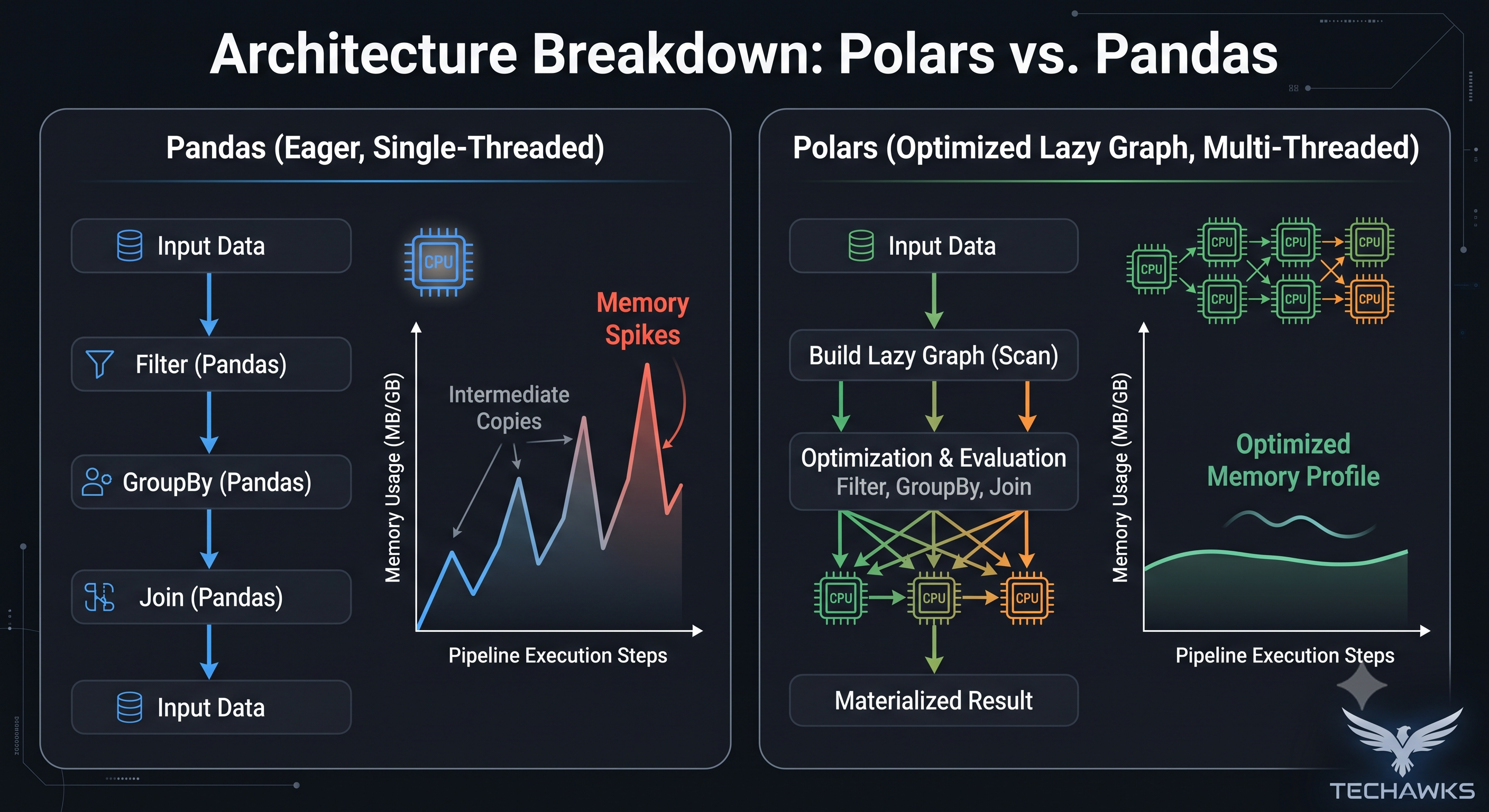
Pandas remains the lingua franca of tabular data manipulation, yet its single-threaded, eager execution model often requires painful workarounds like chunking or premature migration to distributed engines like Spark. Polars takes a radically different architectural approach: written in Rust, built on Apache Arrow, and powered by a lazy evaluation query optimizer with native multithreading.
Where Polars Wins:
Memory Efficiency & Zero-Copy: Because it leverages Arrow memory layouts, Polars handles contiguous memory efficiently and avoids unnecessary object duplication.
Lazy Execution Engine: With pl.scan_parquet() or pl.scan_csv(), Polars optimizes queries before touching data—pushing down predicates and selecting only required columns.
Predictable Syntax: By eliminating multi-indexes and index-based slicing, Polars enforces explicit, expression-based transformations that prevent silent slicing bugs.
Where Pandas Still Holds Ground:
Ecosystem Maturity: The vast majority of legacy ML libraries, specialized stats packages, and visualization tools expect Pandas or standard NumPy arrays natively.
Community Resources: Finding niche debugging solutions, custom extensions, and Stack Overflow answers is still effortless in Pandas compared to newer Polars patterns.
Learning Curve for SQL-Like Thinking: Polars discourages procedural row-by-row iteration in favor of columnar expressions, which requires unlearning years of df.apply() habits.
Key Takeaways
Scale locally first: Polars bridges the gap between single-machine analysis and expensive distributed clusters by maximizing multi-core CPU and memory usage.
Expressions over indices: Dropping explicit index tracking removes a major source of syntax confusion and performance bottlenecks.
Hybrid coexistence: You don't need an immediate full migration; converting from Polars to Pandas via PyArrow at the model boundary is nearly zero-cost.
CTA (Invite analysis and opinions)
If your team handles 5GB–50GB datasets on a single node: Have you made the shift to Polars in production pipelines, or is Pandas (especially with the PyArrow engine backend) still your default? What friction did your team face during the transition? Let’s hear your benchmarks and real-world trade-offs below.
Pandas remains the lingua franca of tabular data manipulation, yet its single-threaded, eager execution model often requires painful workarounds like chunking or premature migration to distributed engines like Spark. Polars takes a radically different architectural approach: written in Rust, built on Apache Arrow, and powered by a lazy evaluation query optimizer with native multithreading.
Where Polars Wins:
Memory Efficiency & Zero-Copy: Because it leverages Arrow memory layouts, Polars handles contiguous memory efficiently and avoids unnecessary object duplication.
Lazy Execution Engine: With pl.scan_parquet() or pl.scan_csv(), Polars optimizes queries before touching data—pushing down predicates and selecting only required columns.
Predictable Syntax: By eliminating multi-indexes and index-based slicing, Polars enforces explicit, expression-based transformations that prevent silent slicing bugs.
Where Pandas Still Holds Ground:
Ecosystem Maturity: The vast majority of legacy ML libraries, specialized stats packages, and visualization tools expect Pandas or standard NumPy arrays natively.
Community Resources: Finding niche debugging solutions, custom extensions, and Stack Overflow answers is still effortless in Pandas compared to newer Polars patterns.
Learning Curve for SQL-Like Thinking: Polars discourages procedural row-by-row iteration in favor of columnar expressions, which requires unlearning years of df.apply() habits.
Key Takeaways
Scale locally first: Polars bridges the gap between single-machine analysis and expensive distributed clusters by maximizing multi-core CPU and memory usage.
Expressions over indices: Dropping explicit index tracking removes a major source of syntax confusion and performance bottlenecks.
Hybrid coexistence: You don't need an immediate full migration; converting from Polars to Pandas via PyArrow at the model boundary is nearly zero-cost.
CTA (Invite analysis and opinions)
If your team handles 5GB–50GB datasets on a single node: Have you made the shift to Polars in production pipelines, or is Pandas (especially with the PyArrow engine backend) still your default? What friction did your team face during the transition? Let’s hear your benchmarks and real-world trade-offs below.
Tool Review: Polars vs. Pandas—Is It Finally Time to Retire the Default DataFrame?
Pandas remains the lingua franca of tabular data manipulation, yet its single-threaded, eager execution model often requires painful workarounds like chunking or premature migration to distributed engines like Spark. Polars takes a radically different architectural approach: written in Rust, built on Apache Arrow, and powered by a lazy evaluation query optimizer with native multithreading.
Where Polars Wins:
Memory Efficiency & Zero-Copy: Because it leverages Arrow memory layouts, Polars handles contiguous memory efficiently and avoids unnecessary object duplication.
Lazy Execution Engine: With pl.scan_parquet() or pl.scan_csv(), Polars optimizes queries before touching data—pushing down predicates and selecting only required columns.
Predictable Syntax: By eliminating multi-indexes and index-based slicing, Polars enforces explicit, expression-based transformations that prevent silent slicing bugs.
Where Pandas Still Holds Ground:
Ecosystem Maturity: The vast majority of legacy ML libraries, specialized stats packages, and visualization tools expect Pandas or standard NumPy arrays natively.
Community Resources: Finding niche debugging solutions, custom extensions, and Stack Overflow answers is still effortless in Pandas compared to newer Polars patterns.
Learning Curve for SQL-Like Thinking: Polars discourages procedural row-by-row iteration in favor of columnar expressions, which requires unlearning years of df.apply() habits.
Key Takeaways
Scale locally first: Polars bridges the gap between single-machine analysis and expensive distributed clusters by maximizing multi-core CPU and memory usage.
Expressions over indices: Dropping explicit index tracking removes a major source of syntax confusion and performance bottlenecks.
Hybrid coexistence: You don't need an immediate full migration; converting from Polars to Pandas via PyArrow at the model boundary is nearly zero-cost.
CTA (Invite analysis and opinions)
If your team handles 5GB–50GB datasets on a single node: Have you made the shift to Polars in production pipelines, or is Pandas (especially with the PyArrow engine backend) still your default? What friction did your team face during the transition? Let’s hear your benchmarks and real-world trade-offs below.

 English
 Arabic
 French
 Spanish
 Portuguese
 Turkish
 Dutch
Dutch
 Italiano
 Russian
 Romaian
 Portuguese (Brazil)
 Greek
Greek