


Stop Treating Autonomous Agents Like Web Apps: The Architectural Flaw in Modern AI Systems
Every week, another team wires a frontier LLM directly to production APIs, database connectors, and command-line execution tools.
They drop a system prompt at the top, add a regex filter for "malicious instructions," and declare the agent "enterprise-ready."
Here is why that assumption is broken at the foundational level:
1. In an LLM, the Data Plane IS the Control Plane
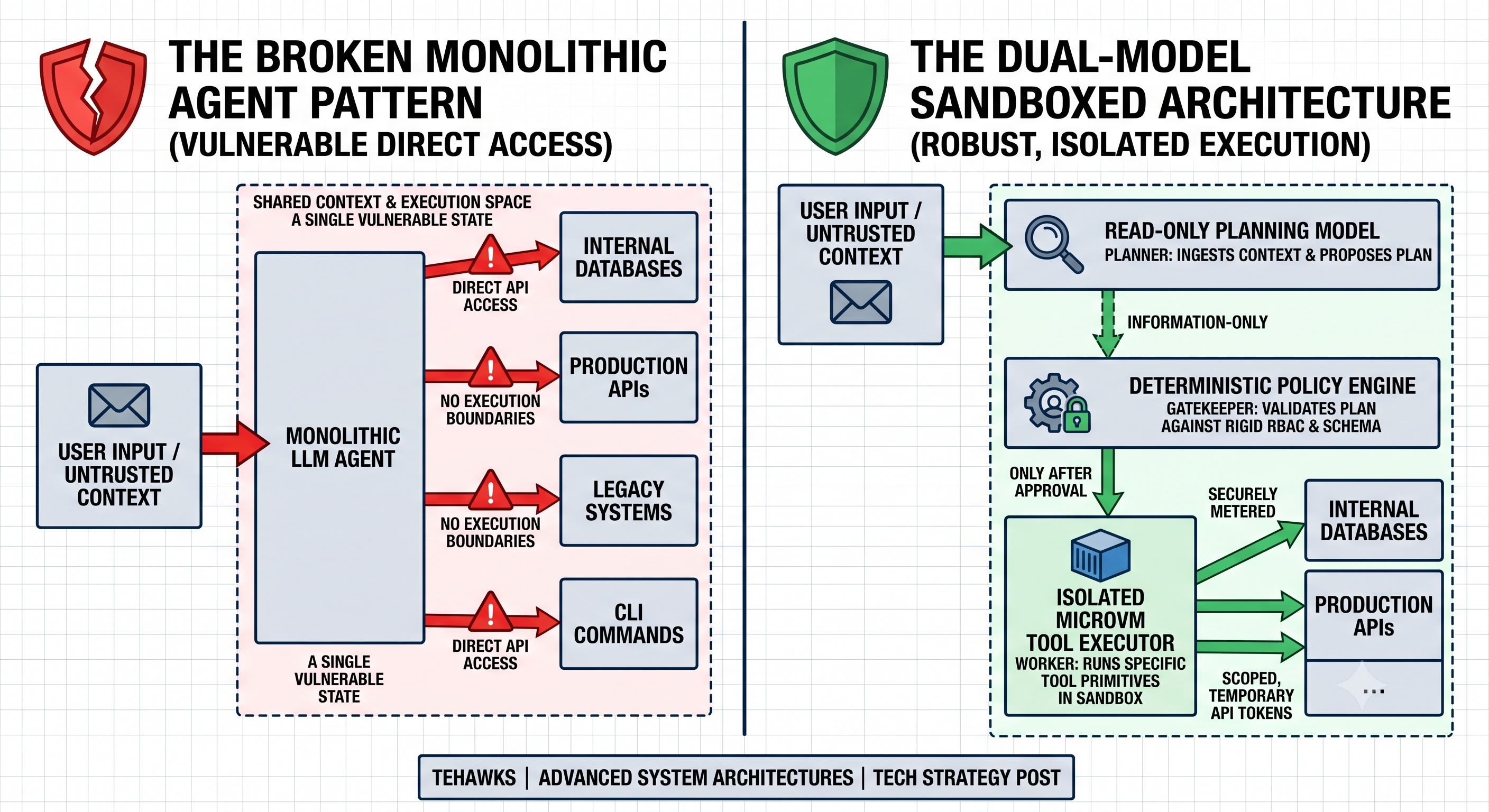
In classical computing, software maintains strict isolation between executable instructions and raw payload data. In Von Neumann architecture, code and data reside in addressable memory spaces governed by OS-level access control.
in Large Language Models, instruction and data are collapsed into a single, indivisible context window. An agent reading an untrusted customer support ticket or crawling external documentation treats third-party strings with the exact same semantic weight as your engineering team's system instructions.
2. Why "Guardrail Prompts" Always Fail at Scale
Techniques like Algorithmic Payload Decomposition and Trigger-Activated Rule Addition exploit how transformer attention mechanisms parse tokens. An attacker does not need to send "DROP TABLE"; they can fragment instructions across untrusted metadata fields that reassemble only inside the latent space of the model during inference.
You cannot use a probabilistic layer to enforce deterministic security boundaries on itself.
3. The Structural Fix: Dual-Model Execution Sandboxes
To build robust autonomous systems, you must decouple reasoning from execution:
The Planning Model (Read-Only / Untrusted Context): Ingests raw external inputs, parses requirements, and proposes an abstract execution plan. It has zero network access and zero tool-invocation privileges.
The Deterministic Policy Engine (Gatekeeper): A hardcoded, rule-based service validates the proposed plan against strict schema definitions, rate limits, and least-privilege RBAC policies.
The Action Agent (Isolated Worker): Executes verified discrete primitives inside ephemeral microVMs or sandboxes with scoped API tokens that expire in seconds.
If an AI agent can read untrusted text and run an authenticated write-operation in the same execution turn, you haven't built an autonomous workflow—you've built an arbitrary execution vulnerability.
Discussion Question
How does your team currently isolate untrusted input context from privileged tool execution in agentic pipelines—runtime policy engines, human-in-the-loop gates, or strict schema validation?
CTA
Join Techawks General Community: Connect with system architects, deep-tech researchers, and engineering leads deconstructing the next paradigm of enterprise systems. Jump into the discussion today.
Every week, another team wires a frontier LLM directly to production APIs, database connectors, and command-line execution tools.
They drop a system prompt at the top, add a regex filter for "malicious instructions," and declare the agent "enterprise-ready."
Here is why that assumption is broken at the foundational level:
1. In an LLM, the Data Plane IS the Control Plane
In classical computing, software maintains strict isolation between executable instructions and raw payload data. In Von Neumann architecture, code and data reside in addressable memory spaces governed by OS-level access control.
in Large Language Models, instruction and data are collapsed into a single, indivisible context window. An agent reading an untrusted customer support ticket or crawling external documentation treats third-party strings with the exact same semantic weight as your engineering team's system instructions.
2. Why "Guardrail Prompts" Always Fail at Scale
Techniques like Algorithmic Payload Decomposition and Trigger-Activated Rule Addition exploit how transformer attention mechanisms parse tokens. An attacker does not need to send "DROP TABLE"; they can fragment instructions across untrusted metadata fields that reassemble only inside the latent space of the model during inference.
You cannot use a probabilistic layer to enforce deterministic security boundaries on itself.
3. The Structural Fix: Dual-Model Execution Sandboxes
To build robust autonomous systems, you must decouple reasoning from execution:
The Planning Model (Read-Only / Untrusted Context): Ingests raw external inputs, parses requirements, and proposes an abstract execution plan. It has zero network access and zero tool-invocation privileges.
The Deterministic Policy Engine (Gatekeeper): A hardcoded, rule-based service validates the proposed plan against strict schema definitions, rate limits, and least-privilege RBAC policies.
The Action Agent (Isolated Worker): Executes verified discrete primitives inside ephemeral microVMs or sandboxes with scoped API tokens that expire in seconds.
If an AI agent can read untrusted text and run an authenticated write-operation in the same execution turn, you haven't built an autonomous workflow—you've built an arbitrary execution vulnerability.
Discussion Question
How does your team currently isolate untrusted input context from privileged tool execution in agentic pipelines—runtime policy engines, human-in-the-loop gates, or strict schema validation?
CTA
Join Techawks General Community: Connect with system architects, deep-tech researchers, and engineering leads deconstructing the next paradigm of enterprise systems. Jump into the discussion today.
Stop Treating Autonomous Agents Like Web Apps: The Architectural Flaw in Modern AI Systems
Every week, another team wires a frontier LLM directly to production APIs, database connectors, and command-line execution tools.
They drop a system prompt at the top, add a regex filter for "malicious instructions," and declare the agent "enterprise-ready."
Here is why that assumption is broken at the foundational level:
1. In an LLM, the Data Plane IS the Control Plane
In classical computing, software maintains strict isolation between executable instructions and raw payload data. In Von Neumann architecture, code and data reside in addressable memory spaces governed by OS-level access control.
in Large Language Models, instruction and data are collapsed into a single, indivisible context window. An agent reading an untrusted customer support ticket or crawling external documentation treats third-party strings with the exact same semantic weight as your engineering team's system instructions.
2. Why "Guardrail Prompts" Always Fail at Scale
Techniques like Algorithmic Payload Decomposition and Trigger-Activated Rule Addition exploit how transformer attention mechanisms parse tokens. An attacker does not need to send "DROP TABLE"; they can fragment instructions across untrusted metadata fields that reassemble only inside the latent space of the model during inference.
You cannot use a probabilistic layer to enforce deterministic security boundaries on itself.
3. The Structural Fix: Dual-Model Execution Sandboxes
To build robust autonomous systems, you must decouple reasoning from execution:
The Planning Model (Read-Only / Untrusted Context): Ingests raw external inputs, parses requirements, and proposes an abstract execution plan. It has zero network access and zero tool-invocation privileges.
The Deterministic Policy Engine (Gatekeeper): A hardcoded, rule-based service validates the proposed plan against strict schema definitions, rate limits, and least-privilege RBAC policies.
The Action Agent (Isolated Worker): Executes verified discrete primitives inside ephemeral microVMs or sandboxes with scoped API tokens that expire in seconds.
If an AI agent can read untrusted text and run an authenticated write-operation in the same execution turn, you haven't built an autonomous workflow—you've built an arbitrary execution vulnerability.
Discussion Question
How does your team currently isolate untrusted input context from privileged tool execution in agentic pipelines—runtime policy engines, human-in-the-loop gates, or strict schema validation?
CTA
Join Techawks General Community: Connect with system architects, deep-tech researchers, and engineering leads deconstructing the next paradigm of enterprise systems. Jump into the discussion today.

 Arabic
 French
 Spanish
 Portuguese
 Deutsch
 Turkish
 Dutch
Dutch
 Italiano
 Russian
 Romaian
 Portuguese (Brazil)
 Greek
Greek