


The Systems of Record Illusion: Why Your "AI-First" Workflow Has Zero Defensibility
Founders are falling into a recurring trap: building a slick, autonomous AI workflow on top of someone else’s data layer and mistaking early user delight for a moat.
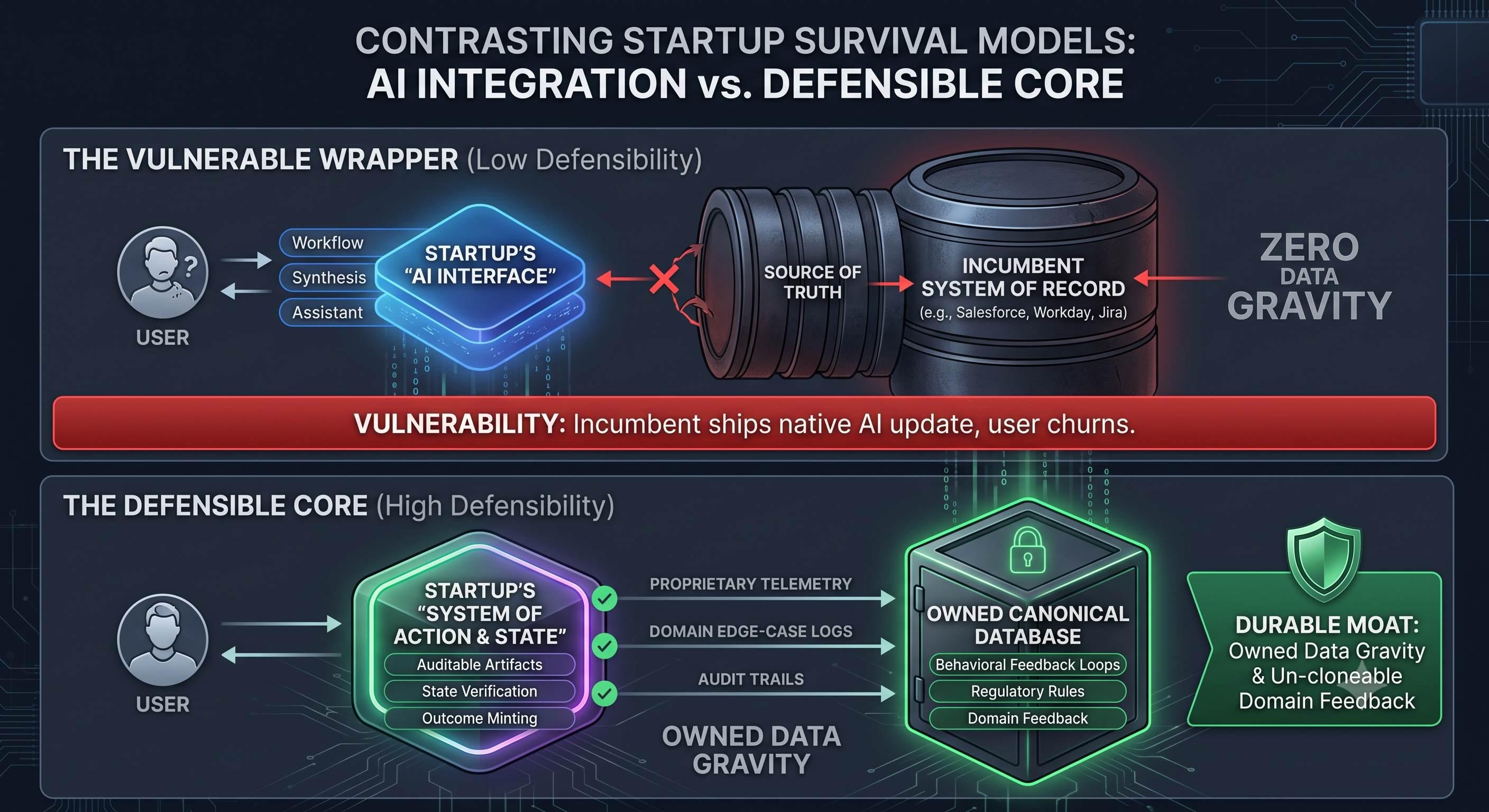
When you build an AI-native layer that reads from Salesforce, writes to Jira, or synthesizes data from Workday, you live on rented territory. The moment foundation models improve context handling or an incumbent releases an in-house agentic feature, your startup gets Sherlocked out of the stack.
The brutal reality of modern enterprise software: He who owns the system of record captures the surplus of the workflow.
If a legacy tool holds the source of truth, user identity, and audit compliance, adding intelligence is just an incremental feature for them. For you, it is your entire company.
The Strategic Shift: From "System of Intelligence" to "System of Action & Authority"
To survive the consolidation wave, founders must engineer structural defensibility:
Capture the Canonical State: Stop exporting output back to legacy databases. Design your product so that the final, auditable artifact (the generated contract, the underwritten risk score, the verified ledger) is minted and lives inside your proprietary database schema.
Compound Asymmetric Domain Telemetry: General LLM capabilities are a commodity. Your defensibility comes from behavioral feedback loops: capturing un-scraped domain corrections, domain-specific human rejections, and multi-variable regulatory rules that cannot be crawled from the public web.
Monetize Outcomes, Not Seats: Incumbents are paralyzed by per-seat SaaS pricing because efficiency destroys their top line. Price on business throughput or verified units of work (e.g., claims processed, audits completed), forcing legacy vendors to cannibalize their own revenue models to compete with you.
Don't build an assistant that helps people use legacy software. Build the replacement engine where the work actually terminates.
Discussion Question
Are you trying to replace an incumbent’s database, or are you hoping your interface stays sticky enough before they ship your core feature in their next release?
CTA
Build defensible products, master startup economics, and scale ventures designed to last. Join Startup Founders & Entrepreneurs at Techawks Startups.
Founders are falling into a recurring trap: building a slick, autonomous AI workflow on top of someone else’s data layer and mistaking early user delight for a moat.
When you build an AI-native layer that reads from Salesforce, writes to Jira, or synthesizes data from Workday, you live on rented territory. The moment foundation models improve context handling or an incumbent releases an in-house agentic feature, your startup gets Sherlocked out of the stack.
The brutal reality of modern enterprise software: He who owns the system of record captures the surplus of the workflow.
If a legacy tool holds the source of truth, user identity, and audit compliance, adding intelligence is just an incremental feature for them. For you, it is your entire company.
The Strategic Shift: From "System of Intelligence" to "System of Action & Authority"
To survive the consolidation wave, founders must engineer structural defensibility:
Capture the Canonical State: Stop exporting output back to legacy databases. Design your product so that the final, auditable artifact (the generated contract, the underwritten risk score, the verified ledger) is minted and lives inside your proprietary database schema.
Compound Asymmetric Domain Telemetry: General LLM capabilities are a commodity. Your defensibility comes from behavioral feedback loops: capturing un-scraped domain corrections, domain-specific human rejections, and multi-variable regulatory rules that cannot be crawled from the public web.
Monetize Outcomes, Not Seats: Incumbents are paralyzed by per-seat SaaS pricing because efficiency destroys their top line. Price on business throughput or verified units of work (e.g., claims processed, audits completed), forcing legacy vendors to cannibalize their own revenue models to compete with you.
Don't build an assistant that helps people use legacy software. Build the replacement engine where the work actually terminates.
Discussion Question
Are you trying to replace an incumbent’s database, or are you hoping your interface stays sticky enough before they ship your core feature in their next release?
CTA
Build defensible products, master startup economics, and scale ventures designed to last. Join Startup Founders & Entrepreneurs at Techawks Startups.
The Systems of Record Illusion: Why Your "AI-First" Workflow Has Zero Defensibility
Founders are falling into a recurring trap: building a slick, autonomous AI workflow on top of someone else’s data layer and mistaking early user delight for a moat.
When you build an AI-native layer that reads from Salesforce, writes to Jira, or synthesizes data from Workday, you live on rented territory. The moment foundation models improve context handling or an incumbent releases an in-house agentic feature, your startup gets Sherlocked out of the stack.
The brutal reality of modern enterprise software: He who owns the system of record captures the surplus of the workflow.
If a legacy tool holds the source of truth, user identity, and audit compliance, adding intelligence is just an incremental feature for them. For you, it is your entire company.
The Strategic Shift: From "System of Intelligence" to "System of Action & Authority"
To survive the consolidation wave, founders must engineer structural defensibility:
Capture the Canonical State: Stop exporting output back to legacy databases. Design your product so that the final, auditable artifact (the generated contract, the underwritten risk score, the verified ledger) is minted and lives inside your proprietary database schema.
Compound Asymmetric Domain Telemetry: General LLM capabilities are a commodity. Your defensibility comes from behavioral feedback loops: capturing un-scraped domain corrections, domain-specific human rejections, and multi-variable regulatory rules that cannot be crawled from the public web.
Monetize Outcomes, Not Seats: Incumbents are paralyzed by per-seat SaaS pricing because efficiency destroys their top line. Price on business throughput or verified units of work (e.g., claims processed, audits completed), forcing legacy vendors to cannibalize their own revenue models to compete with you.
Don't build an assistant that helps people use legacy software. Build the replacement engine where the work actually terminates.
Discussion Question
Are you trying to replace an incumbent’s database, or are you hoping your interface stays sticky enough before they ship your core feature in their next release?
CTA
Build defensible products, master startup economics, and scale ventures designed to last. Join Startup Founders & Entrepreneurs at Techawks Startups.

 English
 Arabic
 French
 Spanish
 Portuguese
 Deutsch
 Turkish
 Dutch
Dutch
 Italiano
 Russian
 Romaian
 Greek
Greek