


The Cognitive Offloading Trap: Why Paste-to-Fix Is Killing Your Mental Model
A dangerous habit has quietly infected computer science education: treating AI as an auto-debugger before forming an independent hypothesis.
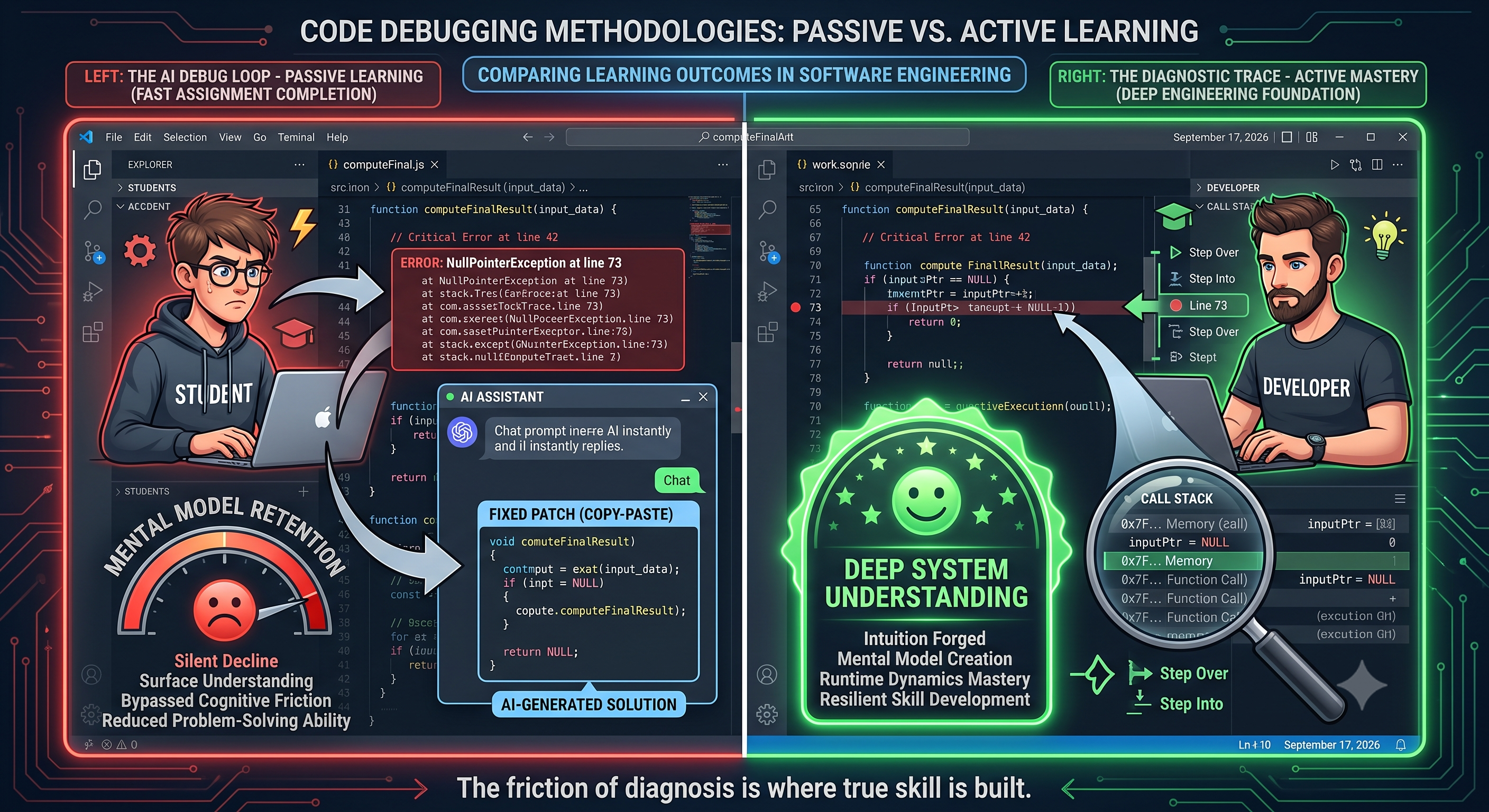
Recent studies on cognitive offloading show that students who outsource error diagnosis see short-term assignment completion spike, but their closed-environment problem-solving ability drops significantly within months. The reason isn't that tools are bad; it's that you bypass the single most important cognitive exercise in computer science: mental execution.
When an exception triggers (a NullPointerException, a memory segmentation fault, or an off-by-one array overflow), your brain is forced to walk the call stack backwards. That friction is where intuition is forged:
You map variable states across execution boundaries.
You learn how your runtime allocates memory and handles frames.
You discover the difference between what you intended the machine to do and what you instructed it to do.
When you paste an error directly into an assistant to get an instant patch, you skip that diagnostic loop. You get a green test suite, but your mental model of the system stays completely blank.
The Fix: The 10-Minute "Manual Trace" Rule
Before you touch an automated assistant when code breaks, enforce this diagnostic routine:
Read the Raw Stack Trace: Identify the exact file, method, and line number where the boundary failed. Do not look away until you can explain what exception type was thrown and why.
Form an Explicit Hypothesis: Write down one physical sentence explaining what state you believe was violated: “Line 42 expects an initialized object, but the upstream loop terminated early on an empty list.”
Verify with an Active Probe: Step through the line using an actual interactive debugger (breakpoints, watch expressions) or targeted print assertions to check if runtime reality matches your guess.
Only after you have isolated the root cause should you use automated tools to explore alternative implementations or refactoring patterns.
The machine executes your code deterministically. If you cannot trace its path yourself, you don't control the system—you are just guessing in the dark.
Discussion Question
When was the last time you used a native interactive debugger (breakpoints and call stack stepping) instead of pasting a stack trace into an AI?
CTA
Tackle tough engineering challenges, master computer science fundamentals, and build true technical resilience. Join Students in Tech at Techawks Students.
A dangerous habit has quietly infected computer science education: treating AI as an auto-debugger before forming an independent hypothesis.
Recent studies on cognitive offloading show that students who outsource error diagnosis see short-term assignment completion spike, but their closed-environment problem-solving ability drops significantly within months. The reason isn't that tools are bad; it's that you bypass the single most important cognitive exercise in computer science: mental execution.
When an exception triggers (a NullPointerException, a memory segmentation fault, or an off-by-one array overflow), your brain is forced to walk the call stack backwards. That friction is where intuition is forged:
You map variable states across execution boundaries.
You learn how your runtime allocates memory and handles frames.
You discover the difference between what you intended the machine to do and what you instructed it to do.
When you paste an error directly into an assistant to get an instant patch, you skip that diagnostic loop. You get a green test suite, but your mental model of the system stays completely blank.
The Fix: The 10-Minute "Manual Trace" Rule
Before you touch an automated assistant when code breaks, enforce this diagnostic routine:
Read the Raw Stack Trace: Identify the exact file, method, and line number where the boundary failed. Do not look away until you can explain what exception type was thrown and why.
Form an Explicit Hypothesis: Write down one physical sentence explaining what state you believe was violated: “Line 42 expects an initialized object, but the upstream loop terminated early on an empty list.”
Verify with an Active Probe: Step through the line using an actual interactive debugger (breakpoints, watch expressions) or targeted print assertions to check if runtime reality matches your guess.
Only after you have isolated the root cause should you use automated tools to explore alternative implementations or refactoring patterns.
The machine executes your code deterministically. If you cannot trace its path yourself, you don't control the system—you are just guessing in the dark.
Discussion Question
When was the last time you used a native interactive debugger (breakpoints and call stack stepping) instead of pasting a stack trace into an AI?
CTA
Tackle tough engineering challenges, master computer science fundamentals, and build true technical resilience. Join Students in Tech at Techawks Students.
The Cognitive Offloading Trap: Why Paste-to-Fix Is Killing Your Mental Model
A dangerous habit has quietly infected computer science education: treating AI as an auto-debugger before forming an independent hypothesis.
Recent studies on cognitive offloading show that students who outsource error diagnosis see short-term assignment completion spike, but their closed-environment problem-solving ability drops significantly within months. The reason isn't that tools are bad; it's that you bypass the single most important cognitive exercise in computer science: mental execution.
When an exception triggers (a NullPointerException, a memory segmentation fault, or an off-by-one array overflow), your brain is forced to walk the call stack backwards. That friction is where intuition is forged:
You map variable states across execution boundaries.
You learn how your runtime allocates memory and handles frames.
You discover the difference between what you intended the machine to do and what you instructed it to do.
When you paste an error directly into an assistant to get an instant patch, you skip that diagnostic loop. You get a green test suite, but your mental model of the system stays completely blank.
The Fix: The 10-Minute "Manual Trace" Rule
Before you touch an automated assistant when code breaks, enforce this diagnostic routine:
Read the Raw Stack Trace: Identify the exact file, method, and line number where the boundary failed. Do not look away until you can explain what exception type was thrown and why.
Form an Explicit Hypothesis: Write down one physical sentence explaining what state you believe was violated: “Line 42 expects an initialized object, but the upstream loop terminated early on an empty list.”
Verify with an Active Probe: Step through the line using an actual interactive debugger (breakpoints, watch expressions) or targeted print assertions to check if runtime reality matches your guess.
Only after you have isolated the root cause should you use automated tools to explore alternative implementations or refactoring patterns.
The machine executes your code deterministically. If you cannot trace its path yourself, you don't control the system—you are just guessing in the dark.
Discussion Question
When was the last time you used a native interactive debugger (breakpoints and call stack stepping) instead of pasting a stack trace into an AI?
CTA
Tackle tough engineering challenges, master computer science fundamentals, and build true technical resilience. Join Students in Tech at Techawks Students.

 English
 Arabic
 Spanish
 Portuguese
 Deutsch
 Turkish
 Dutch
Dutch
 Italiano
 Russian
 Romaian
 Portuguese (Brazil)
 Greek
Greek