


MFA Isn’t Broken, But Your Session Tokens Are: The Rise of Adversary-in-the-Middle Attacks
Most entry-level security learners spend months mastering brute-force mechanics, password cracking, and phishing filters. Meanwhile, real-world breaches have largely abandoned password guessing: attackers don't break credentials anymore—they hijack authenticated sessions.
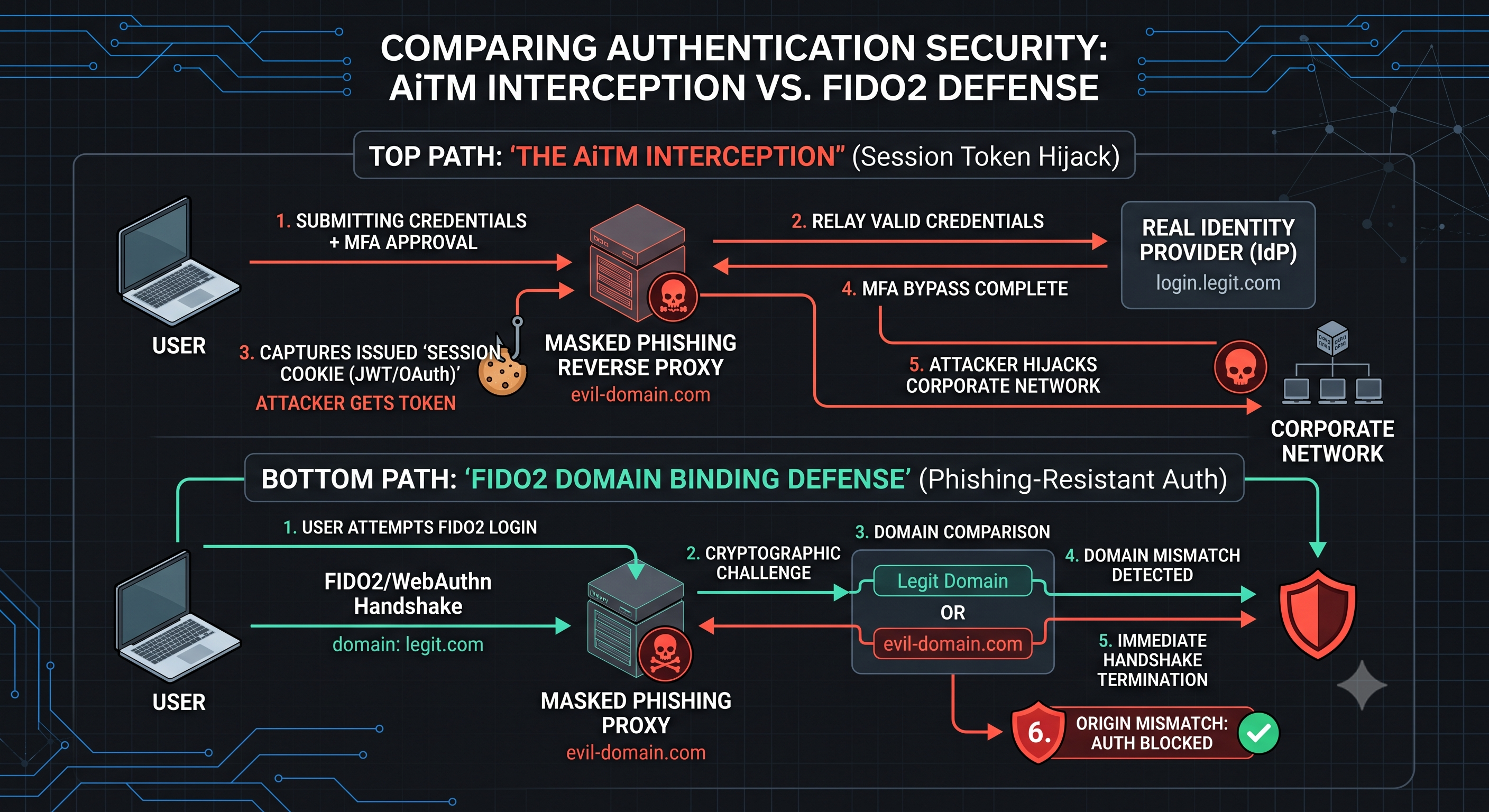
In an Adversary-in-the-Middle (AiTM) campaign, the threat actor deploys reverse-proxy infrastructure (such as Evilginx or Modlishka) between the target and the legitimate identity provider (IdP).
Here is why standard multi-factor authentication fails against this vector:
The victim enters their username and password on the reverse proxy, which passes them straight to the real login page.
The real IdP prompts for an MFA code or push notification.
The victim completes the MFA prompt.
The IdP issues a valid session cookie / OAuth refresh token.
The proxy intercepts and captures that session token before forwarding it to the user.
Once the attacker holds that token, the authentication process is over. They inject the session cookie into their own browser and inherit the user's active session without needing the password, the phone, or the hardware token ever again.
The Defensive Shift: Fast-Track to FIDO2 / Passkeys and Token Binding
To build resilient defensive architecture against AiTM, security teams must move beyond push- and SMS-based multi-factor protocols:
Enforce FIDO2 / WebAuthn (Passkeys): Traditional TOTP codes and push prompts don't validate the origin URL. FIDO2 protocols bind authentication cryptographically to the exact domain name in the browser address bar. If a user is on a phishing proxy domain, the cryptographic handshake fails automatically.
Continuous Access Evaluation (CAE): Traditional tokens remain valid for hours regardless of network shifts. Implement IdP policies that continuously evaluate context—instantly revoking token validity if IP geolocation, device compliance, or user risk scores abruptly deviate mid-session.
Device-Bound Session Credentials (DBSC): Adopt emerging token-binding standards that tie session keys to the client machine's TPM (Trusted Platform Module), ensuring intercepted cookies cannot be replayed on an attacker’s machine.
Authentication isn't a one-time gate at the front door; it must be an ongoing, cryptographically verified session.
Discussion Question
Has your team transitioned to phishing-resistant FIDO2/WebAuthn credentials yet, or are you still relying on push-based notifications and TOTP codes across your perimeter?
CTA
Master red team offensive tactics, fortify cloud defenses, and become a threat-hunting authority. Join Cybersecurity & Ethical Hacking at Techawks Cybersecurity.
Most entry-level security learners spend months mastering brute-force mechanics, password cracking, and phishing filters. Meanwhile, real-world breaches have largely abandoned password guessing: attackers don't break credentials anymore—they hijack authenticated sessions.
In an Adversary-in-the-Middle (AiTM) campaign, the threat actor deploys reverse-proxy infrastructure (such as Evilginx or Modlishka) between the target and the legitimate identity provider (IdP).
Here is why standard multi-factor authentication fails against this vector:
The victim enters their username and password on the reverse proxy, which passes them straight to the real login page.
The real IdP prompts for an MFA code or push notification.
The victim completes the MFA prompt.
The IdP issues a valid session cookie / OAuth refresh token.
The proxy intercepts and captures that session token before forwarding it to the user.
Once the attacker holds that token, the authentication process is over. They inject the session cookie into their own browser and inherit the user's active session without needing the password, the phone, or the hardware token ever again.
The Defensive Shift: Fast-Track to FIDO2 / Passkeys and Token Binding
To build resilient defensive architecture against AiTM, security teams must move beyond push- and SMS-based multi-factor protocols:
Enforce FIDO2 / WebAuthn (Passkeys): Traditional TOTP codes and push prompts don't validate the origin URL. FIDO2 protocols bind authentication cryptographically to the exact domain name in the browser address bar. If a user is on a phishing proxy domain, the cryptographic handshake fails automatically.
Continuous Access Evaluation (CAE): Traditional tokens remain valid for hours regardless of network shifts. Implement IdP policies that continuously evaluate context—instantly revoking token validity if IP geolocation, device compliance, or user risk scores abruptly deviate mid-session.
Device-Bound Session Credentials (DBSC): Adopt emerging token-binding standards that tie session keys to the client machine's TPM (Trusted Platform Module), ensuring intercepted cookies cannot be replayed on an attacker’s machine.
Authentication isn't a one-time gate at the front door; it must be an ongoing, cryptographically verified session.
Discussion Question
Has your team transitioned to phishing-resistant FIDO2/WebAuthn credentials yet, or are you still relying on push-based notifications and TOTP codes across your perimeter?
CTA
Master red team offensive tactics, fortify cloud defenses, and become a threat-hunting authority. Join Cybersecurity & Ethical Hacking at Techawks Cybersecurity.
MFA Isn’t Broken, But Your Session Tokens Are: The Rise of Adversary-in-the-Middle Attacks
Most entry-level security learners spend months mastering brute-force mechanics, password cracking, and phishing filters. Meanwhile, real-world breaches have largely abandoned password guessing: attackers don't break credentials anymore—they hijack authenticated sessions.
In an Adversary-in-the-Middle (AiTM) campaign, the threat actor deploys reverse-proxy infrastructure (such as Evilginx or Modlishka) between the target and the legitimate identity provider (IdP).
Here is why standard multi-factor authentication fails against this vector:
The victim enters their username and password on the reverse proxy, which passes them straight to the real login page.
The real IdP prompts for an MFA code or push notification.
The victim completes the MFA prompt.
The IdP issues a valid session cookie / OAuth refresh token.
The proxy intercepts and captures that session token before forwarding it to the user.
Once the attacker holds that token, the authentication process is over. They inject the session cookie into their own browser and inherit the user's active session without needing the password, the phone, or the hardware token ever again.
The Defensive Shift: Fast-Track to FIDO2 / Passkeys and Token Binding
To build resilient defensive architecture against AiTM, security teams must move beyond push- and SMS-based multi-factor protocols:
Enforce FIDO2 / WebAuthn (Passkeys): Traditional TOTP codes and push prompts don't validate the origin URL. FIDO2 protocols bind authentication cryptographically to the exact domain name in the browser address bar. If a user is on a phishing proxy domain, the cryptographic handshake fails automatically.
Continuous Access Evaluation (CAE): Traditional tokens remain valid for hours regardless of network shifts. Implement IdP policies that continuously evaluate context—instantly revoking token validity if IP geolocation, device compliance, or user risk scores abruptly deviate mid-session.
Device-Bound Session Credentials (DBSC): Adopt emerging token-binding standards that tie session keys to the client machine's TPM (Trusted Platform Module), ensuring intercepted cookies cannot be replayed on an attacker’s machine.
Authentication isn't a one-time gate at the front door; it must be an ongoing, cryptographically verified session.
Discussion Question
Has your team transitioned to phishing-resistant FIDO2/WebAuthn credentials yet, or are you still relying on push-based notifications and TOTP codes across your perimeter?
CTA
Master red team offensive tactics, fortify cloud defenses, and become a threat-hunting authority. Join Cybersecurity & Ethical Hacking at Techawks Cybersecurity.

 English
 Arabic
 French
 Spanish
 Portuguese
 Deutsch
 Turkish
 Dutch
Dutch
 Italiano
 Russian
 Portuguese (Brazil)
 Greek
Greek