


The Metric Drift Disaster: Why Your Data Warehouse Is Just a Fragmented Math Engine
Modern analytics stacks made data ingestion and physical storage cheap, but they spawned a quiet crisis: distributed metric logic.
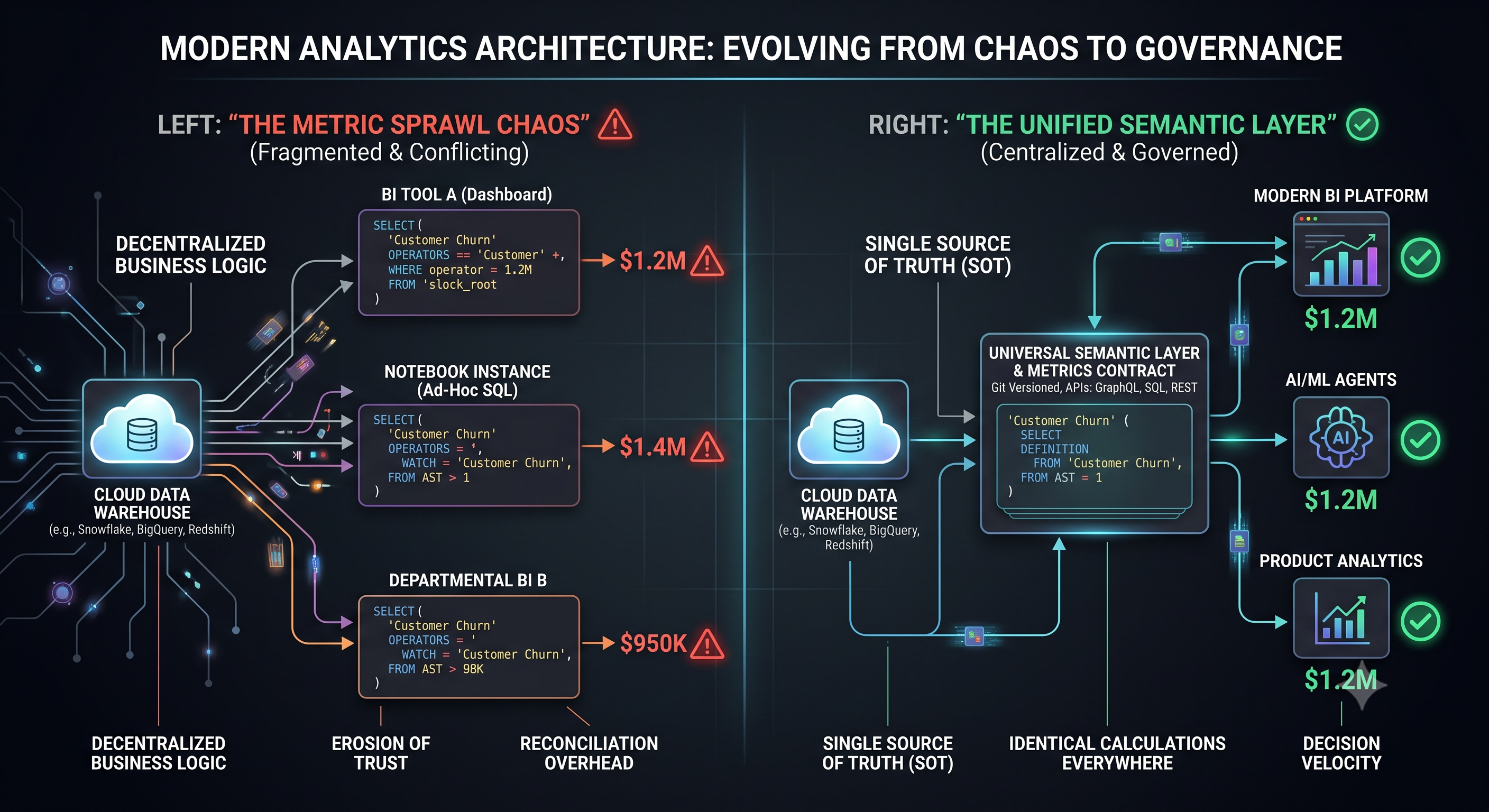
When organizations give every team their own BI tool, notebook instance, or downstream dashboard, business logic naturally scatters across hundreds of un-versioned SQL models. Finance calculates "Revenue" excluding pending refunds, Sales calculates it including pipeline promises, and Product filters out internal trial accounts via an undocumented WHERE clause.
The result is metric drift: data teams spend up to 40% of their time reconciling why downstream numbers don't match, eroding stakeholder trust in the warehouse.
The Fix: Elevate the Universal Semantic Layer
Stop embedding mission-critical KPI formulas inside individual BI dashboard queries or one-off dbt models. Decouple your business logic from both your physical storage and your presentation layer:
Centralize Semantics as Code: Treat definitions like software. Write your dimensions and measures once into a governed semantic catalog (using tools like Cube, dbt Semantic Layer, or headless metrics layers) backed by Git version control.
Decouple Presentation from Aggregation: Ban raw SQL aggregation inside BI tools. Your dashboards, AI agents, and notebooks should query standard APIs that resolve against the central semantic contract, guaranteeing identical calculations everywhere.
Enforce Upstream Data Contracts: Combine semantic definitions with data contracts at the ingestion boundary. When upstream application schemas change, automated CI pipelines must block breaking shifts before they silently invalidate downstream metric models.
Dashboards are just viewing panes. If your metrics aren't governed in an explicit layer between your warehouse and your users, you aren't building a single source of truth—you are running an unverified calculation factory.
Discussion Question
How does your team eliminate metric discrepancies: do you enforce a centralized semantic layer, or are you still chasing down divergent SQL queries across multiple dashboards?
CTA
Master modern analytics architecture, build unified semantic models, and eliminate data fragmentation. Join Data Science & Analytics at Techawks Data & Analytics.
Modern analytics stacks made data ingestion and physical storage cheap, but they spawned a quiet crisis: distributed metric logic.
When organizations give every team their own BI tool, notebook instance, or downstream dashboard, business logic naturally scatters across hundreds of un-versioned SQL models. Finance calculates "Revenue" excluding pending refunds, Sales calculates it including pipeline promises, and Product filters out internal trial accounts via an undocumented WHERE clause.
The result is metric drift: data teams spend up to 40% of their time reconciling why downstream numbers don't match, eroding stakeholder trust in the warehouse.
The Fix: Elevate the Universal Semantic Layer
Stop embedding mission-critical KPI formulas inside individual BI dashboard queries or one-off dbt models. Decouple your business logic from both your physical storage and your presentation layer:
Centralize Semantics as Code: Treat definitions like software. Write your dimensions and measures once into a governed semantic catalog (using tools like Cube, dbt Semantic Layer, or headless metrics layers) backed by Git version control.
Decouple Presentation from Aggregation: Ban raw SQL aggregation inside BI tools. Your dashboards, AI agents, and notebooks should query standard APIs that resolve against the central semantic contract, guaranteeing identical calculations everywhere.
Enforce Upstream Data Contracts: Combine semantic definitions with data contracts at the ingestion boundary. When upstream application schemas change, automated CI pipelines must block breaking shifts before they silently invalidate downstream metric models.
Dashboards are just viewing panes. If your metrics aren't governed in an explicit layer between your warehouse and your users, you aren't building a single source of truth—you are running an unverified calculation factory.
Discussion Question
How does your team eliminate metric discrepancies: do you enforce a centralized semantic layer, or are you still chasing down divergent SQL queries across multiple dashboards?
CTA
Master modern analytics architecture, build unified semantic models, and eliminate data fragmentation. Join Data Science & Analytics at Techawks Data & Analytics.
The Metric Drift Disaster: Why Your Data Warehouse Is Just a Fragmented Math Engine
Modern analytics stacks made data ingestion and physical storage cheap, but they spawned a quiet crisis: distributed metric logic.
When organizations give every team their own BI tool, notebook instance, or downstream dashboard, business logic naturally scatters across hundreds of un-versioned SQL models. Finance calculates "Revenue" excluding pending refunds, Sales calculates it including pipeline promises, and Product filters out internal trial accounts via an undocumented WHERE clause.
The result is metric drift: data teams spend up to 40% of their time reconciling why downstream numbers don't match, eroding stakeholder trust in the warehouse.
The Fix: Elevate the Universal Semantic Layer
Stop embedding mission-critical KPI formulas inside individual BI dashboard queries or one-off dbt models. Decouple your business logic from both your physical storage and your presentation layer:
Centralize Semantics as Code: Treat definitions like software. Write your dimensions and measures once into a governed semantic catalog (using tools like Cube, dbt Semantic Layer, or headless metrics layers) backed by Git version control.
Decouple Presentation from Aggregation: Ban raw SQL aggregation inside BI tools. Your dashboards, AI agents, and notebooks should query standard APIs that resolve against the central semantic contract, guaranteeing identical calculations everywhere.
Enforce Upstream Data Contracts: Combine semantic definitions with data contracts at the ingestion boundary. When upstream application schemas change, automated CI pipelines must block breaking shifts before they silently invalidate downstream metric models.
Dashboards are just viewing panes. If your metrics aren't governed in an explicit layer between your warehouse and your users, you aren't building a single source of truth—you are running an unverified calculation factory.
Discussion Question
How does your team eliminate metric discrepancies: do you enforce a centralized semantic layer, or are you still chasing down divergent SQL queries across multiple dashboards?
CTA
Master modern analytics architecture, build unified semantic models, and eliminate data fragmentation. Join Data Science & Analytics at Techawks Data & Analytics.

 Arabic
 French
 Spanish
 Portuguese
 Deutsch
 Turkish
 Dutch
Dutch
 Italiano
 Russian
 Romaian
 Portuguese (Brazil)
 Greek
Greek