


The HPA Thrashing Trap: Why Your Autoscaling Loop Is Bleeding Cloud Capital and Causing Outages
A hidden reliability killer is quietly draining production clusters: autoscaling oscillation (thrashing).
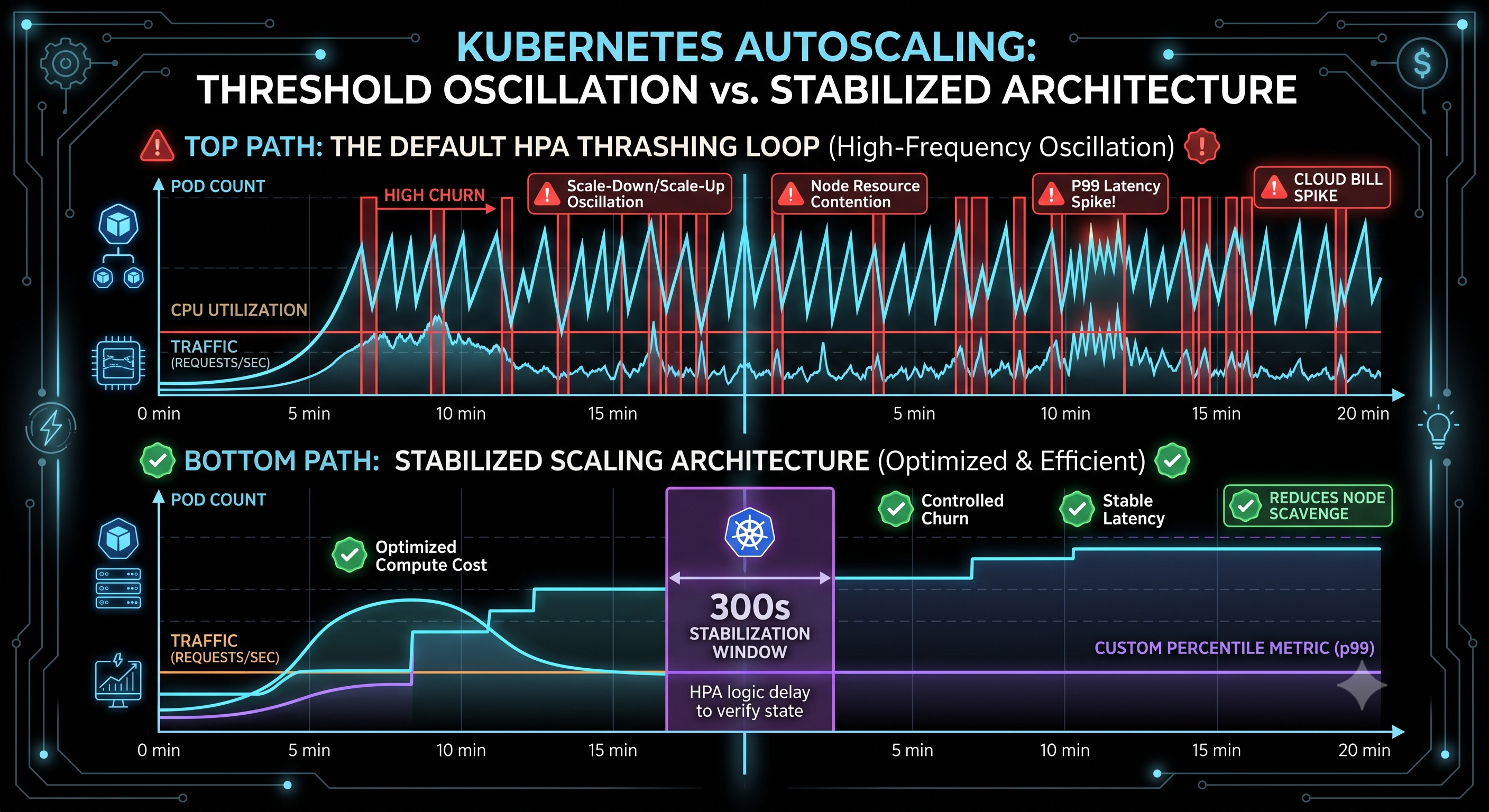
When an application experiences variable traffic, default HPA configurations react instantaneously to raw metric spikes (like CPU usage crossing a 75% threshold). Pods spin up, pull heavy initial loads, cause resource contention on worker nodes, trigger a sudden metric drop, scale down pods, and immediately face a new traffic wave that forces another scale-up.
This destructive cycle creates three severe production failures:
The Orchestration Churn Tax: Rapidly provisioning and terminating pods floods the Kubernetes control plane with API requests, forces kubelet to constantly manage container lifecycle overhead, and saturates container network interfaces.
Cascading P99 Latency Spikes: Cold starts, un-warmed connection pools, and database connection storms triggered by hundreds of short-lived pods simultaneously initializing degrade tail latencies far worse than handling peak load with a stable fleet.
Cloud Cost Amplification: Managed Kubernetes node autoscalers (EKS, GKE, AKS) interpret pod scheduling pressure as a demand for more underlying VM instances, locking you into hourly billing for idle nodes provisioned during brief traffic spikes.
The Architectural Fix: Implement Stabilization and Granular Metric Smoothing
Stop letting raw, unfiltered metrics dictate cluster state. Reshape your autoscaling architecture with these three controls:
Configure Scale-Down Stabilization Windows: Add explicit stabilization windows to your HPA manifest to delay scale-down actions (e.g., evaluating a 5-minute rolling window), preventing transient traffic dips from killing active pods prematurely:
YAML
behavior:
scaleDown:
stabilizationWindowSeconds: 300
policies:
- type: Percent
value: 10
periodSeconds: 60
Switch to Custom Percentile Metrics: Raw average CPU or memory metrics can be easily skewed by a single runaway thread. Use Prometheus adapters to scale based on p95 or p99 request latency rather than raw node resource consumption.
Enforce Pod Disruption Budgets (PDBs): Pair HPA rules with strict PDBs to ensure that automated scaling events never compromise minimum available replica counts during high-churn deployments.
Elasticity without boundaries is just unmanaged chaos. Design your control loops to absorb volatility, not amplify it.
Discussion Question
How do your teams tune HPA cooldown windows and metric thresholds to prevent pod thrashing under unpredictable traffic surges?
CTA
Master resilient cloud-native architectures, optimize production workloads, and conquer infrastructure scale. Join Cloud, DevOps & Open Source at Techawks Cloud & DevOps.
A hidden reliability killer is quietly draining production clusters: autoscaling oscillation (thrashing).
When an application experiences variable traffic, default HPA configurations react instantaneously to raw metric spikes (like CPU usage crossing a 75% threshold). Pods spin up, pull heavy initial loads, cause resource contention on worker nodes, trigger a sudden metric drop, scale down pods, and immediately face a new traffic wave that forces another scale-up.
This destructive cycle creates three severe production failures:
The Orchestration Churn Tax: Rapidly provisioning and terminating pods floods the Kubernetes control plane with API requests, forces kubelet to constantly manage container lifecycle overhead, and saturates container network interfaces.
Cascading P99 Latency Spikes: Cold starts, un-warmed connection pools, and database connection storms triggered by hundreds of short-lived pods simultaneously initializing degrade tail latencies far worse than handling peak load with a stable fleet.
Cloud Cost Amplification: Managed Kubernetes node autoscalers (EKS, GKE, AKS) interpret pod scheduling pressure as a demand for more underlying VM instances, locking you into hourly billing for idle nodes provisioned during brief traffic spikes.
The Architectural Fix: Implement Stabilization and Granular Metric Smoothing
Stop letting raw, unfiltered metrics dictate cluster state. Reshape your autoscaling architecture with these three controls:
Configure Scale-Down Stabilization Windows: Add explicit stabilization windows to your HPA manifest to delay scale-down actions (e.g., evaluating a 5-minute rolling window), preventing transient traffic dips from killing active pods prematurely:
YAML
behavior:
scaleDown:
stabilizationWindowSeconds: 300
policies:
- type: Percent
value: 10
periodSeconds: 60
Switch to Custom Percentile Metrics: Raw average CPU or memory metrics can be easily skewed by a single runaway thread. Use Prometheus adapters to scale based on p95 or p99 request latency rather than raw node resource consumption.
Enforce Pod Disruption Budgets (PDBs): Pair HPA rules with strict PDBs to ensure that automated scaling events never compromise minimum available replica counts during high-churn deployments.
Elasticity without boundaries is just unmanaged chaos. Design your control loops to absorb volatility, not amplify it.
Discussion Question
How do your teams tune HPA cooldown windows and metric thresholds to prevent pod thrashing under unpredictable traffic surges?
CTA
Master resilient cloud-native architectures, optimize production workloads, and conquer infrastructure scale. Join Cloud, DevOps & Open Source at Techawks Cloud & DevOps.
The HPA Thrashing Trap: Why Your Autoscaling Loop Is Bleeding Cloud Capital and Causing Outages
A hidden reliability killer is quietly draining production clusters: autoscaling oscillation (thrashing).
When an application experiences variable traffic, default HPA configurations react instantaneously to raw metric spikes (like CPU usage crossing a 75% threshold). Pods spin up, pull heavy initial loads, cause resource contention on worker nodes, trigger a sudden metric drop, scale down pods, and immediately face a new traffic wave that forces another scale-up.
This destructive cycle creates three severe production failures:
The Orchestration Churn Tax: Rapidly provisioning and terminating pods floods the Kubernetes control plane with API requests, forces kubelet to constantly manage container lifecycle overhead, and saturates container network interfaces.
Cascading P99 Latency Spikes: Cold starts, un-warmed connection pools, and database connection storms triggered by hundreds of short-lived pods simultaneously initializing degrade tail latencies far worse than handling peak load with a stable fleet.
Cloud Cost Amplification: Managed Kubernetes node autoscalers (EKS, GKE, AKS) interpret pod scheduling pressure as a demand for more underlying VM instances, locking you into hourly billing for idle nodes provisioned during brief traffic spikes.
The Architectural Fix: Implement Stabilization and Granular Metric Smoothing
Stop letting raw, unfiltered metrics dictate cluster state. Reshape your autoscaling architecture with these three controls:
Configure Scale-Down Stabilization Windows: Add explicit stabilization windows to your HPA manifest to delay scale-down actions (e.g., evaluating a 5-minute rolling window), preventing transient traffic dips from killing active pods prematurely:
YAML
behavior:
scaleDown:
stabilizationWindowSeconds: 300
policies:
- type: Percent
value: 10
periodSeconds: 60
Switch to Custom Percentile Metrics: Raw average CPU or memory metrics can be easily skewed by a single runaway thread. Use Prometheus adapters to scale based on p95 or p99 request latency rather than raw node resource consumption.
Enforce Pod Disruption Budgets (PDBs): Pair HPA rules with strict PDBs to ensure that automated scaling events never compromise minimum available replica counts during high-churn deployments.
Elasticity without boundaries is just unmanaged chaos. Design your control loops to absorb volatility, not amplify it.
Discussion Question
How do your teams tune HPA cooldown windows and metric thresholds to prevent pod thrashing under unpredictable traffic surges?
CTA
Master resilient cloud-native architectures, optimize production workloads, and conquer infrastructure scale. Join Cloud, DevOps & Open Source at Techawks Cloud & DevOps.

 Arabic
 French
 Spanish
 Portuguese
 Deutsch
 Turkish
 Dutch
Dutch
 Italiano
 Russian
 Romaian
 Portuguese (Brazil)
 Greek
Greek