


The Ultimate Pre-Deployment Checklist for Production Kubernetes Workloads
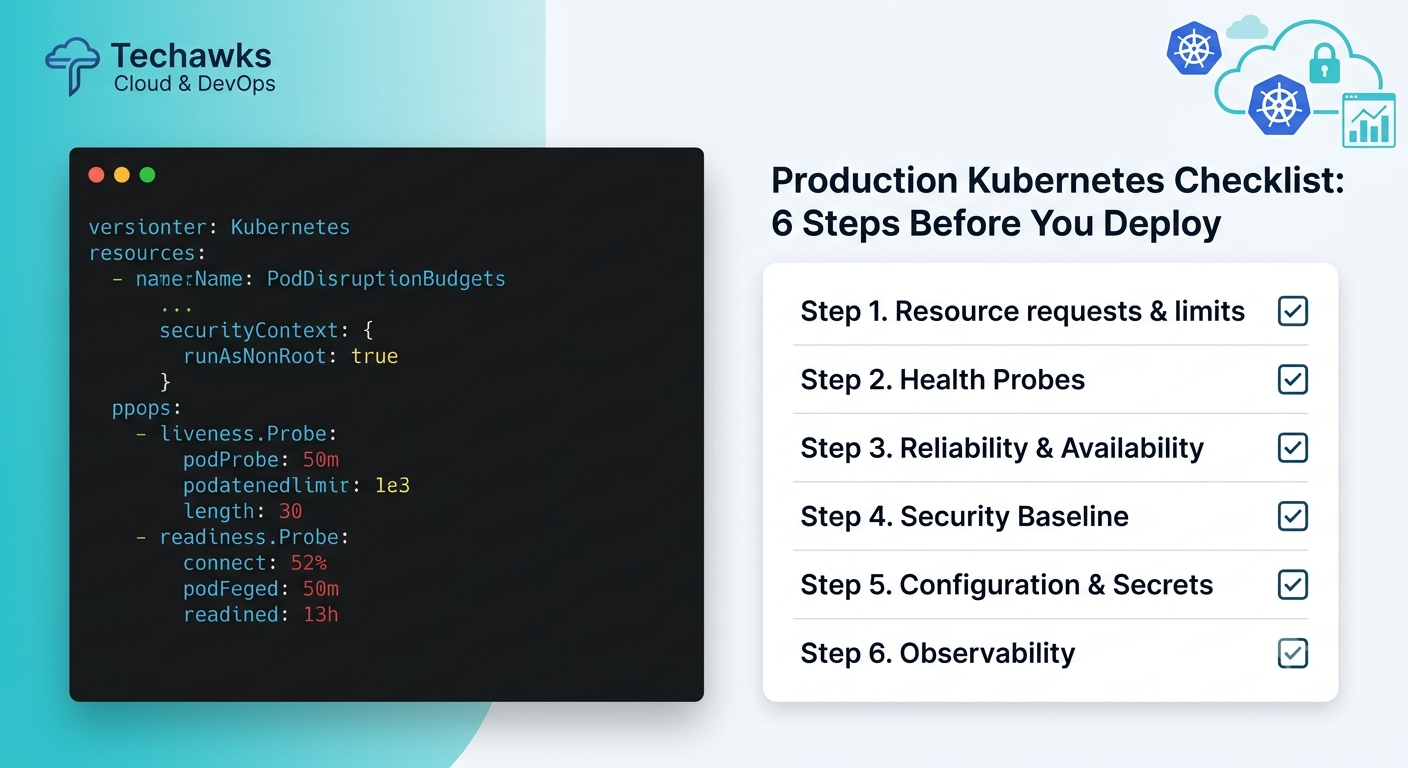
Deploying to production without a baseline standard is a recipe for silent failures, resource starvation, and unexpected cloud bills. Bookmark this checklist and run through it for every new workload you deploy.
1. Resource Requests & Limits
Define CPU/Memory Requests: Ensure the scheduler knows where to place your pods.
Set Memory Limits: Protect nodes from Out-Of-Memory (OOM) kills caused by runaway processes.
Avoid Strict CPU Limits (if throttling occurs): Benchmark your workload under load before hard-capping CPU.
2. Health Probes
Startup Probe: Configured for slow-booting applications to prevent premature restarts.
Liveness Probe: Configured to restart pods if they deadlock or hit an unrecoverable state.
Readiness Probe: Configured so traffic only routes to pods ready to handle requests.
3. Reliability & Availability
Replicas > 1: Run at least 2–3 instances across multiple Availability Zones (AZs).
PodDisruptionBudget (PDB): Set up PDBs so cluster maintenance or node drains don't drop your available pods to zero.
Anti-Affinity Rules: Distribute pods across separate nodes or zones.
4. Security Baseline
Non-Root Execution: Set runAsNonRoot: true in your securityContext.
Read-Only Root Filesystem: Enforce readOnlyRootFilesystem: true where possible.
Network Policies: Restrict ingress and egress traffic to only required dependencies.
5. Configuration & Secrets
Externalized Configs: Store environment variables in ConfigMaps, not hardcoded image tags.
Encrypted Secrets: Manage sensitive credentials via External Secrets Operator or HashiCorp Vault.
6. Observability
Structured Logging: Output JSON logs to standard output/error (stdout/stderr).
Metrics Endpoint: Expose a /metrics path for Prometheus scrapers.
Key Takeaways
Predictability over intuition: Reliability isn't luck; it's enforcing guardrails at deployment time.
Fail gracefully: Probes and PodDisruptionBudgets ensure your system self-heals during node failures or cluster upgrades.
Security is shift-left: Setting security contexts early prevents container breakout risks down the road.
CTA
🚀 Level up your cloud skills! Join the Techawks Cloud, DevOps & Open Source community to get expert architecture guides, hands-on tutorials, and real-world infrastructure strategies.
Deploying to production without a baseline standard is a recipe for silent failures, resource starvation, and unexpected cloud bills. Bookmark this checklist and run through it for every new workload you deploy.
1. Resource Requests & Limits
Define CPU/Memory Requests: Ensure the scheduler knows where to place your pods.
Set Memory Limits: Protect nodes from Out-Of-Memory (OOM) kills caused by runaway processes.
Avoid Strict CPU Limits (if throttling occurs): Benchmark your workload under load before hard-capping CPU.
2. Health Probes
Startup Probe: Configured for slow-booting applications to prevent premature restarts.
Liveness Probe: Configured to restart pods if they deadlock or hit an unrecoverable state.
Readiness Probe: Configured so traffic only routes to pods ready to handle requests.
3. Reliability & Availability
Replicas > 1: Run at least 2–3 instances across multiple Availability Zones (AZs).
PodDisruptionBudget (PDB): Set up PDBs so cluster maintenance or node drains don't drop your available pods to zero.
Anti-Affinity Rules: Distribute pods across separate nodes or zones.
4. Security Baseline
Non-Root Execution: Set runAsNonRoot: true in your securityContext.
Read-Only Root Filesystem: Enforce readOnlyRootFilesystem: true where possible.
Network Policies: Restrict ingress and egress traffic to only required dependencies.
5. Configuration & Secrets
Externalized Configs: Store environment variables in ConfigMaps, not hardcoded image tags.
Encrypted Secrets: Manage sensitive credentials via External Secrets Operator or HashiCorp Vault.
6. Observability
Structured Logging: Output JSON logs to standard output/error (stdout/stderr).
Metrics Endpoint: Expose a /metrics path for Prometheus scrapers.
Key Takeaways
Predictability over intuition: Reliability isn't luck; it's enforcing guardrails at deployment time.
Fail gracefully: Probes and PodDisruptionBudgets ensure your system self-heals during node failures or cluster upgrades.
Security is shift-left: Setting security contexts early prevents container breakout risks down the road.
CTA
🚀 Level up your cloud skills! Join the Techawks Cloud, DevOps & Open Source community to get expert architecture guides, hands-on tutorials, and real-world infrastructure strategies.
The Ultimate Pre-Deployment Checklist for Production Kubernetes Workloads
Deploying to production without a baseline standard is a recipe for silent failures, resource starvation, and unexpected cloud bills. Bookmark this checklist and run through it for every new workload you deploy.
1. Resource Requests & Limits
Define CPU/Memory Requests: Ensure the scheduler knows where to place your pods.
Set Memory Limits: Protect nodes from Out-Of-Memory (OOM) kills caused by runaway processes.
Avoid Strict CPU Limits (if throttling occurs): Benchmark your workload under load before hard-capping CPU.
2. Health Probes
Startup Probe: Configured for slow-booting applications to prevent premature restarts.
Liveness Probe: Configured to restart pods if they deadlock or hit an unrecoverable state.
Readiness Probe: Configured so traffic only routes to pods ready to handle requests.
3. Reliability & Availability
Replicas > 1: Run at least 2–3 instances across multiple Availability Zones (AZs).
PodDisruptionBudget (PDB): Set up PDBs so cluster maintenance or node drains don't drop your available pods to zero.
Anti-Affinity Rules: Distribute pods across separate nodes or zones.
4. Security Baseline
Non-Root Execution: Set runAsNonRoot: true in your securityContext.
Read-Only Root Filesystem: Enforce readOnlyRootFilesystem: true where possible.
Network Policies: Restrict ingress and egress traffic to only required dependencies.
5. Configuration & Secrets
Externalized Configs: Store environment variables in ConfigMaps, not hardcoded image tags.
Encrypted Secrets: Manage sensitive credentials via External Secrets Operator or HashiCorp Vault.
6. Observability
Structured Logging: Output JSON logs to standard output/error (stdout/stderr).
Metrics Endpoint: Expose a /metrics path for Prometheus scrapers.
Key Takeaways
Predictability over intuition: Reliability isn't luck; it's enforcing guardrails at deployment time.
Fail gracefully: Probes and PodDisruptionBudgets ensure your system self-heals during node failures or cluster upgrades.
Security is shift-left: Setting security contexts early prevents container breakout risks down the road.
CTA
🚀 Level up your cloud skills! Join the Techawks Cloud, DevOps & Open Source community to get expert architecture guides, hands-on tutorials, and real-world infrastructure strategies.

 English
 Arabic
 French
 Spanish
 Portuguese
 Deutsch
 Turkish
 Dutch
Dutch
 Russian
 Romaian
 Portuguese (Brazil)
 Greek
Greek