


The Million-Token Mirage: Why Bigger Context Windows Won't Save Bad Architecture
As model context windows balloon into the millions, a persistent industry myth has taken hold across product teams:
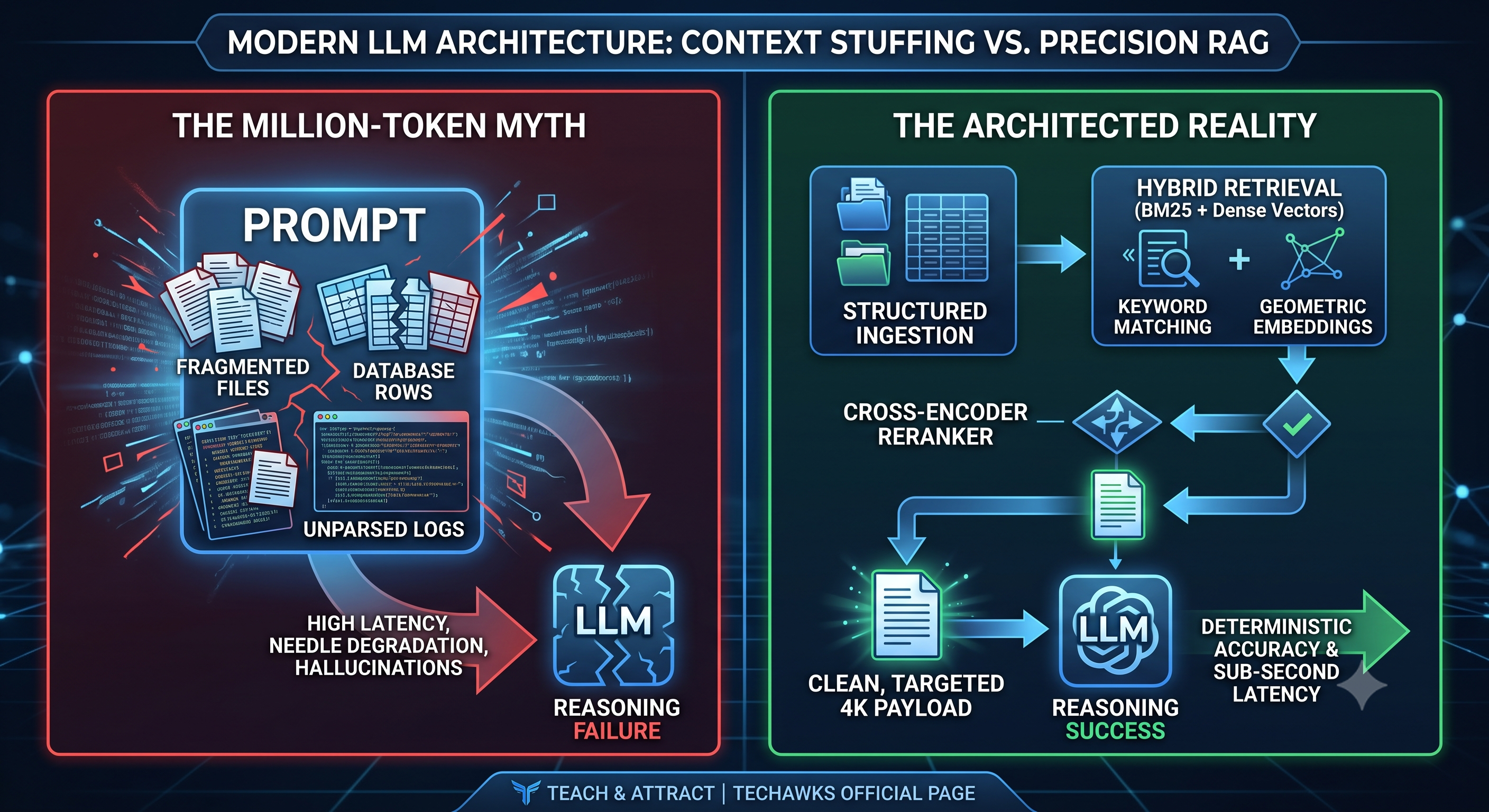
❌ The Myth: "Just dump your entire codebase, API documentation, and database logs directly into the prompt. The model will sort it out."
✅ The Reality: The bottleneck in production AI has shifted from context capacity to attention degradation, latency, and cost.
Why Context Stuffing Fails in Enterprise Systems:
The "Lost-in-the-Middle" Phenomenon: Even cutting-edge frontier models experience retrieval degradation when critical data is buried inside massive contexts. Attention is not uniformly distributed across a 1M-token sequence.
Context Poisoning & Hallucination Vectors: Every irrelevant token introduced into the context increases the probability space of conflicting instructions and phantom dependencies. Irrelevant data acts as signal interference, not enrichment.
The Latency and Token Tax: Processing a million tokens per query slows First-Token-Time (TTFT) and multiplies API bills, turning a microsecond sub-routine into an expensive synchronous bottleneck.
The Architectural Shift: Smart Routing > Brute-Force Context
High-reliability AI systems aren't built on massive context dumping. They rely on hybrid retrieval:
Deterministic Hierarchies: Use metadata filtering, hybrid search (dense embeddings + BM25), and rerankers (e.g., cross-encoders) before prompt injection.
Agentic Chunking: Let autonomous sub-agents fetch structured, minimal payloads rather than global state dumps.
Stateful Memory Caching: Leverage prompt caching and structured scratchpads rather than re-streaming entire historical states per turn.
The takeaway: A 2M context window is an incredible buffer for long-form synthesis, but it is not a substitute for disciplined software architecture. Context is memory—and unfiltered memory is just noise.
Discussion Question
Have you tested your pipelines at deep context lengths? Where did you see retrieval and reasoning start to degrade first—latency, accuracy, or cost?
CTA (Join Techawks General Community)
Join the Techawks General Community to discuss production architectures, real-world deployment challenges, and deep-dive technical benchmarks with builders worldwide.
As model context windows balloon into the millions, a persistent industry myth has taken hold across product teams:
❌ The Myth: "Just dump your entire codebase, API documentation, and database logs directly into the prompt. The model will sort it out."
✅ The Reality: The bottleneck in production AI has shifted from context capacity to attention degradation, latency, and cost.
Why Context Stuffing Fails in Enterprise Systems:
The "Lost-in-the-Middle" Phenomenon: Even cutting-edge frontier models experience retrieval degradation when critical data is buried inside massive contexts. Attention is not uniformly distributed across a 1M-token sequence.
Context Poisoning & Hallucination Vectors: Every irrelevant token introduced into the context increases the probability space of conflicting instructions and phantom dependencies. Irrelevant data acts as signal interference, not enrichment.
The Latency and Token Tax: Processing a million tokens per query slows First-Token-Time (TTFT) and multiplies API bills, turning a microsecond sub-routine into an expensive synchronous bottleneck.
The Architectural Shift: Smart Routing > Brute-Force Context
High-reliability AI systems aren't built on massive context dumping. They rely on hybrid retrieval:
Deterministic Hierarchies: Use metadata filtering, hybrid search (dense embeddings + BM25), and rerankers (e.g., cross-encoders) before prompt injection.
Agentic Chunking: Let autonomous sub-agents fetch structured, minimal payloads rather than global state dumps.
Stateful Memory Caching: Leverage prompt caching and structured scratchpads rather than re-streaming entire historical states per turn.
The takeaway: A 2M context window is an incredible buffer for long-form synthesis, but it is not a substitute for disciplined software architecture. Context is memory—and unfiltered memory is just noise.
Discussion Question
Have you tested your pipelines at deep context lengths? Where did you see retrieval and reasoning start to degrade first—latency, accuracy, or cost?
CTA (Join Techawks General Community)
Join the Techawks General Community to discuss production architectures, real-world deployment challenges, and deep-dive technical benchmarks with builders worldwide.
The Million-Token Mirage: Why Bigger Context Windows Won't Save Bad Architecture
As model context windows balloon into the millions, a persistent industry myth has taken hold across product teams:
❌ The Myth: "Just dump your entire codebase, API documentation, and database logs directly into the prompt. The model will sort it out."
✅ The Reality: The bottleneck in production AI has shifted from context capacity to attention degradation, latency, and cost.
Why Context Stuffing Fails in Enterprise Systems:
The "Lost-in-the-Middle" Phenomenon: Even cutting-edge frontier models experience retrieval degradation when critical data is buried inside massive contexts. Attention is not uniformly distributed across a 1M-token sequence.
Context Poisoning & Hallucination Vectors: Every irrelevant token introduced into the context increases the probability space of conflicting instructions and phantom dependencies. Irrelevant data acts as signal interference, not enrichment.
The Latency and Token Tax: Processing a million tokens per query slows First-Token-Time (TTFT) and multiplies API bills, turning a microsecond sub-routine into an expensive synchronous bottleneck.
The Architectural Shift: Smart Routing > Brute-Force Context
High-reliability AI systems aren't built on massive context dumping. They rely on hybrid retrieval:
Deterministic Hierarchies: Use metadata filtering, hybrid search (dense embeddings + BM25), and rerankers (e.g., cross-encoders) before prompt injection.
Agentic Chunking: Let autonomous sub-agents fetch structured, minimal payloads rather than global state dumps.
Stateful Memory Caching: Leverage prompt caching and structured scratchpads rather than re-streaming entire historical states per turn.
The takeaway: A 2M context window is an incredible buffer for long-form synthesis, but it is not a substitute for disciplined software architecture. Context is memory—and unfiltered memory is just noise.
Discussion Question
Have you tested your pipelines at deep context lengths? Where did you see retrieval and reasoning start to degrade first—latency, accuracy, or cost?
CTA (Join Techawks General Community)
Join the Techawks General Community to discuss production architectures, real-world deployment challenges, and deep-dive technical benchmarks with builders worldwide.

 English
 Arabic
 French
 Spanish
 Deutsch
 Turkish
 Dutch
Dutch
 Italiano
 Russian
 Romaian
 Portuguese (Brazil)
 Greek
Greek