


The Flat-Rate Trap: Why Classic SaaS Pricing Is Silently Bankrupting AI Startups
Founders raised on the playbook of the 2010s are running into a structural wall:
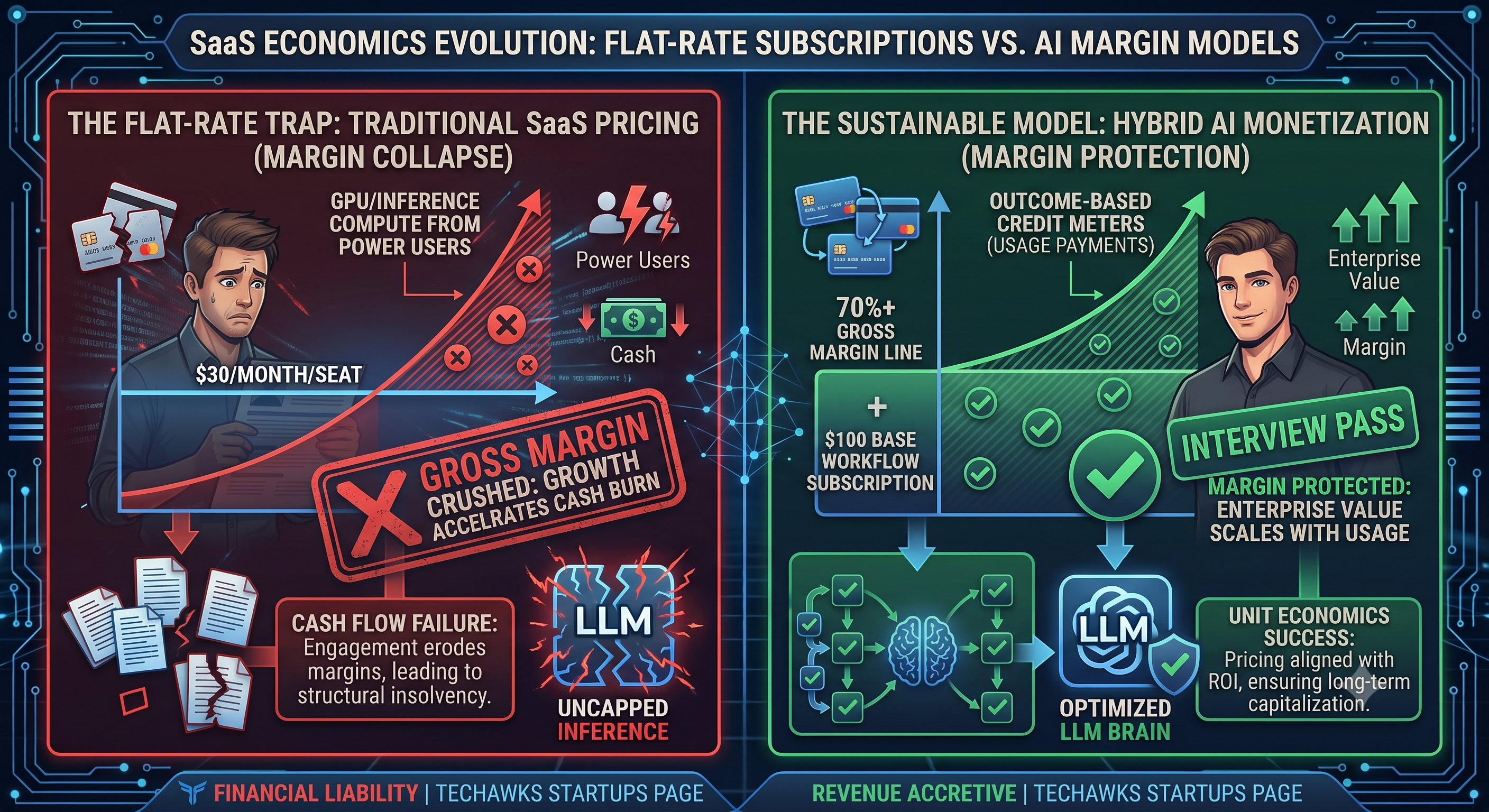
❌ The Myth: "Charge a flat $30 to $50 per-seat monthly subscription. Software has near-zero marginal cost, so more daily active users automatically equals higher margins and enterprise valuation."
✅ The Reality: In traditional SaaS, the marginal cost of serving user number 10,000 was effectively zero. In AI-native applications, growth without metered unit economics scales cost faster than revenue. Power users don't boost your bottom line—they erode your gross margins.
The Anatomy of the Margin Collapse:
The Variable Cost-of-Goods-Sold (COGS) Reality: In conventional B2B software, hosting and infrastructure make up roughly 10% to 15% of revenue, leaving gross margins of 80% to 85%. In AI-native products, inference compute, token egress, embedding lookups, and multi-agent loops sit directly inside COGS.
The Power-User Inversion: On a flat-rate tier, casual users subsidize power users. But as your core audience matures, a customer running complex multi-step agent workflows can easily cost $60/month in API/GPU compute against a $30/month subscription—turning your most engaged champions into your largest financial liabilities.
The Valuation Penalty: Late-seed and Series A investors evaluate gross margins above all else. Startups posting 40% gross margins get valued like low-margin IT services rather than high-multiple software companies.
How High-Defensibility Founders Price Today:
Decouple Platform Access from Execution Units: Move to a hybrid model. Charge a predictable base subscription for UI, workflow integrations, and seat permissions, paired with credit-based or metered billing for high-compute model invocations.
Price by Outcome, Not Just Per-Seat: Instead of billing per user seat, align pricing with delivered business units (e.g., contracts audited, tickets resolved, database schemas migrated). This anchors price to real ROI rather than raw token usage.
Implement Tiered Inference Routing: Don't route simple queries to high-cost reasoning models. Dynamically downgrade casual extraction and classification to small open-weight models, preserving expensive inference budgets only for complex reasoning tasks.
The takeaway: Building a defensible startup isn't just about owning proprietary data—it's about surviving your own product engagement. If your unit economics can't survive a power user, your business model is a liability disguised as traction.
Discussion Question
What does your gross margin look like after factoring in model inference and GPU compute? Have you shifted to hybrid or credit-based pricing, or are you still relying on flat per-seat subscriptions?
CTA (Join Startup Founders & Entrepreneurs)
Join the Startup Founders & Entrepreneurs community to benchmark unit economics, dissect real AI pricing strategies, and build defensible, capital-efficient businesses.
Founders raised on the playbook of the 2010s are running into a structural wall:
❌ The Myth: "Charge a flat $30 to $50 per-seat monthly subscription. Software has near-zero marginal cost, so more daily active users automatically equals higher margins and enterprise valuation."
✅ The Reality: In traditional SaaS, the marginal cost of serving user number 10,000 was effectively zero. In AI-native applications, growth without metered unit economics scales cost faster than revenue. Power users don't boost your bottom line—they erode your gross margins.
The Anatomy of the Margin Collapse:
The Variable Cost-of-Goods-Sold (COGS) Reality: In conventional B2B software, hosting and infrastructure make up roughly 10% to 15% of revenue, leaving gross margins of 80% to 85%. In AI-native products, inference compute, token egress, embedding lookups, and multi-agent loops sit directly inside COGS.
The Power-User Inversion: On a flat-rate tier, casual users subsidize power users. But as your core audience matures, a customer running complex multi-step agent workflows can easily cost $60/month in API/GPU compute against a $30/month subscription—turning your most engaged champions into your largest financial liabilities.
The Valuation Penalty: Late-seed and Series A investors evaluate gross margins above all else. Startups posting 40% gross margins get valued like low-margin IT services rather than high-multiple software companies.
How High-Defensibility Founders Price Today:
Decouple Platform Access from Execution Units: Move to a hybrid model. Charge a predictable base subscription for UI, workflow integrations, and seat permissions, paired with credit-based or metered billing for high-compute model invocations.
Price by Outcome, Not Just Per-Seat: Instead of billing per user seat, align pricing with delivered business units (e.g., contracts audited, tickets resolved, database schemas migrated). This anchors price to real ROI rather than raw token usage.
Implement Tiered Inference Routing: Don't route simple queries to high-cost reasoning models. Dynamically downgrade casual extraction and classification to small open-weight models, preserving expensive inference budgets only for complex reasoning tasks.
The takeaway: Building a defensible startup isn't just about owning proprietary data—it's about surviving your own product engagement. If your unit economics can't survive a power user, your business model is a liability disguised as traction.
Discussion Question
What does your gross margin look like after factoring in model inference and GPU compute? Have you shifted to hybrid or credit-based pricing, or are you still relying on flat per-seat subscriptions?
CTA (Join Startup Founders & Entrepreneurs)
Join the Startup Founders & Entrepreneurs community to benchmark unit economics, dissect real AI pricing strategies, and build defensible, capital-efficient businesses.
The Flat-Rate Trap: Why Classic SaaS Pricing Is Silently Bankrupting AI Startups
Founders raised on the playbook of the 2010s are running into a structural wall:
❌ The Myth: "Charge a flat $30 to $50 per-seat monthly subscription. Software has near-zero marginal cost, so more daily active users automatically equals higher margins and enterprise valuation."
✅ The Reality: In traditional SaaS, the marginal cost of serving user number 10,000 was effectively zero. In AI-native applications, growth without metered unit economics scales cost faster than revenue. Power users don't boost your bottom line—they erode your gross margins.
The Anatomy of the Margin Collapse:
The Variable Cost-of-Goods-Sold (COGS) Reality: In conventional B2B software, hosting and infrastructure make up roughly 10% to 15% of revenue, leaving gross margins of 80% to 85%. In AI-native products, inference compute, token egress, embedding lookups, and multi-agent loops sit directly inside COGS.
The Power-User Inversion: On a flat-rate tier, casual users subsidize power users. But as your core audience matures, a customer running complex multi-step agent workflows can easily cost $60/month in API/GPU compute against a $30/month subscription—turning your most engaged champions into your largest financial liabilities.
The Valuation Penalty: Late-seed and Series A investors evaluate gross margins above all else. Startups posting 40% gross margins get valued like low-margin IT services rather than high-multiple software companies.
How High-Defensibility Founders Price Today:
Decouple Platform Access from Execution Units: Move to a hybrid model. Charge a predictable base subscription for UI, workflow integrations, and seat permissions, paired with credit-based or metered billing for high-compute model invocations.
Price by Outcome, Not Just Per-Seat: Instead of billing per user seat, align pricing with delivered business units (e.g., contracts audited, tickets resolved, database schemas migrated). This anchors price to real ROI rather than raw token usage.
Implement Tiered Inference Routing: Don't route simple queries to high-cost reasoning models. Dynamically downgrade casual extraction and classification to small open-weight models, preserving expensive inference budgets only for complex reasoning tasks.
The takeaway: Building a defensible startup isn't just about owning proprietary data—it's about surviving your own product engagement. If your unit economics can't survive a power user, your business model is a liability disguised as traction.
Discussion Question
What does your gross margin look like after factoring in model inference and GPU compute? Have you shifted to hybrid or credit-based pricing, or are you still relying on flat per-seat subscriptions?
CTA (Join Startup Founders & Entrepreneurs)
Join the Startup Founders & Entrepreneurs community to benchmark unit economics, dissect real AI pricing strategies, and build defensible, capital-efficient businesses.

 English
 Arabic
 French
 Spanish
 Portuguese
 Deutsch
 Turkish
 Dutch
Dutch
 Italiano
 Russian
 Portuguese (Brazil)
 Greek
Greek