


The "Autocomplete Trap": Why Passing Your Programming Lab Isn't the Same as Learning to Code
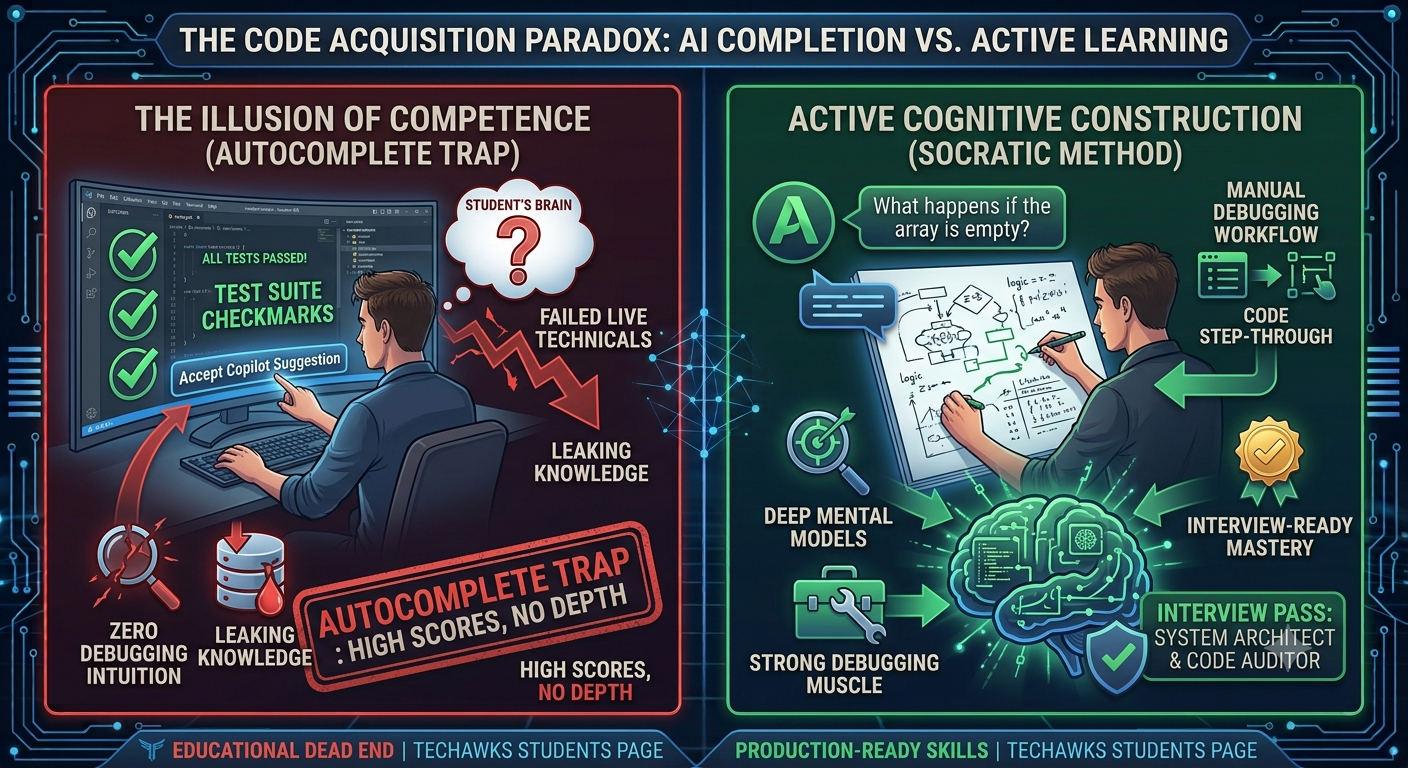
Computer science students and self-taught learners are falling into a deceptive educational trap:
❌ The Myth: "Using an AI assistant to write functions and fix runtime bugs helps me learn faster because I see working code immediately."
✅ The Reality: Completing an assignment quickly is not evidence of learning. Empirical research reveals that heavy AI code generation leads to cognitive offloading—students complete tasks with higher initial scores, but perform up to nearly two letter grades lower on independent conceptual and debugging tests.
Why Copy-Pasting AI Code Blocks Deep Learning
The Short-Circuit of the "Generation Effect": Long-term retention requires your brain to actively retrieve principles from memory. When an AI provides the solution, your brain switches to passive recognition, mistaking ease of reading for genuine comprehension.
Atrophied Debugging Intuition: Research shows the steepest drop in unaided student performance happens in debugging. Stepping through a stack trace, forming hypotheses, and isolating a broken pointer are where core systems knowledge is forged. Offloading debugging to a chatbot eliminates the very feedback loop that makes you an engineer.
The Blind Spot for Architecture: AI defaults to isolated, localized fixes. Relying on it prevents students from grasping how modules interact, how memory is allocated, and how algorithmic complexity scales.
How High-Performing Students Use AI as a Socratic Tutor
Stop treating AI like an oracle that produces the final answer. Turn it into a personal professor:
The "Don't Give Me the Code" Prompt: Before asking a question, explicitly instruct the model: "Explain the concept or bug conceptually using pseudocode and analogies, but do not write any executable code for me."
The Rubber-Duck Inversion: Write the code yourself, then paste it into the AI and prompt: "Critique my time/space complexity and point out potential edge-case failures without fixing them."
The Pen-and-Paper Check: Before typing a single line into your IDE, trace your logic on paper with sample inputs. If you cannot trace your algorithm manually, you are relying on autocomplete rather than understanding.
The takeaway: Anyone can prompt a model to write a binary search. The industry pays engineers who understand memory layouts, race conditions, and edge cases when the AI gets it wrong.
Discussion Question
When you run into a compiler error or logic bug, what is your immediate instinct—step through the debugger manually, or paste the error directly into an AI chat?
CTA (Join Students in Tech)
Join the Students in Tech community to exchange study roadmaps, collaborate on genuine open-source projects, and build rock-solid computer science fundamentals.
Computer science students and self-taught learners are falling into a deceptive educational trap:
❌ The Myth: "Using an AI assistant to write functions and fix runtime bugs helps me learn faster because I see working code immediately."
✅ The Reality: Completing an assignment quickly is not evidence of learning. Empirical research reveals that heavy AI code generation leads to cognitive offloading—students complete tasks with higher initial scores, but perform up to nearly two letter grades lower on independent conceptual and debugging tests.
Why Copy-Pasting AI Code Blocks Deep Learning
The Short-Circuit of the "Generation Effect": Long-term retention requires your brain to actively retrieve principles from memory. When an AI provides the solution, your brain switches to passive recognition, mistaking ease of reading for genuine comprehension.
Atrophied Debugging Intuition: Research shows the steepest drop in unaided student performance happens in debugging. Stepping through a stack trace, forming hypotheses, and isolating a broken pointer are where core systems knowledge is forged. Offloading debugging to a chatbot eliminates the very feedback loop that makes you an engineer.
The Blind Spot for Architecture: AI defaults to isolated, localized fixes. Relying on it prevents students from grasping how modules interact, how memory is allocated, and how algorithmic complexity scales.
How High-Performing Students Use AI as a Socratic Tutor
Stop treating AI like an oracle that produces the final answer. Turn it into a personal professor:
The "Don't Give Me the Code" Prompt: Before asking a question, explicitly instruct the model: "Explain the concept or bug conceptually using pseudocode and analogies, but do not write any executable code for me."
The Rubber-Duck Inversion: Write the code yourself, then paste it into the AI and prompt: "Critique my time/space complexity and point out potential edge-case failures without fixing them."
The Pen-and-Paper Check: Before typing a single line into your IDE, trace your logic on paper with sample inputs. If you cannot trace your algorithm manually, you are relying on autocomplete rather than understanding.
The takeaway: Anyone can prompt a model to write a binary search. The industry pays engineers who understand memory layouts, race conditions, and edge cases when the AI gets it wrong.
Discussion Question
When you run into a compiler error or logic bug, what is your immediate instinct—step through the debugger manually, or paste the error directly into an AI chat?
CTA (Join Students in Tech)
Join the Students in Tech community to exchange study roadmaps, collaborate on genuine open-source projects, and build rock-solid computer science fundamentals.
The "Autocomplete Trap": Why Passing Your Programming Lab Isn't the Same as Learning to Code
Computer science students and self-taught learners are falling into a deceptive educational trap:
❌ The Myth: "Using an AI assistant to write functions and fix runtime bugs helps me learn faster because I see working code immediately."
✅ The Reality: Completing an assignment quickly is not evidence of learning. Empirical research reveals that heavy AI code generation leads to cognitive offloading—students complete tasks with higher initial scores, but perform up to nearly two letter grades lower on independent conceptual and debugging tests.
Why Copy-Pasting AI Code Blocks Deep Learning
The Short-Circuit of the "Generation Effect": Long-term retention requires your brain to actively retrieve principles from memory. When an AI provides the solution, your brain switches to passive recognition, mistaking ease of reading for genuine comprehension.
Atrophied Debugging Intuition: Research shows the steepest drop in unaided student performance happens in debugging. Stepping through a stack trace, forming hypotheses, and isolating a broken pointer are where core systems knowledge is forged. Offloading debugging to a chatbot eliminates the very feedback loop that makes you an engineer.
The Blind Spot for Architecture: AI defaults to isolated, localized fixes. Relying on it prevents students from grasping how modules interact, how memory is allocated, and how algorithmic complexity scales.
How High-Performing Students Use AI as a Socratic Tutor
Stop treating AI like an oracle that produces the final answer. Turn it into a personal professor:
The "Don't Give Me the Code" Prompt: Before asking a question, explicitly instruct the model: "Explain the concept or bug conceptually using pseudocode and analogies, but do not write any executable code for me."
The Rubber-Duck Inversion: Write the code yourself, then paste it into the AI and prompt: "Critique my time/space complexity and point out potential edge-case failures without fixing them."
The Pen-and-Paper Check: Before typing a single line into your IDE, trace your logic on paper with sample inputs. If you cannot trace your algorithm manually, you are relying on autocomplete rather than understanding.
The takeaway: Anyone can prompt a model to write a binary search. The industry pays engineers who understand memory layouts, race conditions, and edge cases when the AI gets it wrong.
Discussion Question
When you run into a compiler error or logic bug, what is your immediate instinct—step through the debugger manually, or paste the error directly into an AI chat?
CTA (Join Students in Tech)
Join the Students in Tech community to exchange study roadmaps, collaborate on genuine open-source projects, and build rock-solid computer science fundamentals.

 English
 Arabic
 French
 Spanish
 Portuguese
 Deutsch
 Dutch
Dutch
 Italiano
 Russian
 Romaian
 Portuguese (Brazil)
 Greek
Greek