


The MFA Fallacy: Why Adversary-in-the-Middle (AiTM) Attacks Bypass 2FA Without Guessing a Single Code
Across security operations and everyday engineering, a dangerous sense of false safety remains:
❌ The Myth: "As long as an account has MFA enabled—whether via SMS, an authenticator app, or push approvals—credentials cannot be phished."
✅ The Reality: Standard MFA protects against static credential replay, but it offers zero native defense against Adversary-in-the-Middle (AiTM) proxy phishing and session token theft.
How AiTM Phishing Bypasses MFA in Real Time:
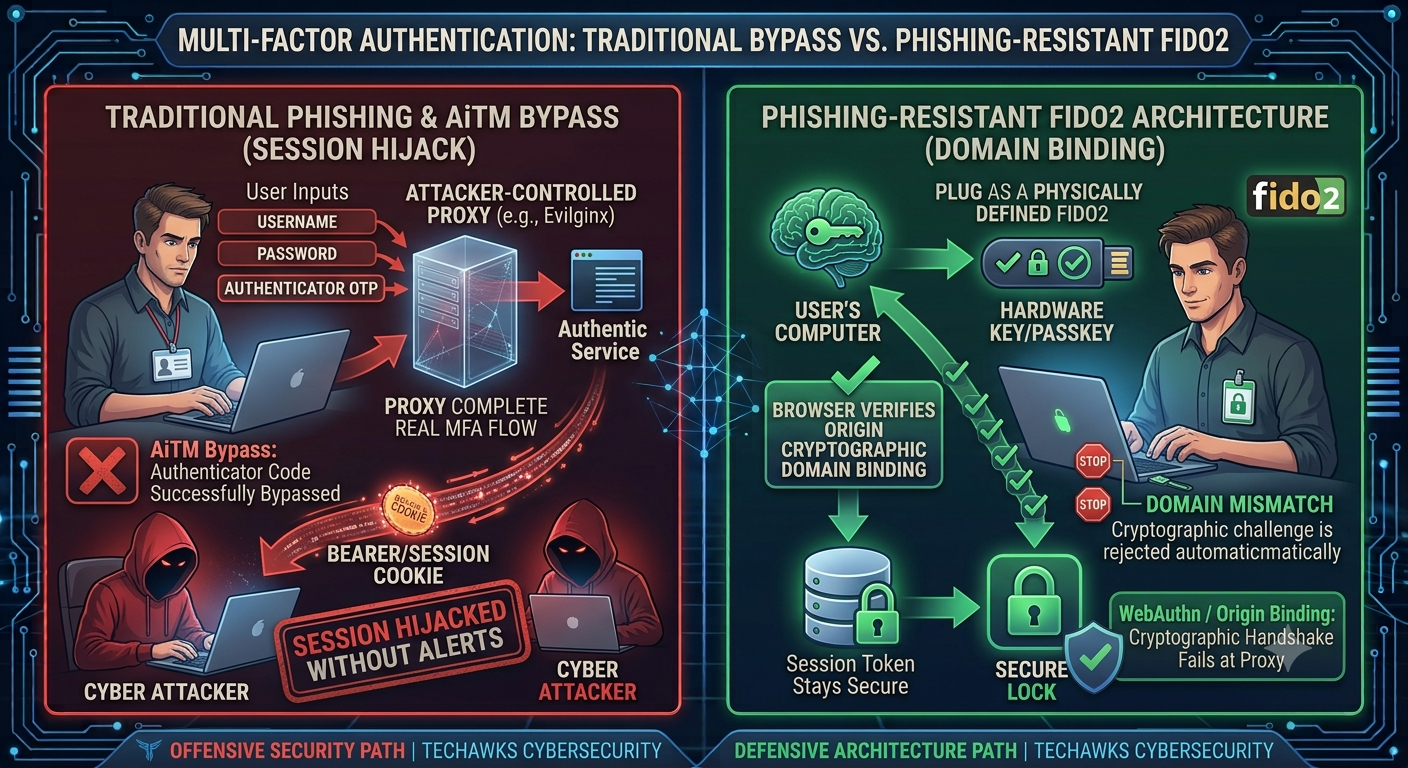
The Reverse Proxy Interception: Instead of serving a static fake page, toolkits (such as Evilginx) sit transparently between the victim and the legitimate authentication server.
Real Authentication Execution: The victim enters their username, password, and real one-time code (OTP). The proxy immediately forwards these inputs to the real service, which validates them and completes authentication.
Session Cookie Exfiltration: Upon successful login, the legitimate platform issues an HTTP session/bearer cookie back to the client. The AiTM proxy intercepts this token, stores it, and sends the user to a benign landing page.
Instant Session Hijacking: The attacker imports the stolen session token directly into their browser. Because the service sees a valid, authenticated session cookie, no password or MFA prompt is ever triggered, giving the attacker immediate access to your inbox, cloud consoles, or internal infrastructure.
Defensive Architecture: How to Protect Sessions
Enforce FIDO2 / Passkeys (WebAuthn): Hardware security keys (e.g., YubiKeys) and platform passkeys use origin-bound cryptographic handshakes. The browser automatically checks the domain name; if the URL points to a proxy rather than the genuine origin, the key simply refuses to sign the authentication challenge.
Cryptographic Token Binding (DPoP): Implement Demonstrating Proof-of-Possession (DPoP) or mTLS token binding for APIs and cloud sessions. This binds the bearer token to a specific client private key, ensuring a stolen cookie is useless on an attacker's machine.
Continuous Conditional Access: Shift evaluation from point-in-time logins to continuous session monitoring. Configure Identity Providers (IdPs) to instantly revoke active sessions when device health, IP subnet, or behavioral risk profiles abruptly drift mid-session.
The takeaway: Authentication isn't a one-time transaction at the door—it's an ongoing state. If your authentication tokens aren't cryptographically bound to the physical hardware, your MFA is only as secure as the cookie in your browser.
Discussion Question
Has your organization made the jump to phishing-resistant WebAuthn/FIDO2 hardware tokens, or are you still relying on time-based one-time passwords (TOTP) and push notifications?
CTA (Join Cybersecurity & Ethical Hacking)
Join the Cybersecurity & Ethical Hacking community to dissect real-world adversary tradecraft, master defensive threat hunting, and elevate your enterprise security architecture.
Across security operations and everyday engineering, a dangerous sense of false safety remains:
❌ The Myth: "As long as an account has MFA enabled—whether via SMS, an authenticator app, or push approvals—credentials cannot be phished."
✅ The Reality: Standard MFA protects against static credential replay, but it offers zero native defense against Adversary-in-the-Middle (AiTM) proxy phishing and session token theft.
How AiTM Phishing Bypasses MFA in Real Time:
The Reverse Proxy Interception: Instead of serving a static fake page, toolkits (such as Evilginx) sit transparently between the victim and the legitimate authentication server.
Real Authentication Execution: The victim enters their username, password, and real one-time code (OTP). The proxy immediately forwards these inputs to the real service, which validates them and completes authentication.
Session Cookie Exfiltration: Upon successful login, the legitimate platform issues an HTTP session/bearer cookie back to the client. The AiTM proxy intercepts this token, stores it, and sends the user to a benign landing page.
Instant Session Hijacking: The attacker imports the stolen session token directly into their browser. Because the service sees a valid, authenticated session cookie, no password or MFA prompt is ever triggered, giving the attacker immediate access to your inbox, cloud consoles, or internal infrastructure.
Defensive Architecture: How to Protect Sessions
Enforce FIDO2 / Passkeys (WebAuthn): Hardware security keys (e.g., YubiKeys) and platform passkeys use origin-bound cryptographic handshakes. The browser automatically checks the domain name; if the URL points to a proxy rather than the genuine origin, the key simply refuses to sign the authentication challenge.
Cryptographic Token Binding (DPoP): Implement Demonstrating Proof-of-Possession (DPoP) or mTLS token binding for APIs and cloud sessions. This binds the bearer token to a specific client private key, ensuring a stolen cookie is useless on an attacker's machine.
Continuous Conditional Access: Shift evaluation from point-in-time logins to continuous session monitoring. Configure Identity Providers (IdPs) to instantly revoke active sessions when device health, IP subnet, or behavioral risk profiles abruptly drift mid-session.
The takeaway: Authentication isn't a one-time transaction at the door—it's an ongoing state. If your authentication tokens aren't cryptographically bound to the physical hardware, your MFA is only as secure as the cookie in your browser.
Discussion Question
Has your organization made the jump to phishing-resistant WebAuthn/FIDO2 hardware tokens, or are you still relying on time-based one-time passwords (TOTP) and push notifications?
CTA (Join Cybersecurity & Ethical Hacking)
Join the Cybersecurity & Ethical Hacking community to dissect real-world adversary tradecraft, master defensive threat hunting, and elevate your enterprise security architecture.
The MFA Fallacy: Why Adversary-in-the-Middle (AiTM) Attacks Bypass 2FA Without Guessing a Single Code
Across security operations and everyday engineering, a dangerous sense of false safety remains:
❌ The Myth: "As long as an account has MFA enabled—whether via SMS, an authenticator app, or push approvals—credentials cannot be phished."
✅ The Reality: Standard MFA protects against static credential replay, but it offers zero native defense against Adversary-in-the-Middle (AiTM) proxy phishing and session token theft.
How AiTM Phishing Bypasses MFA in Real Time:
The Reverse Proxy Interception: Instead of serving a static fake page, toolkits (such as Evilginx) sit transparently between the victim and the legitimate authentication server.
Real Authentication Execution: The victim enters their username, password, and real one-time code (OTP). The proxy immediately forwards these inputs to the real service, which validates them and completes authentication.
Session Cookie Exfiltration: Upon successful login, the legitimate platform issues an HTTP session/bearer cookie back to the client. The AiTM proxy intercepts this token, stores it, and sends the user to a benign landing page.
Instant Session Hijacking: The attacker imports the stolen session token directly into their browser. Because the service sees a valid, authenticated session cookie, no password or MFA prompt is ever triggered, giving the attacker immediate access to your inbox, cloud consoles, or internal infrastructure.
Defensive Architecture: How to Protect Sessions
Enforce FIDO2 / Passkeys (WebAuthn): Hardware security keys (e.g., YubiKeys) and platform passkeys use origin-bound cryptographic handshakes. The browser automatically checks the domain name; if the URL points to a proxy rather than the genuine origin, the key simply refuses to sign the authentication challenge.
Cryptographic Token Binding (DPoP): Implement Demonstrating Proof-of-Possession (DPoP) or mTLS token binding for APIs and cloud sessions. This binds the bearer token to a specific client private key, ensuring a stolen cookie is useless on an attacker's machine.
Continuous Conditional Access: Shift evaluation from point-in-time logins to continuous session monitoring. Configure Identity Providers (IdPs) to instantly revoke active sessions when device health, IP subnet, or behavioral risk profiles abruptly drift mid-session.
The takeaway: Authentication isn't a one-time transaction at the door—it's an ongoing state. If your authentication tokens aren't cryptographically bound to the physical hardware, your MFA is only as secure as the cookie in your browser.
Discussion Question
Has your organization made the jump to phishing-resistant WebAuthn/FIDO2 hardware tokens, or are you still relying on time-based one-time passwords (TOTP) and push notifications?
CTA (Join Cybersecurity & Ethical Hacking)
Join the Cybersecurity & Ethical Hacking community to dissect real-world adversary tradecraft, master defensive threat hunting, and elevate your enterprise security architecture.

 English
 Arabic
 French
 Spanish
 Portuguese
 Deutsch
 Turkish
 Dutch
Dutch
 Russian
 Romaian
 Portuguese (Brazil)
 Greek
Greek