


The Lakehouse Illusion: Why Open Table Formats Won’t Fix Broken Data Modeling
As open lakehouse architectures become the enterprise standard, a pervasive misconception has spread across analytics teams:
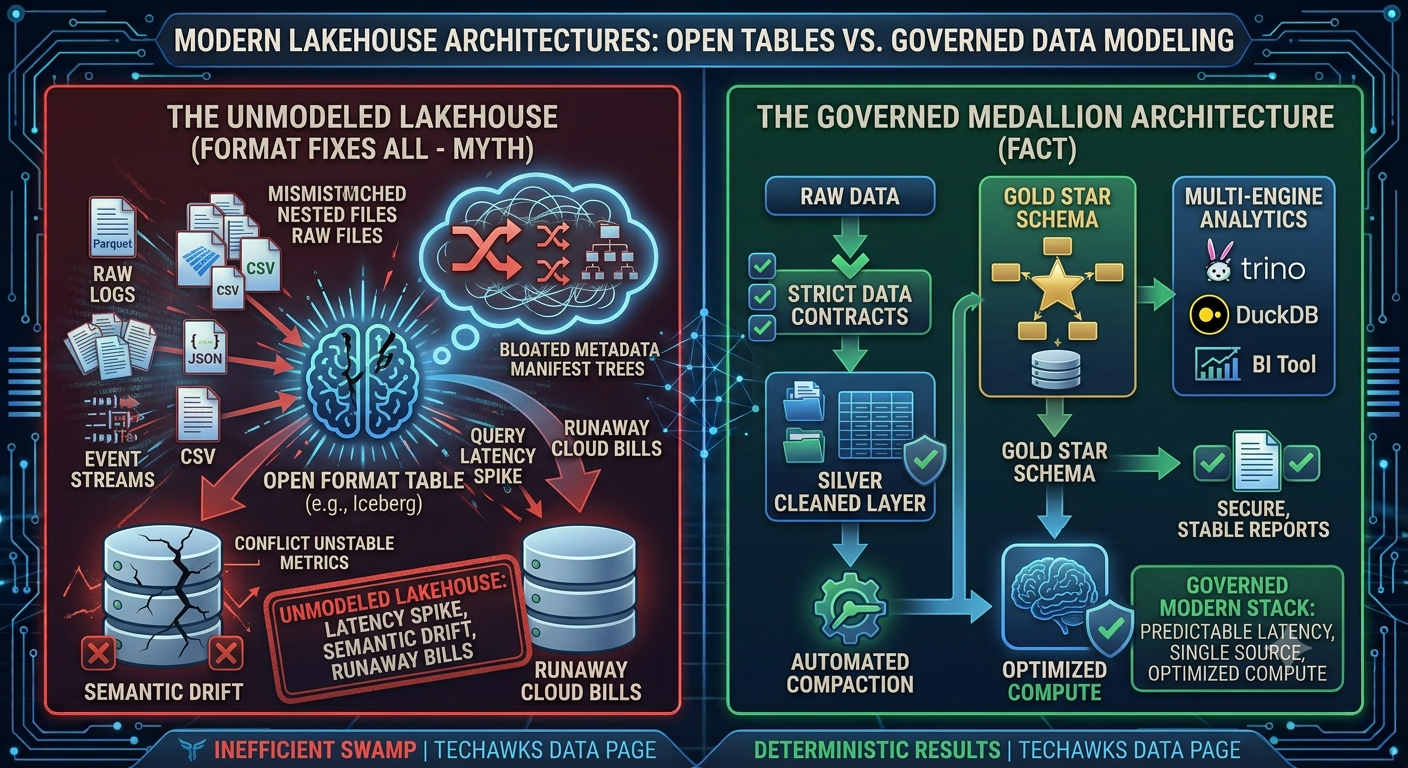
❌ The Myth: "Just dump raw Parquet into an open table format like Apache Iceberg. With ACID transactions, hidden partitioning, and zero-copy engine interoperability, you don't need dimensional modeling or structured semantic layers anymore."
✅ The Reality: Open formats solve file-level coordination and catalog lock-in, but querying unmodeled data lakes creates compute-heavy runtimes, runaway cloud bills, and conflicting business metrics.
Where the "Format Fixes All" Mindset Fails:
The Join Explosion Tax: Open table formats track file manifests and column min/max statistics with high efficiency. However, when analysts run 8-way joins across raw nested event logs to calculate simple churn rates, the underlying compute engine (whether Trino, DuckDB, or Snowflake) still burns through memory and network bandwidth shuffling unindexed petabytes.
Metadata Bloat & Small File Creep: Without disciplined compaction and scheduled snapshot expiration, append-heavy streaming pipelines cause metadata trees to explode. Query engines end up spending more time traversing JSON/Avro manifest lists during scan planning than reading actual Parquet records.
Metric Drift Across Engines: The promise of open formats is engine neutrality (e.g., query the same table via Spark, DuckDB, or a cloud warehouse). But without a standardized semantic layer on top, three different teams will write three variations of the same business metric across those engines—returning conflicting numbers to leadership.
The Analytics Architecture That Actually Scales:
Decouple Storage Standards from Semantic Truth: Use open formats (like Iceberg) to prevent vendor lock-in at the storage layer, but enforce strict Medallion principles (Bronze >>> Silver >>> Gold) with curated dimensional schemas (Kimball star schemas or One Big Table designs) for the presentation layer.
utomate Storage Hygiene: Schedule recurring background compaction (bin-packing small Parquet files into optimal 128MB–512MB chunks) and purge historical snapshots to keep manifest scan planning O(1).
Enforce Upstream Data Contracts: Catch schema drift, null violations, and type mismatches at the ingestion boundary before malformed records pollute downstream silver and gold layers.
The takeaway: A high-performance storage format only changes how data is stored and committed; it doesn't change what questions your business can ask efficiently. Without structured modeling, you haven't built a modern lakehouse—you've just organized your data swamp.
Discussion Question
Is your team managing lakehouse performance at the storage level (file compaction, partitioning) or through upstream data modeling and semantic layers? Where do your bottlenecks hit hardest?
CTA (Join Data Science & Analytics)
Join the Data Science & Analytics community to compare modern lakehouse architectures, master advanced SQL/modeling patterns, and build reliable analytics pipelines alongside global practitioners.
As open lakehouse architectures become the enterprise standard, a pervasive misconception has spread across analytics teams:
❌ The Myth: "Just dump raw Parquet into an open table format like Apache Iceberg. With ACID transactions, hidden partitioning, and zero-copy engine interoperability, you don't need dimensional modeling or structured semantic layers anymore."
✅ The Reality: Open formats solve file-level coordination and catalog lock-in, but querying unmodeled data lakes creates compute-heavy runtimes, runaway cloud bills, and conflicting business metrics.
Where the "Format Fixes All" Mindset Fails:
The Join Explosion Tax: Open table formats track file manifests and column min/max statistics with high efficiency. However, when analysts run 8-way joins across raw nested event logs to calculate simple churn rates, the underlying compute engine (whether Trino, DuckDB, or Snowflake) still burns through memory and network bandwidth shuffling unindexed petabytes.
Metadata Bloat & Small File Creep: Without disciplined compaction and scheduled snapshot expiration, append-heavy streaming pipelines cause metadata trees to explode. Query engines end up spending more time traversing JSON/Avro manifest lists during scan planning than reading actual Parquet records.
Metric Drift Across Engines: The promise of open formats is engine neutrality (e.g., query the same table via Spark, DuckDB, or a cloud warehouse). But without a standardized semantic layer on top, three different teams will write three variations of the same business metric across those engines—returning conflicting numbers to leadership.
The Analytics Architecture That Actually Scales:
Decouple Storage Standards from Semantic Truth: Use open formats (like Iceberg) to prevent vendor lock-in at the storage layer, but enforce strict Medallion principles (Bronze >>> Silver >>> Gold) with curated dimensional schemas (Kimball star schemas or One Big Table designs) for the presentation layer.
utomate Storage Hygiene: Schedule recurring background compaction (bin-packing small Parquet files into optimal 128MB–512MB chunks) and purge historical snapshots to keep manifest scan planning O(1).
Enforce Upstream Data Contracts: Catch schema drift, null violations, and type mismatches at the ingestion boundary before malformed records pollute downstream silver and gold layers.
The takeaway: A high-performance storage format only changes how data is stored and committed; it doesn't change what questions your business can ask efficiently. Without structured modeling, you haven't built a modern lakehouse—you've just organized your data swamp.
Discussion Question
Is your team managing lakehouse performance at the storage level (file compaction, partitioning) or through upstream data modeling and semantic layers? Where do your bottlenecks hit hardest?
CTA (Join Data Science & Analytics)
Join the Data Science & Analytics community to compare modern lakehouse architectures, master advanced SQL/modeling patterns, and build reliable analytics pipelines alongside global practitioners.
The Lakehouse Illusion: Why Open Table Formats Won’t Fix Broken Data Modeling
As open lakehouse architectures become the enterprise standard, a pervasive misconception has spread across analytics teams:
❌ The Myth: "Just dump raw Parquet into an open table format like Apache Iceberg. With ACID transactions, hidden partitioning, and zero-copy engine interoperability, you don't need dimensional modeling or structured semantic layers anymore."
✅ The Reality: Open formats solve file-level coordination and catalog lock-in, but querying unmodeled data lakes creates compute-heavy runtimes, runaway cloud bills, and conflicting business metrics.
Where the "Format Fixes All" Mindset Fails:
The Join Explosion Tax: Open table formats track file manifests and column min/max statistics with high efficiency. However, when analysts run 8-way joins across raw nested event logs to calculate simple churn rates, the underlying compute engine (whether Trino, DuckDB, or Snowflake) still burns through memory and network bandwidth shuffling unindexed petabytes.
Metadata Bloat & Small File Creep: Without disciplined compaction and scheduled snapshot expiration, append-heavy streaming pipelines cause metadata trees to explode. Query engines end up spending more time traversing JSON/Avro manifest lists during scan planning than reading actual Parquet records.
Metric Drift Across Engines: The promise of open formats is engine neutrality (e.g., query the same table via Spark, DuckDB, or a cloud warehouse). But without a standardized semantic layer on top, three different teams will write three variations of the same business metric across those engines—returning conflicting numbers to leadership.
The Analytics Architecture That Actually Scales:
Decouple Storage Standards from Semantic Truth: Use open formats (like Iceberg) to prevent vendor lock-in at the storage layer, but enforce strict Medallion principles (Bronze >>> Silver >>> Gold) with curated dimensional schemas (Kimball star schemas or One Big Table designs) for the presentation layer.
utomate Storage Hygiene: Schedule recurring background compaction (bin-packing small Parquet files into optimal 128MB–512MB chunks) and purge historical snapshots to keep manifest scan planning O(1).
Enforce Upstream Data Contracts: Catch schema drift, null violations, and type mismatches at the ingestion boundary before malformed records pollute downstream silver and gold layers.
The takeaway: A high-performance storage format only changes how data is stored and committed; it doesn't change what questions your business can ask efficiently. Without structured modeling, you haven't built a modern lakehouse—you've just organized your data swamp.
Discussion Question
Is your team managing lakehouse performance at the storage level (file compaction, partitioning) or through upstream data modeling and semantic layers? Where do your bottlenecks hit hardest?
CTA (Join Data Science & Analytics)
Join the Data Science & Analytics community to compare modern lakehouse architectures, master advanced SQL/modeling patterns, and build reliable analytics pipelines alongside global practitioners.

 English
 Arabic
 French
 Portuguese
 Deutsch
 Turkish
 Dutch
Dutch
 Italiano
 Russian
 Romaian
 Portuguese (Brazil)
 Greek
Greek