


The Autoscaling Paradox: Why CPU-Based HPA Is Causing Outages Instead of Preventing Them
Across cloud platforms and Kubernetes clusters, a dangerous operations myth remains standard practice:
❌ The Myth: "Just attach an HPA targeting 60%–70% average CPU utilization to every deployment. If traffic surges, pods scale out, load distributes, and our service remains highly available."
✅ The Reality: HPA solves only one specific problem: throughput degradation in stateless, fast-starting workloads. When applied blindly, it masks underlying memory leaks, creates severe cold-start stampedes, and exhausts downstream database pools.
Why CPU-Driven Autoscaling Fails in Production:
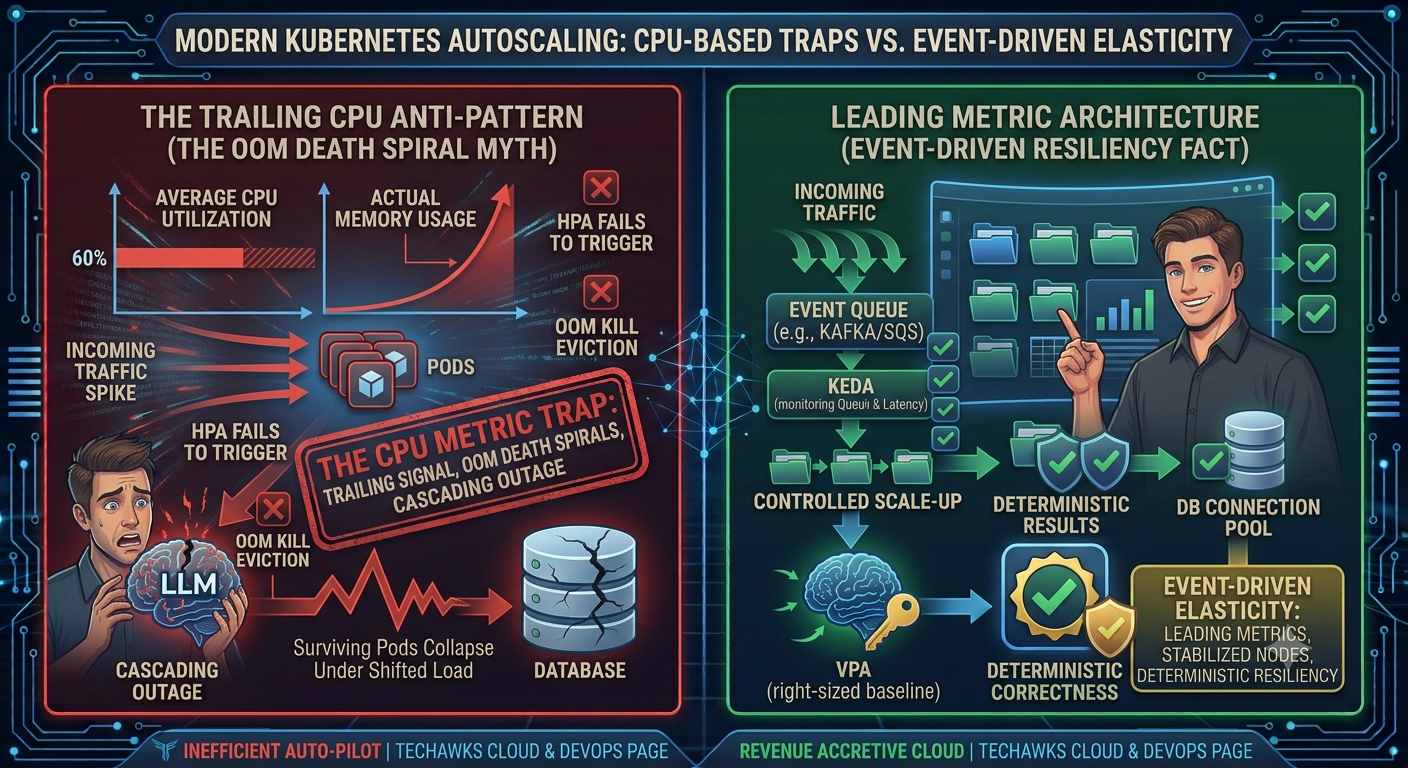
The Out-Of-Memory (OOM) Death Spiral: If your workload bottlenecks on memory allocation or an unoptimized query, CPU usage often stays flat or drops as threads block waiting on I/O. HPA will not trigger because CPU thresholds aren't crossed. The pods then hit their memory limits, get killed by the Linux OOM-killer, drop out of the endpoint pool, and shift remaining load onto surviving replicas—triggering a cluster-wide restart cascade.
Cold-Start Amplification Under Burst Load: New container pods do not handle traffic instantaneously. Between scheduling, image pulling, runtime init (e.g., JVM warm-up or node modules initialization), and readiness checks, a pod can take 45–90 seconds to become healthy. During sudden traffic spikes, HPA aggressively orders 20 new pods, saturating cluster nodes with scheduling contention while the existing pods continue to crash under load.
The Downstream Connection Starvation: Doubling or tripling your pod replicas simultaneously multiplies active connections to downstream stateful components (Postgres pools, Redis clusters, Kafka brokers). Scaling out your compute layer without connection bounding simply pushes the bottleneck downstream, crashing your database.
The Modern Autoscaling Architecture:
Decouple HPA and VPA Roles: Do not let Vertical and Horizontal autoscalers fight over the same resource dimension. Use Vertical Pod Autoscaling (VPA) in recommendation mode to calibrate realistic memory/CPU baseline requests, and use HPA exclusively for dynamic scaling.
Scale on Leading Signals via KEDA: Transition away from generic CPU metrics. Use Kubernetes Event-driven Autoscaling (KEDA) to scale on leading indicators—such as queue lag (Kafka consumer offsets, SQS backlog depth), HTTP request rates, or P99 response latencies.
Configure Defensive Scaling Policies: Define explicit behavior blocks in your HPA manifest. Set stabilization windows (stabilizationWindowSeconds) and rate limits on scale-up/scale-down to avoid pod thrashing, and size minimum replicas (minReplicas) to absorb bursts during cold starts.
The takeaway: Scaling pods is an infrastructure intervention, not application optimization. If your autoscaling trigger doesn't reflect actual user queue saturation or application state, you aren't building elasticity—you're just automating instability.
Discussion Question
What metrics drive your production autoscalers today—generic CPU/memory averages, or custom application signals like queue depth and request latency?
CTA (Join Cloud, DevOps & Open Source)
Join the Cloud, DevOps & Open Source community to debate modern platform engineering patterns, benchmark Kubernetes autoscaling setups, and design resilient cloud architectures.
Across cloud platforms and Kubernetes clusters, a dangerous operations myth remains standard practice:
❌ The Myth: "Just attach an HPA targeting 60%–70% average CPU utilization to every deployment. If traffic surges, pods scale out, load distributes, and our service remains highly available."
✅ The Reality: HPA solves only one specific problem: throughput degradation in stateless, fast-starting workloads. When applied blindly, it masks underlying memory leaks, creates severe cold-start stampedes, and exhausts downstream database pools.
Why CPU-Driven Autoscaling Fails in Production:
The Out-Of-Memory (OOM) Death Spiral: If your workload bottlenecks on memory allocation or an unoptimized query, CPU usage often stays flat or drops as threads block waiting on I/O. HPA will not trigger because CPU thresholds aren't crossed. The pods then hit their memory limits, get killed by the Linux OOM-killer, drop out of the endpoint pool, and shift remaining load onto surviving replicas—triggering a cluster-wide restart cascade.
Cold-Start Amplification Under Burst Load: New container pods do not handle traffic instantaneously. Between scheduling, image pulling, runtime init (e.g., JVM warm-up or node modules initialization), and readiness checks, a pod can take 45–90 seconds to become healthy. During sudden traffic spikes, HPA aggressively orders 20 new pods, saturating cluster nodes with scheduling contention while the existing pods continue to crash under load.
The Downstream Connection Starvation: Doubling or tripling your pod replicas simultaneously multiplies active connections to downstream stateful components (Postgres pools, Redis clusters, Kafka brokers). Scaling out your compute layer without connection bounding simply pushes the bottleneck downstream, crashing your database.
The Modern Autoscaling Architecture:
Decouple HPA and VPA Roles: Do not let Vertical and Horizontal autoscalers fight over the same resource dimension. Use Vertical Pod Autoscaling (VPA) in recommendation mode to calibrate realistic memory/CPU baseline requests, and use HPA exclusively for dynamic scaling.
Scale on Leading Signals via KEDA: Transition away from generic CPU metrics. Use Kubernetes Event-driven Autoscaling (KEDA) to scale on leading indicators—such as queue lag (Kafka consumer offsets, SQS backlog depth), HTTP request rates, or P99 response latencies.
Configure Defensive Scaling Policies: Define explicit behavior blocks in your HPA manifest. Set stabilization windows (stabilizationWindowSeconds) and rate limits on scale-up/scale-down to avoid pod thrashing, and size minimum replicas (minReplicas) to absorb bursts during cold starts.
The takeaway: Scaling pods is an infrastructure intervention, not application optimization. If your autoscaling trigger doesn't reflect actual user queue saturation or application state, you aren't building elasticity—you're just automating instability.
Discussion Question
What metrics drive your production autoscalers today—generic CPU/memory averages, or custom application signals like queue depth and request latency?
CTA (Join Cloud, DevOps & Open Source)
Join the Cloud, DevOps & Open Source community to debate modern platform engineering patterns, benchmark Kubernetes autoscaling setups, and design resilient cloud architectures.
The Autoscaling Paradox: Why CPU-Based HPA Is Causing Outages Instead of Preventing Them
Across cloud platforms and Kubernetes clusters, a dangerous operations myth remains standard practice:
❌ The Myth: "Just attach an HPA targeting 60%–70% average CPU utilization to every deployment. If traffic surges, pods scale out, load distributes, and our service remains highly available."
✅ The Reality: HPA solves only one specific problem: throughput degradation in stateless, fast-starting workloads. When applied blindly, it masks underlying memory leaks, creates severe cold-start stampedes, and exhausts downstream database pools.
Why CPU-Driven Autoscaling Fails in Production:
The Out-Of-Memory (OOM) Death Spiral: If your workload bottlenecks on memory allocation or an unoptimized query, CPU usage often stays flat or drops as threads block waiting on I/O. HPA will not trigger because CPU thresholds aren't crossed. The pods then hit their memory limits, get killed by the Linux OOM-killer, drop out of the endpoint pool, and shift remaining load onto surviving replicas—triggering a cluster-wide restart cascade.
Cold-Start Amplification Under Burst Load: New container pods do not handle traffic instantaneously. Between scheduling, image pulling, runtime init (e.g., JVM warm-up or node modules initialization), and readiness checks, a pod can take 45–90 seconds to become healthy. During sudden traffic spikes, HPA aggressively orders 20 new pods, saturating cluster nodes with scheduling contention while the existing pods continue to crash under load.
The Downstream Connection Starvation: Doubling or tripling your pod replicas simultaneously multiplies active connections to downstream stateful components (Postgres pools, Redis clusters, Kafka brokers). Scaling out your compute layer without connection bounding simply pushes the bottleneck downstream, crashing your database.
The Modern Autoscaling Architecture:
Decouple HPA and VPA Roles: Do not let Vertical and Horizontal autoscalers fight over the same resource dimension. Use Vertical Pod Autoscaling (VPA) in recommendation mode to calibrate realistic memory/CPU baseline requests, and use HPA exclusively for dynamic scaling.
Scale on Leading Signals via KEDA: Transition away from generic CPU metrics. Use Kubernetes Event-driven Autoscaling (KEDA) to scale on leading indicators—such as queue lag (Kafka consumer offsets, SQS backlog depth), HTTP request rates, or P99 response latencies.
Configure Defensive Scaling Policies: Define explicit behavior blocks in your HPA manifest. Set stabilization windows (stabilizationWindowSeconds) and rate limits on scale-up/scale-down to avoid pod thrashing, and size minimum replicas (minReplicas) to absorb bursts during cold starts.
The takeaway: Scaling pods is an infrastructure intervention, not application optimization. If your autoscaling trigger doesn't reflect actual user queue saturation or application state, you aren't building elasticity—you're just automating instability.
Discussion Question
What metrics drive your production autoscalers today—generic CPU/memory averages, or custom application signals like queue depth and request latency?
CTA (Join Cloud, DevOps & Open Source)
Join the Cloud, DevOps & Open Source community to debate modern platform engineering patterns, benchmark Kubernetes autoscaling setups, and design resilient cloud architectures.

 Arabic
 French
 Spanish
 Portuguese
 Deutsch
 Turkish
 Dutch
Dutch
 Italiano
 Russian
 Romaian
 Portuguese (Brazil)
 Greek
Greek