


Myth vs. Fact: 4 Dangerous Misconceptions About Cloud Cost Optimization
Optimizing cloud infrastructure isn't just about deleting idle EC2 instances or setting up budget alerts; it requires understanding how cloud architectures actually spend money.
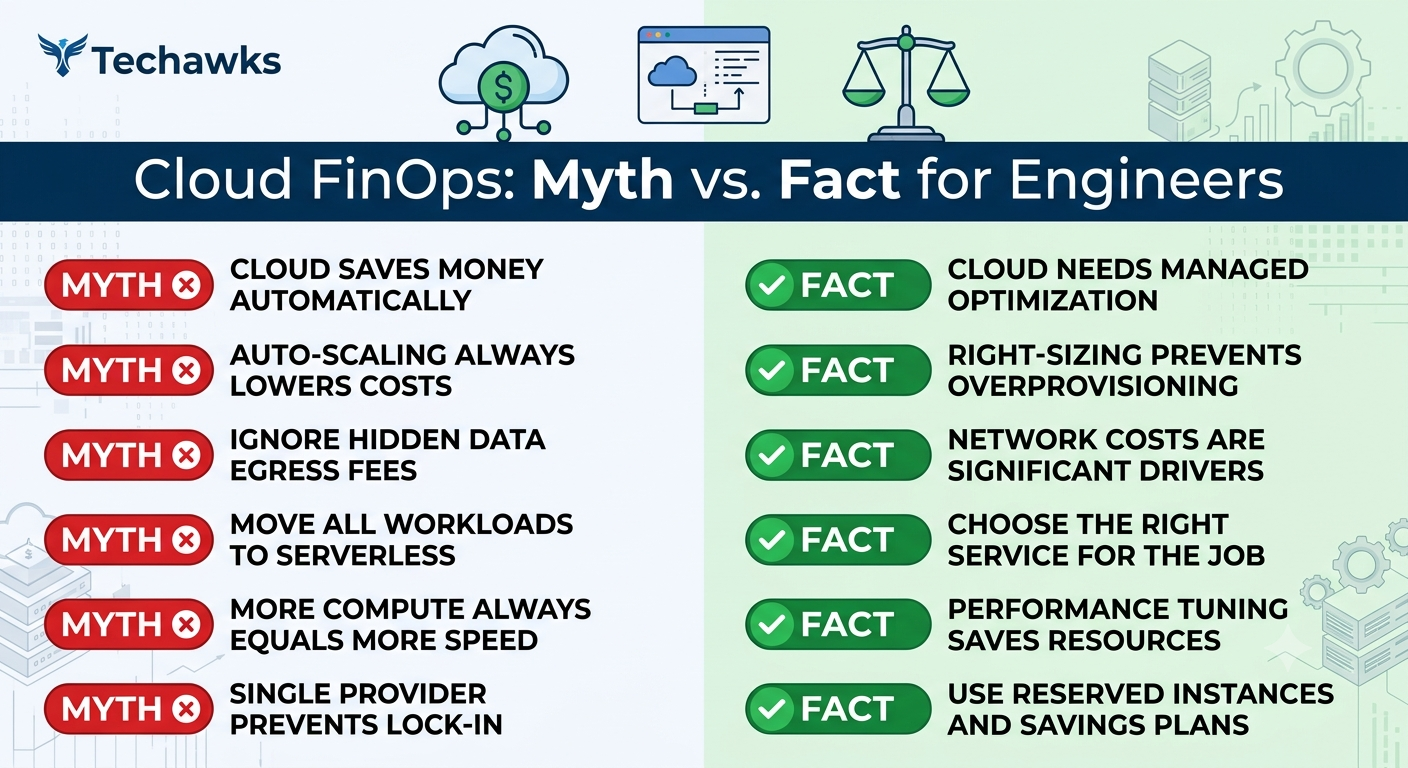
Here are four common myths that trap cloud engineers and DevOps teams:
Myth 1: Auto-Scaling Always Reduces Costs
❌ Myth: Automatically spinning up and down instances guarantees you only pay for what you need.
✅ Fact: Frequent scaling churn can actually increase costs if your scaling policies are misconfigured.
Actionable Advice: Tune your scaling thresholds with cooldown periods and use predictive scaling based on historical trends rather than reactive spike triggers.
Myth 2: Multi-Cloud Strategies Save Money Through Competition
❌ Myth: Spreading workloads across AWS, Azure, and GCP allows you to play providers against each other for cheaper compute rates.
✅ Fact: Data egress fees and cross-cloud networking complexity almost always eat up any marginal compute savings.
Actionable Advice: Stick to a single primary cloud provider for core workloads unless regulatory compliance or ultra-high availability across providers strictly demands multi-cloud.
Myth 3: Rightsizing Means Shrinking Instance Sizes
❌ Myth: Cost optimization is simply downgrading your instance sizes from xlarge to large.
✅ Fact: Changing instance families (e.g., switching from memory-optimized to compute-optimized or moving to ARM-based Graviton/Ampere processors) often yields far higher performance-per-dollar.
Actionable Advice: Profile your workloads for resource bottlenecks (CPU vs. RAM vs. I/O). Switch to modern CPU architectures (like AWS Graviton or GCP Tau T2A) before simply downgrading hardware specs.
Myth 4: Reserved Instances / Savings Plans Are a One-and-Done Fix
❌ Myth: Lock in a 3-year commitment for maximum discount and forget about it.
✅ Fact: Unused reserved capacity is wasted money, and static commitments restrict your ability to modernize your tech stack.
Actionable Advice: Maintain a blended strategy: coverage of 60–70% baseline capacity with flexible commitment models (like Compute Savings Plans) while leaving room for dynamic spot instances or serverless workloads.
Key Takeaways
Architect for efficiency: Cost optimization starts with good system design, not post-deployment cleanup.
Watch out for hidden fees: Network egress and inter-AZ data transfer are often bigger budget drivers than raw compute.
Architecture over simple downgrades: Migrating to ARM-based CPUs or modern instance generations yields better performance and cost savings than just shrinking node sizes.
CTA
💡 Want to build cost-effective, scalable cloud architectures that actually perform? Join the Techawks Cloud, DevOps & Open Source community for hands-on guides, real-world case studies, and practical DevOps tutorials.
Optimizing cloud infrastructure isn't just about deleting idle EC2 instances or setting up budget alerts; it requires understanding how cloud architectures actually spend money.
Here are four common myths that trap cloud engineers and DevOps teams:
Myth 1: Auto-Scaling Always Reduces Costs
❌ Myth: Automatically spinning up and down instances guarantees you only pay for what you need.
✅ Fact: Frequent scaling churn can actually increase costs if your scaling policies are misconfigured.
Actionable Advice: Tune your scaling thresholds with cooldown periods and use predictive scaling based on historical trends rather than reactive spike triggers.
Myth 2: Multi-Cloud Strategies Save Money Through Competition
❌ Myth: Spreading workloads across AWS, Azure, and GCP allows you to play providers against each other for cheaper compute rates.
✅ Fact: Data egress fees and cross-cloud networking complexity almost always eat up any marginal compute savings.
Actionable Advice: Stick to a single primary cloud provider for core workloads unless regulatory compliance or ultra-high availability across providers strictly demands multi-cloud.
Myth 3: Rightsizing Means Shrinking Instance Sizes
❌ Myth: Cost optimization is simply downgrading your instance sizes from xlarge to large.
✅ Fact: Changing instance families (e.g., switching from memory-optimized to compute-optimized or moving to ARM-based Graviton/Ampere processors) often yields far higher performance-per-dollar.
Actionable Advice: Profile your workloads for resource bottlenecks (CPU vs. RAM vs. I/O). Switch to modern CPU architectures (like AWS Graviton or GCP Tau T2A) before simply downgrading hardware specs.
Myth 4: Reserved Instances / Savings Plans Are a One-and-Done Fix
❌ Myth: Lock in a 3-year commitment for maximum discount and forget about it.
✅ Fact: Unused reserved capacity is wasted money, and static commitments restrict your ability to modernize your tech stack.
Actionable Advice: Maintain a blended strategy: coverage of 60–70% baseline capacity with flexible commitment models (like Compute Savings Plans) while leaving room for dynamic spot instances or serverless workloads.
Key Takeaways
Architect for efficiency: Cost optimization starts with good system design, not post-deployment cleanup.
Watch out for hidden fees: Network egress and inter-AZ data transfer are often bigger budget drivers than raw compute.
Architecture over simple downgrades: Migrating to ARM-based CPUs or modern instance generations yields better performance and cost savings than just shrinking node sizes.
CTA
💡 Want to build cost-effective, scalable cloud architectures that actually perform? Join the Techawks Cloud, DevOps & Open Source community for hands-on guides, real-world case studies, and practical DevOps tutorials.
Myth vs. Fact: 4 Dangerous Misconceptions About Cloud Cost Optimization
Optimizing cloud infrastructure isn't just about deleting idle EC2 instances or setting up budget alerts; it requires understanding how cloud architectures actually spend money.
Here are four common myths that trap cloud engineers and DevOps teams:
Myth 1: Auto-Scaling Always Reduces Costs
❌ Myth: Automatically spinning up and down instances guarantees you only pay for what you need.
✅ Fact: Frequent scaling churn can actually increase costs if your scaling policies are misconfigured.
Actionable Advice: Tune your scaling thresholds with cooldown periods and use predictive scaling based on historical trends rather than reactive spike triggers.
Myth 2: Multi-Cloud Strategies Save Money Through Competition
❌ Myth: Spreading workloads across AWS, Azure, and GCP allows you to play providers against each other for cheaper compute rates.
✅ Fact: Data egress fees and cross-cloud networking complexity almost always eat up any marginal compute savings.
Actionable Advice: Stick to a single primary cloud provider for core workloads unless regulatory compliance or ultra-high availability across providers strictly demands multi-cloud.
Myth 3: Rightsizing Means Shrinking Instance Sizes
❌ Myth: Cost optimization is simply downgrading your instance sizes from xlarge to large.
✅ Fact: Changing instance families (e.g., switching from memory-optimized to compute-optimized or moving to ARM-based Graviton/Ampere processors) often yields far higher performance-per-dollar.
Actionable Advice: Profile your workloads for resource bottlenecks (CPU vs. RAM vs. I/O). Switch to modern CPU architectures (like AWS Graviton or GCP Tau T2A) before simply downgrading hardware specs.
Myth 4: Reserved Instances / Savings Plans Are a One-and-Done Fix
❌ Myth: Lock in a 3-year commitment for maximum discount and forget about it.
✅ Fact: Unused reserved capacity is wasted money, and static commitments restrict your ability to modernize your tech stack.
Actionable Advice: Maintain a blended strategy: coverage of 60–70% baseline capacity with flexible commitment models (like Compute Savings Plans) while leaving room for dynamic spot instances or serverless workloads.
Key Takeaways
Architect for efficiency: Cost optimization starts with good system design, not post-deployment cleanup.
Watch out for hidden fees: Network egress and inter-AZ data transfer are often bigger budget drivers than raw compute.
Architecture over simple downgrades: Migrating to ARM-based CPUs or modern instance generations yields better performance and cost savings than just shrinking node sizes.
CTA
💡 Want to build cost-effective, scalable cloud architectures that actually perform? Join the Techawks Cloud, DevOps & Open Source community for hands-on guides, real-world case studies, and practical DevOps tutorials.

 English
 Arabic
 French
 Spanish
 Portuguese
 Deutsch
 Turkish
 Dutch
Dutch
 Italiano
 Russian
 Portuguese (Brazil)
 Greek
Greek