


Myth vs Fact: Is 80% Gross Margin Still the Gold Standard for Tech Startups?
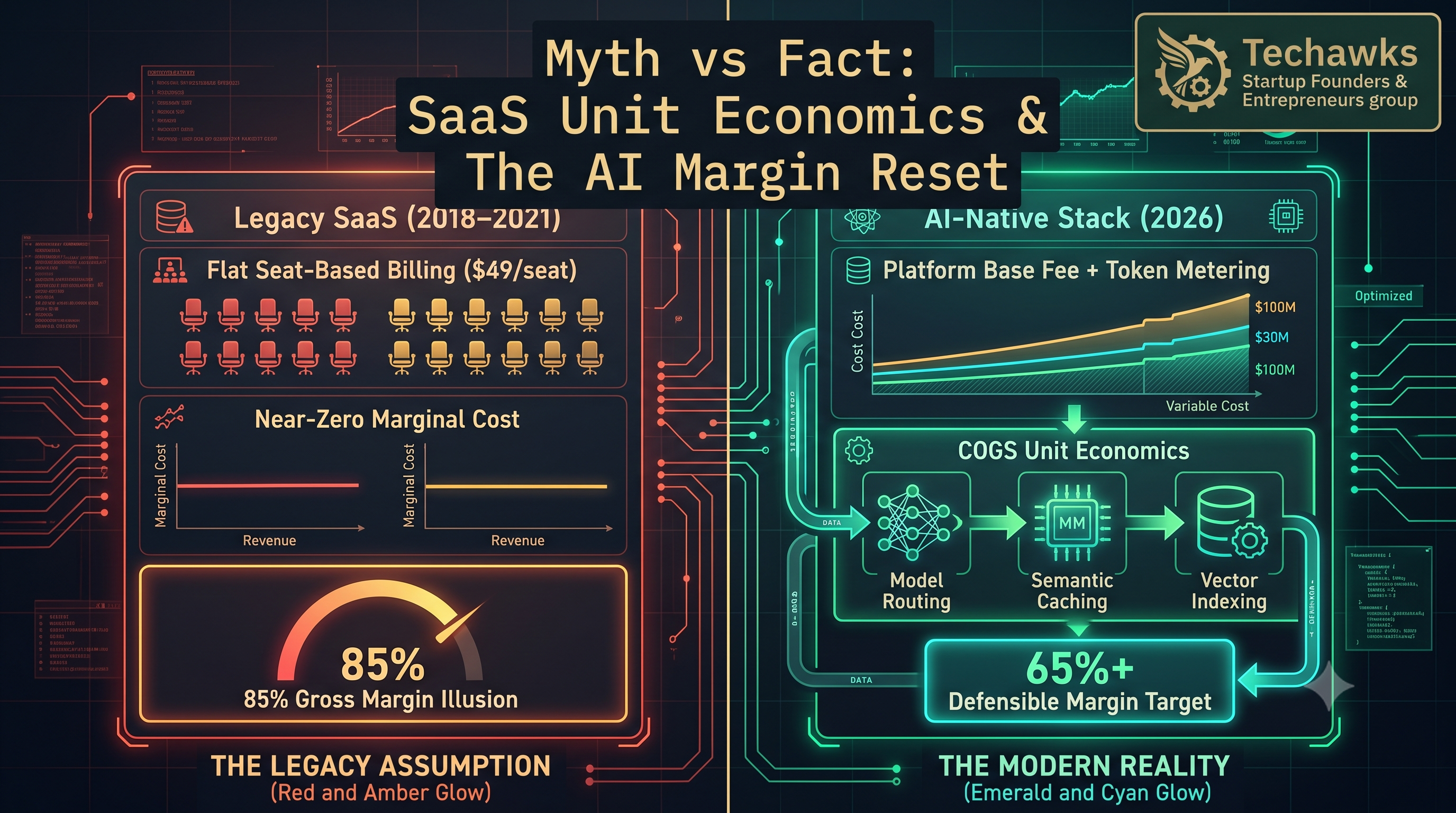
The classic definition of software profitability was near-zero marginal cost per user. With intelligent workflows, that model has broken down:
❌ Myth 1: "AI startups enjoy the same 80%+ gross margins as legacy B2B SaaS."
The Reality: Every customer interaction now incurs real, metered compute costs. Industry benchmarks show that while traditional SaaS companies maintained 75%–85% gross margins, AI-native startups average between 50% and 60% gross margins. Even when per-token API prices fall, enterprise applications add agentic multi-hop loops, semantic re-rankers, automated evaluations, and background data indexing—offsetting token price cuts and keeping structural inference costs between 4% to 9% of revenue.
❌ Myth 2: "Seat-based pricing ($49/seat/month) is still the best monetization model."
The Reality: Seat-based pricing creates a catastrophic margin mismatch for AI products. If a power user deploys autonomous agents or complex document reasoning 50 times a day, their inference compute quickly surpasses their monthly subscription price. The industry is moving rapidly toward hybrid consumption and outcome-based pricing: charging an upfront platform baseline plus metered credits, task-based billing, or value-metric pricing tied directly to completed work units.
❌ Myth 3: "Early-stage founders should ignore unit economics until Series B."
The Reality: In today’s disciplined funding climate, investors scrutinize Burn Multiples, Cost to Serve, and Gross Margin Trajectories at Seed and Series A. Treating inference compute as a generic "hosting overhead" line item instead of allocating it to customer COGS hides negative unit economics. When your customer acquisition costs (CAC) are compounded by high serving costs, scaling volume burns cash faster instead of creating operating leverage.
What Actually Works for Founders in 2026
Model Routing & Tiered Compute: Route 80% of routine user queries through fine-tuned small language models (SLMs) or cached embedding lookups, saving high-latency frontier reasoning models exclusively for complex edge cases.
Instrument Per-Customer Unit Margins: Track GPU and token spend down to individual client IDs so you can flag power users eroding your margin profile.
Build Workflow Moats, Not Wrapper Moats: Models are commodities; deep domain integration, proprietary telemetry loops, and mission-critical workflows are where defensible enterprise pricing power lives.
Discussion Question
Founders and operators: How has adding AI or automation impacted your gross margin structure? Are you sticking to flat monthly subscriptions, or have you transitioned to hybrid/usage-based pricing to protect your unit economics?
CTA
Share your lessons with the community! Drop your real-world insights, pricing experiments, or margin optimization tips in the comments below. Let’s trade notes on building durable, high-margin businesses. 🦅🚀
The classic definition of software profitability was near-zero marginal cost per user. With intelligent workflows, that model has broken down:
❌ Myth 1: "AI startups enjoy the same 80%+ gross margins as legacy B2B SaaS."
The Reality: Every customer interaction now incurs real, metered compute costs. Industry benchmarks show that while traditional SaaS companies maintained 75%–85% gross margins, AI-native startups average between 50% and 60% gross margins. Even when per-token API prices fall, enterprise applications add agentic multi-hop loops, semantic re-rankers, automated evaluations, and background data indexing—offsetting token price cuts and keeping structural inference costs between 4% to 9% of revenue.
❌ Myth 2: "Seat-based pricing ($49/seat/month) is still the best monetization model."
The Reality: Seat-based pricing creates a catastrophic margin mismatch for AI products. If a power user deploys autonomous agents or complex document reasoning 50 times a day, their inference compute quickly surpasses their monthly subscription price. The industry is moving rapidly toward hybrid consumption and outcome-based pricing: charging an upfront platform baseline plus metered credits, task-based billing, or value-metric pricing tied directly to completed work units.
❌ Myth 3: "Early-stage founders should ignore unit economics until Series B."
The Reality: In today’s disciplined funding climate, investors scrutinize Burn Multiples, Cost to Serve, and Gross Margin Trajectories at Seed and Series A. Treating inference compute as a generic "hosting overhead" line item instead of allocating it to customer COGS hides negative unit economics. When your customer acquisition costs (CAC) are compounded by high serving costs, scaling volume burns cash faster instead of creating operating leverage.
What Actually Works for Founders in 2026
Model Routing & Tiered Compute: Route 80% of routine user queries through fine-tuned small language models (SLMs) or cached embedding lookups, saving high-latency frontier reasoning models exclusively for complex edge cases.
Instrument Per-Customer Unit Margins: Track GPU and token spend down to individual client IDs so you can flag power users eroding your margin profile.
Build Workflow Moats, Not Wrapper Moats: Models are commodities; deep domain integration, proprietary telemetry loops, and mission-critical workflows are where defensible enterprise pricing power lives.
Discussion Question
Founders and operators: How has adding AI or automation impacted your gross margin structure? Are you sticking to flat monthly subscriptions, or have you transitioned to hybrid/usage-based pricing to protect your unit economics?
CTA
Share your lessons with the community! Drop your real-world insights, pricing experiments, or margin optimization tips in the comments below. Let’s trade notes on building durable, high-margin businesses. 🦅🚀
Myth vs Fact: Is 80% Gross Margin Still the Gold Standard for Tech Startups?
The classic definition of software profitability was near-zero marginal cost per user. With intelligent workflows, that model has broken down:
❌ Myth 1: "AI startups enjoy the same 80%+ gross margins as legacy B2B SaaS."
The Reality: Every customer interaction now incurs real, metered compute costs. Industry benchmarks show that while traditional SaaS companies maintained 75%–85% gross margins, AI-native startups average between 50% and 60% gross margins. Even when per-token API prices fall, enterprise applications add agentic multi-hop loops, semantic re-rankers, automated evaluations, and background data indexing—offsetting token price cuts and keeping structural inference costs between 4% to 9% of revenue.
❌ Myth 2: "Seat-based pricing ($49/seat/month) is still the best monetization model."
The Reality: Seat-based pricing creates a catastrophic margin mismatch for AI products. If a power user deploys autonomous agents or complex document reasoning 50 times a day, their inference compute quickly surpasses their monthly subscription price. The industry is moving rapidly toward hybrid consumption and outcome-based pricing: charging an upfront platform baseline plus metered credits, task-based billing, or value-metric pricing tied directly to completed work units.
❌ Myth 3: "Early-stage founders should ignore unit economics until Series B."
The Reality: In today’s disciplined funding climate, investors scrutinize Burn Multiples, Cost to Serve, and Gross Margin Trajectories at Seed and Series A. Treating inference compute as a generic "hosting overhead" line item instead of allocating it to customer COGS hides negative unit economics. When your customer acquisition costs (CAC) are compounded by high serving costs, scaling volume burns cash faster instead of creating operating leverage.
What Actually Works for Founders in 2026
Model Routing & Tiered Compute: Route 80% of routine user queries through fine-tuned small language models (SLMs) or cached embedding lookups, saving high-latency frontier reasoning models exclusively for complex edge cases.
Instrument Per-Customer Unit Margins: Track GPU and token spend down to individual client IDs so you can flag power users eroding your margin profile.
Build Workflow Moats, Not Wrapper Moats: Models are commodities; deep domain integration, proprietary telemetry loops, and mission-critical workflows are where defensible enterprise pricing power lives.
Discussion Question
Founders and operators: How has adding AI or automation impacted your gross margin structure? Are you sticking to flat monthly subscriptions, or have you transitioned to hybrid/usage-based pricing to protect your unit economics?
CTA
Share your lessons with the community! Drop your real-world insights, pricing experiments, or margin optimization tips in the comments below. Let’s trade notes on building durable, high-margin businesses. 🦅🚀

 Arabic
 French
 Spanish
 Portuguese
 Deutsch
 Turkish
 Dutch
Dutch
 Italiano
 Russian
 Romaian
 Portuguese (Brazil)
 Greek
Greek