


Can Your Feature Store Detect Training-Serving Skew in Real Time? The 24-Hour Silent Drift Challenge.
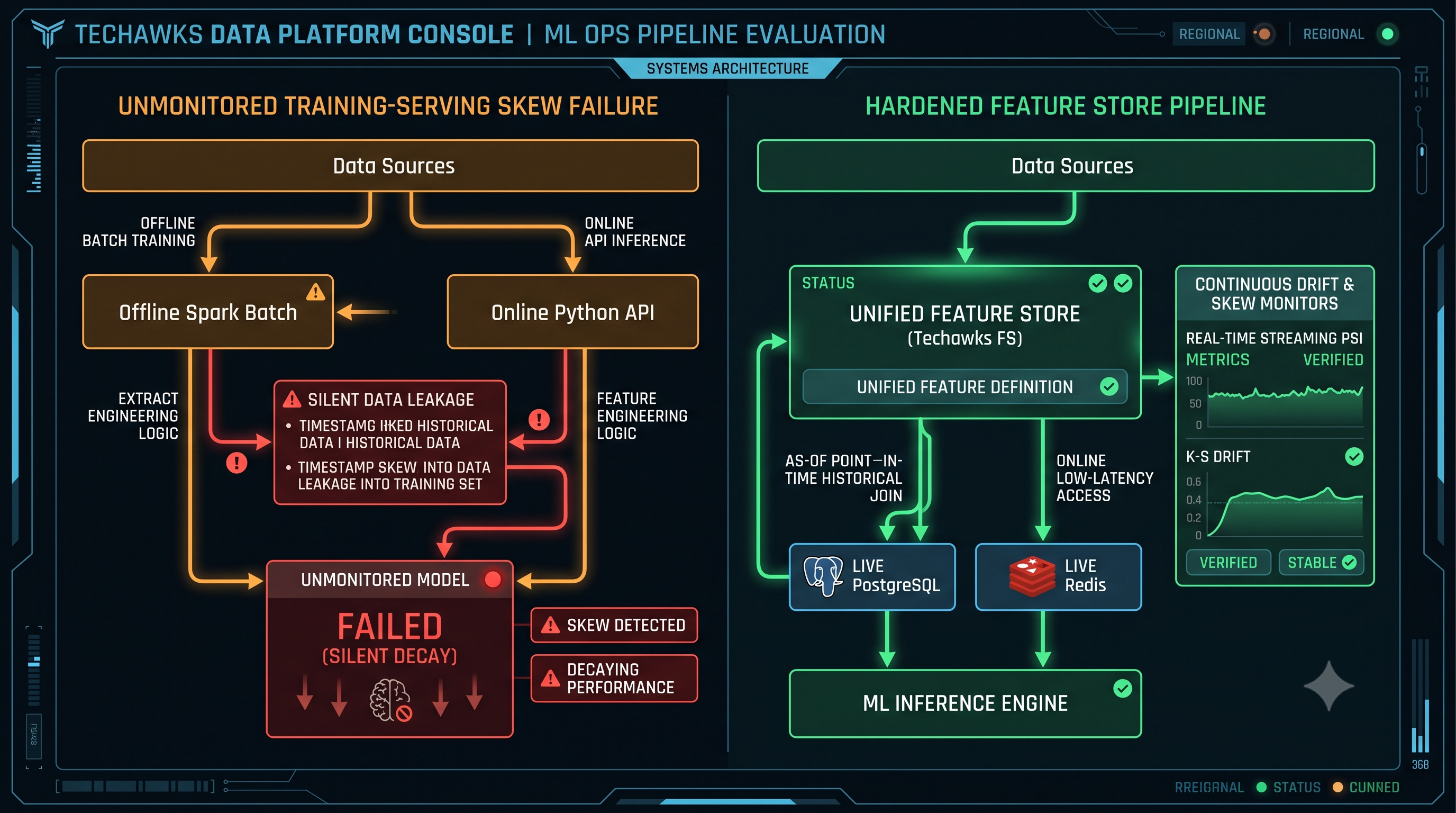
In production ML systems, raw model architecture matters far less than data consistency across the serving boundary. When offline training batches use point-in-time joins that differ even slightly from real-time streaming feature transformations, training-serving skew corrupts your inference results while pipelines report 100% health.
Take the Techawks 24-Hour Data Pipeline Challenge to audit whether your data stack catches silent feature corruption before downstream systems ingest faulty predictions:
Audit Point-in-Time Correctness (Time-Travel Joins)
The Problem: Joining feature tables on static entity IDs without strict timestamp boundaries introduces subtle data leakage from future events into historical training sets, inflating offline accuracy metrics.
The Fix: Enforce point-in-time correct joins (AS-OF joins) in your feature store. Ensure every historical training observation only joins with feature values timestamped strictly prior to the observation event.
Benchmark Online vs. Offline Transformation Parity
The Problem: Re-implementing feature logic across different runtimes—such as running SQL/Spark for batch model training and rewriting the same logic in Python/Go for real-time API inference—creates discrepancies in null handling, string tokenization, or numerical scaling.
The Fix: Unify the transformation engine using a single declarative feature definition (via Feast, Hopsworks, or dbt/DuckDB engines) that compiles identical logic for both batch backfills and low-latency key-value stores (Redis/DynamoDB).
Deploy Statistical Drift Alarms on Streaming Ingress
The Problem: Traditional monitoring tracks system health metrics (latency, HTTP 500s, CPU usage) while ignoring distributional shifts in input features (e.g., changes in mean, variance, or categorical cardinality).
The Fix: Implement streaming Kolmogorov-Smirnov (K-S) or Population Stability Index (PSI) tests on real-time inference payloads. Set automated alerts to trip when input feature distributions deviate past a 0.1 PSI threshold compared to the baseline training distribution.
Key Takeaways
Time-Travel Hygiene Is Non-Negotiable: If your training pipeline doesn't enforce strict event-timestamp joins, your offline performance metrics are compromised by data leakage.
One Feature Definition, Two Storage Engines: Never maintain two separate codebases for offline batch features and online serving lookups.
Distributional Shift Is a Critical Bug: Monitor feature data drift with the same alerting rigor applied to API latency and 5xx errors.
CTA (Invite analysis and opinions)
How does your data team guard against training-serving skew and silent pipeline drift?
Do you enforce unified feature stores (like Feast or Hopsworks), or do you rely on custom microservice transformation layers?
What statistical drift thresholds or monitoring tools (e.g., Evidently AI, Great Expectations, Whylabs) have proven most dependable in your production stack?
Share your pipeline trade-offs and battle-tested strategies below!
In production ML systems, raw model architecture matters far less than data consistency across the serving boundary. When offline training batches use point-in-time joins that differ even slightly from real-time streaming feature transformations, training-serving skew corrupts your inference results while pipelines report 100% health.
Take the Techawks 24-Hour Data Pipeline Challenge to audit whether your data stack catches silent feature corruption before downstream systems ingest faulty predictions:
Audit Point-in-Time Correctness (Time-Travel Joins)
The Problem: Joining feature tables on static entity IDs without strict timestamp boundaries introduces subtle data leakage from future events into historical training sets, inflating offline accuracy metrics.
The Fix: Enforce point-in-time correct joins (AS-OF joins) in your feature store. Ensure every historical training observation only joins with feature values timestamped strictly prior to the observation event.
Benchmark Online vs. Offline Transformation Parity
The Problem: Re-implementing feature logic across different runtimes—such as running SQL/Spark for batch model training and rewriting the same logic in Python/Go for real-time API inference—creates discrepancies in null handling, string tokenization, or numerical scaling.
The Fix: Unify the transformation engine using a single declarative feature definition (via Feast, Hopsworks, or dbt/DuckDB engines) that compiles identical logic for both batch backfills and low-latency key-value stores (Redis/DynamoDB).
Deploy Statistical Drift Alarms on Streaming Ingress
The Problem: Traditional monitoring tracks system health metrics (latency, HTTP 500s, CPU usage) while ignoring distributional shifts in input features (e.g., changes in mean, variance, or categorical cardinality).
The Fix: Implement streaming Kolmogorov-Smirnov (K-S) or Population Stability Index (PSI) tests on real-time inference payloads. Set automated alerts to trip when input feature distributions deviate past a 0.1 PSI threshold compared to the baseline training distribution.
Key Takeaways
Time-Travel Hygiene Is Non-Negotiable: If your training pipeline doesn't enforce strict event-timestamp joins, your offline performance metrics are compromised by data leakage.
One Feature Definition, Two Storage Engines: Never maintain two separate codebases for offline batch features and online serving lookups.
Distributional Shift Is a Critical Bug: Monitor feature data drift with the same alerting rigor applied to API latency and 5xx errors.
CTA (Invite analysis and opinions)
How does your data team guard against training-serving skew and silent pipeline drift?
Do you enforce unified feature stores (like Feast or Hopsworks), or do you rely on custom microservice transformation layers?
What statistical drift thresholds or monitoring tools (e.g., Evidently AI, Great Expectations, Whylabs) have proven most dependable in your production stack?
Share your pipeline trade-offs and battle-tested strategies below!
Can Your Feature Store Detect Training-Serving Skew in Real Time? The 24-Hour Silent Drift Challenge.
In production ML systems, raw model architecture matters far less than data consistency across the serving boundary. When offline training batches use point-in-time joins that differ even slightly from real-time streaming feature transformations, training-serving skew corrupts your inference results while pipelines report 100% health.
Take the Techawks 24-Hour Data Pipeline Challenge to audit whether your data stack catches silent feature corruption before downstream systems ingest faulty predictions:
Audit Point-in-Time Correctness (Time-Travel Joins)
The Problem: Joining feature tables on static entity IDs without strict timestamp boundaries introduces subtle data leakage from future events into historical training sets, inflating offline accuracy metrics.
The Fix: Enforce point-in-time correct joins (AS-OF joins) in your feature store. Ensure every historical training observation only joins with feature values timestamped strictly prior to the observation event.
Benchmark Online vs. Offline Transformation Parity
The Problem: Re-implementing feature logic across different runtimes—such as running SQL/Spark for batch model training and rewriting the same logic in Python/Go for real-time API inference—creates discrepancies in null handling, string tokenization, or numerical scaling.
The Fix: Unify the transformation engine using a single declarative feature definition (via Feast, Hopsworks, or dbt/DuckDB engines) that compiles identical logic for both batch backfills and low-latency key-value stores (Redis/DynamoDB).
Deploy Statistical Drift Alarms on Streaming Ingress
The Problem: Traditional monitoring tracks system health metrics (latency, HTTP 500s, CPU usage) while ignoring distributional shifts in input features (e.g., changes in mean, variance, or categorical cardinality).
The Fix: Implement streaming Kolmogorov-Smirnov (K-S) or Population Stability Index (PSI) tests on real-time inference payloads. Set automated alerts to trip when input feature distributions deviate past a 0.1 PSI threshold compared to the baseline training distribution.
Key Takeaways
Time-Travel Hygiene Is Non-Negotiable: If your training pipeline doesn't enforce strict event-timestamp joins, your offline performance metrics are compromised by data leakage.
One Feature Definition, Two Storage Engines: Never maintain two separate codebases for offline batch features and online serving lookups.
Distributional Shift Is a Critical Bug: Monitor feature data drift with the same alerting rigor applied to API latency and 5xx errors.
CTA (Invite analysis and opinions)
How does your data team guard against training-serving skew and silent pipeline drift?
Do you enforce unified feature stores (like Feast or Hopsworks), or do you rely on custom microservice transformation layers?
What statistical drift thresholds or monitoring tools (e.g., Evidently AI, Great Expectations, Whylabs) have proven most dependable in your production stack?
Share your pipeline trade-offs and battle-tested strategies below!

 English
 Arabic
 French
 Spanish
 Portuguese
 Deutsch
 Turkish
 Dutch
Dutch
 Italiano
 Russian
 Romaian
 Greek
Greek