


Headless Semantic Layers: Why Standardizing Metrics is the Missing Link for Reliable AI & BI Analytics
Modern analytics engineering is moving away from platform-locked metrics toward centralized, code-first semantic modeling. Tools like Cube and the dbt Semantic Layer decouple business definitions from the underlying data warehouse and downstream presentation layer.
Why it matters:
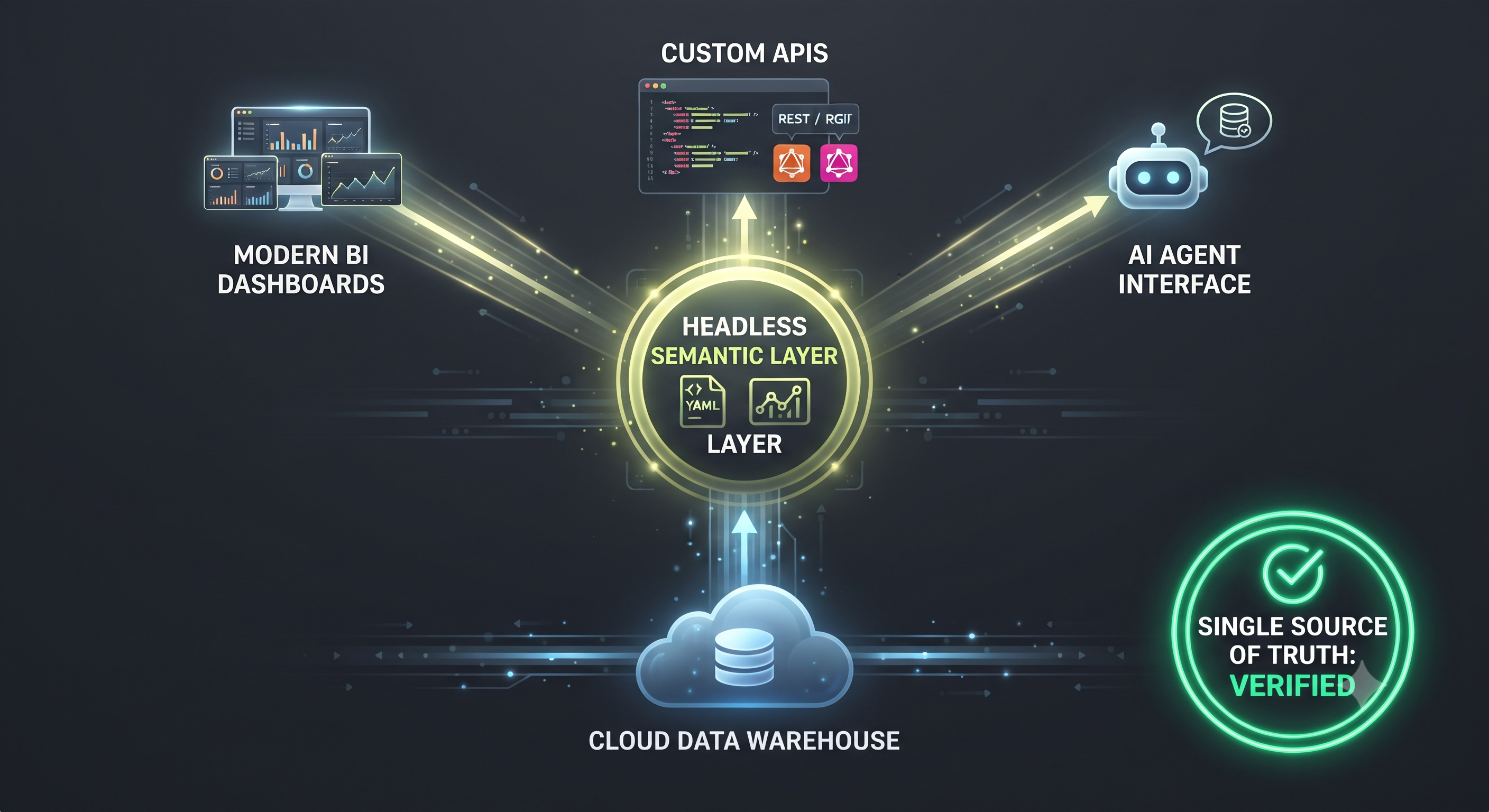
When AI agents, LLM analytical assistants, and modern BI dashboards query a warehouse directly using raw Text-to-SQL, they frequently hallucinate joins, miscalculate aggregations, or misinterpret business logic. A headless semantic layer acts as an authoritative abstraction barrier. It provides a single source of truth for metrics, dimensions, and security filters that can be safely exposed to both human dashboards and autonomous AI agents via standardized APIs.
What you can learn (The Architecture Breakdown):
When implementing a robust semantic model for your organization, focus on three core principles:
Metrics as Code: Define measures, dimensions, and complex joins version-controlled in YAML or repository code rather than hiding them inside proprietary BI tool menus.
Multi-Interface Serving: Ensure your semantic layer can serve data uniformly across multiple endpoints—whether feeding traditional BI, custom web apps via REST/GraphQL, or agentic workflows via Model Context Protocols (MCP).
Pre-Aggregation & Caching: Build high-performance caching layers directly into your semantic architecture to handle heavy query volumes and keep sub-second latencies for downstream consumers.
Discussion Question
Is your organization adopting a headless semantic layer to unify BI and AI analytics, or are metric definitions still scattered across individual dashboard tools?
CTA (Join Data Science & Analytics)
Ready to master modern data architecture, semantic modeling, and scalable analytics workflows? Join the Techawks Data Science & Analytics community today to collaborate with top data professionals worldwide:
Modern analytics engineering is moving away from platform-locked metrics toward centralized, code-first semantic modeling. Tools like Cube and the dbt Semantic Layer decouple business definitions from the underlying data warehouse and downstream presentation layer.
Why it matters:
When AI agents, LLM analytical assistants, and modern BI dashboards query a warehouse directly using raw Text-to-SQL, they frequently hallucinate joins, miscalculate aggregations, or misinterpret business logic. A headless semantic layer acts as an authoritative abstraction barrier. It provides a single source of truth for metrics, dimensions, and security filters that can be safely exposed to both human dashboards and autonomous AI agents via standardized APIs.
What you can learn (The Architecture Breakdown):
When implementing a robust semantic model for your organization, focus on three core principles:
Metrics as Code: Define measures, dimensions, and complex joins version-controlled in YAML or repository code rather than hiding them inside proprietary BI tool menus.
Multi-Interface Serving: Ensure your semantic layer can serve data uniformly across multiple endpoints—whether feeding traditional BI, custom web apps via REST/GraphQL, or agentic workflows via Model Context Protocols (MCP).
Pre-Aggregation & Caching: Build high-performance caching layers directly into your semantic architecture to handle heavy query volumes and keep sub-second latencies for downstream consumers.
Discussion Question
Is your organization adopting a headless semantic layer to unify BI and AI analytics, or are metric definitions still scattered across individual dashboard tools?
CTA (Join Data Science & Analytics)
Ready to master modern data architecture, semantic modeling, and scalable analytics workflows? Join the Techawks Data Science & Analytics community today to collaborate with top data professionals worldwide:
Headless Semantic Layers: Why Standardizing Metrics is the Missing Link for Reliable AI & BI Analytics
Modern analytics engineering is moving away from platform-locked metrics toward centralized, code-first semantic modeling. Tools like Cube and the dbt Semantic Layer decouple business definitions from the underlying data warehouse and downstream presentation layer.
Why it matters:
When AI agents, LLM analytical assistants, and modern BI dashboards query a warehouse directly using raw Text-to-SQL, they frequently hallucinate joins, miscalculate aggregations, or misinterpret business logic. A headless semantic layer acts as an authoritative abstraction barrier. It provides a single source of truth for metrics, dimensions, and security filters that can be safely exposed to both human dashboards and autonomous AI agents via standardized APIs.
What you can learn (The Architecture Breakdown):
When implementing a robust semantic model for your organization, focus on three core principles:
Metrics as Code: Define measures, dimensions, and complex joins version-controlled in YAML or repository code rather than hiding them inside proprietary BI tool menus.
Multi-Interface Serving: Ensure your semantic layer can serve data uniformly across multiple endpoints—whether feeding traditional BI, custom web apps via REST/GraphQL, or agentic workflows via Model Context Protocols (MCP).
Pre-Aggregation & Caching: Build high-performance caching layers directly into your semantic architecture to handle heavy query volumes and keep sub-second latencies for downstream consumers.
Discussion Question
Is your organization adopting a headless semantic layer to unify BI and AI analytics, or are metric definitions still scattered across individual dashboard tools?
CTA (Join Data Science & Analytics)
Ready to master modern data architecture, semantic modeling, and scalable analytics workflows? Join the Techawks Data Science & Analytics community today to collaborate with top data professionals worldwide:

 English
 French
 Spanish
 Portuguese
 Deutsch
 Turkish
 Dutch
Dutch
 Italiano
 Russian
 Romaian
 Portuguese (Brazil)
 Greek
Greek