


Taming Infrastructure Drift: Why Control-Plane Orchestration is Replacing Static Terraform Pipelines
Modern cloud architecture is moving away from fire-and-forget Infrastructure-as-Code (IaC) toward continuous, API-driven control-plane orchestration. Frameworks like Crossplane and modern multi-engine orchestrators are shifting how engineering teams manage drift.
Why it matters:
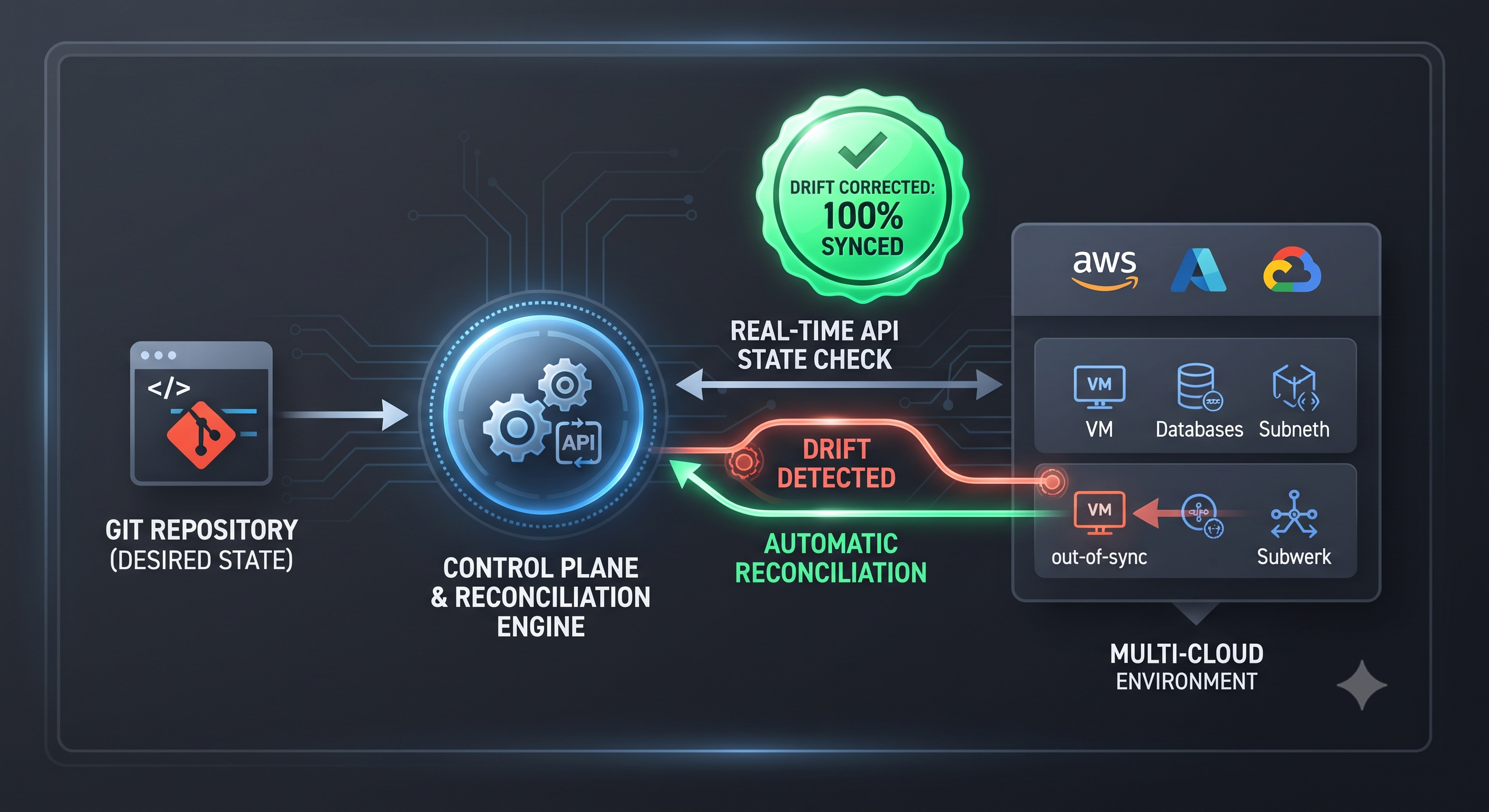
Traditional pipelines only check state when someone triggers a run. If an engineer manually tweaks a security group or a cloud provider updates an underlying resource, your codebase drifts out of sync. Control planes introduce active reconciliation loops: they continuously query cloud APIs, compare actual state against declared intent, and automatically remediate drift before it turns into a security vulnerability or a silent outage.
What you can learn (The Cloud Architecture Breakdown):
When scaling your infrastructure automation beyond basic scripts, build your workflows around three control-plane principles:
Continuous Reconciliation over One-Off Applies: Shift from reactive execution to proactive loops that enforce desired states automatically, ensuring your infrastructure heals itself from manual drift.
Abstracted Composite APIs: Wrap complex multi-resource configurations (like a secure VPC with subnets, NAT gateways, and IAM roles) into simple, self-service custom resources for application developers.
Policy-as-Code Enforcement: Embed guardrails (using Open Policy Agent or similar frameworks) directly into the control loop so non-compliant infrastructure can never be provisioned in the first place.
Discussion Question
Are you still relying on traditional CI/CD pipelines to apply your infrastructure code, or have you transitioned to control-plane orchestration and continuous reconciliation? What is your biggest pain point with drift detection?
CTA (Join Cloud, DevOps & Open Source)
Ready to master advanced cloud architectures, platform engineering, and modern DevOps tooling? Join the Techawks Cloud, DevOps & Open Source community today to build and scale resilient systems with cloud engineers worldwide:
Modern cloud architecture is moving away from fire-and-forget Infrastructure-as-Code (IaC) toward continuous, API-driven control-plane orchestration. Frameworks like Crossplane and modern multi-engine orchestrators are shifting how engineering teams manage drift.
Why it matters:
Traditional pipelines only check state when someone triggers a run. If an engineer manually tweaks a security group or a cloud provider updates an underlying resource, your codebase drifts out of sync. Control planes introduce active reconciliation loops: they continuously query cloud APIs, compare actual state against declared intent, and automatically remediate drift before it turns into a security vulnerability or a silent outage.
What you can learn (The Cloud Architecture Breakdown):
When scaling your infrastructure automation beyond basic scripts, build your workflows around three control-plane principles:
Continuous Reconciliation over One-Off Applies: Shift from reactive execution to proactive loops that enforce desired states automatically, ensuring your infrastructure heals itself from manual drift.
Abstracted Composite APIs: Wrap complex multi-resource configurations (like a secure VPC with subnets, NAT gateways, and IAM roles) into simple, self-service custom resources for application developers.
Policy-as-Code Enforcement: Embed guardrails (using Open Policy Agent or similar frameworks) directly into the control loop so non-compliant infrastructure can never be provisioned in the first place.
Discussion Question
Are you still relying on traditional CI/CD pipelines to apply your infrastructure code, or have you transitioned to control-plane orchestration and continuous reconciliation? What is your biggest pain point with drift detection?
CTA (Join Cloud, DevOps & Open Source)
Ready to master advanced cloud architectures, platform engineering, and modern DevOps tooling? Join the Techawks Cloud, DevOps & Open Source community today to build and scale resilient systems with cloud engineers worldwide:
Taming Infrastructure Drift: Why Control-Plane Orchestration is Replacing Static Terraform Pipelines
Modern cloud architecture is moving away from fire-and-forget Infrastructure-as-Code (IaC) toward continuous, API-driven control-plane orchestration. Frameworks like Crossplane and modern multi-engine orchestrators are shifting how engineering teams manage drift.
Why it matters:
Traditional pipelines only check state when someone triggers a run. If an engineer manually tweaks a security group or a cloud provider updates an underlying resource, your codebase drifts out of sync. Control planes introduce active reconciliation loops: they continuously query cloud APIs, compare actual state against declared intent, and automatically remediate drift before it turns into a security vulnerability or a silent outage.
What you can learn (The Cloud Architecture Breakdown):
When scaling your infrastructure automation beyond basic scripts, build your workflows around three control-plane principles:
Continuous Reconciliation over One-Off Applies: Shift from reactive execution to proactive loops that enforce desired states automatically, ensuring your infrastructure heals itself from manual drift.
Abstracted Composite APIs: Wrap complex multi-resource configurations (like a secure VPC with subnets, NAT gateways, and IAM roles) into simple, self-service custom resources for application developers.
Policy-as-Code Enforcement: Embed guardrails (using Open Policy Agent or similar frameworks) directly into the control loop so non-compliant infrastructure can never be provisioned in the first place.
Discussion Question
Are you still relying on traditional CI/CD pipelines to apply your infrastructure code, or have you transitioned to control-plane orchestration and continuous reconciliation? What is your biggest pain point with drift detection?
CTA (Join Cloud, DevOps & Open Source)
Ready to master advanced cloud architectures, platform engineering, and modern DevOps tooling? Join the Techawks Cloud, DevOps & Open Source community today to build and scale resilient systems with cloud engineers worldwide:

 Arabic
 French
 Spanish
 Portuguese
 Deutsch
 Turkish
 Dutch
Dutch
 Italiano
 Russian
 Romaian
 Portuguese (Brazil)
 Greek
Greek