


The Silent Pipeline Killer: Why Isolated Drift Alerts Are Ruining Production ML (And How to Fix Your MLOps Stack)
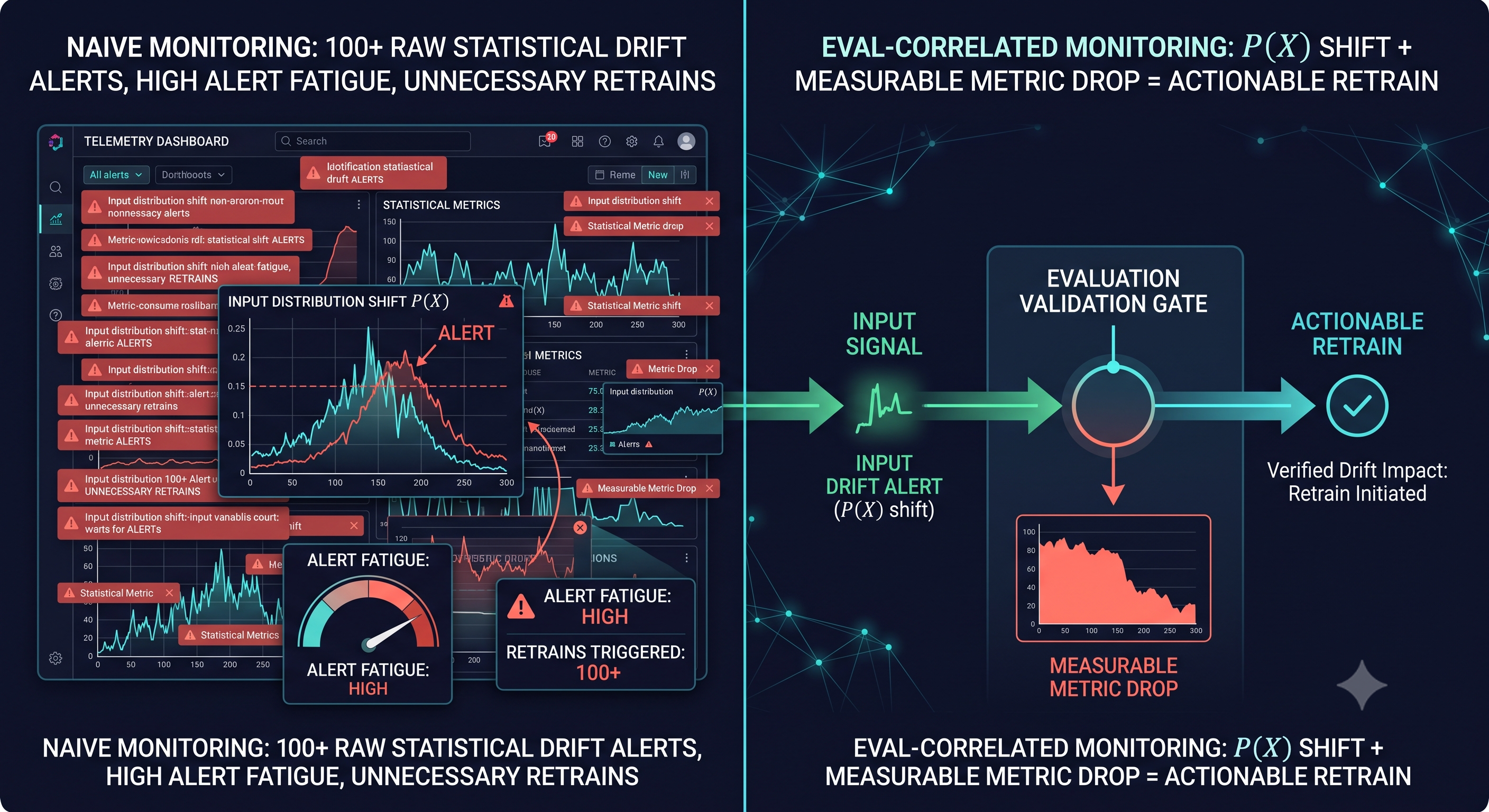
Enterprise analytics and ML systems are managing unprecedented streaming throughput, with over 80% of organizations now deploying AI-augmented and real-time inference pipelines. Yet the biggest operational failure in production ML remains unchanged: treating statistical input drift ($P(X)$) as an automatic crisis without verifying concept drift or downstream evaluation impact ($P(Y\vert{}X)$).When a feature distribution shifts—such as a seasonal traffic spike skewing session lengths—a standard statistical test (KS test, Chi-square, or PSI > 0.2) triggers an alert. But if the relationship between input features and target predictions holds steady, triggering an emergency retrain wastes compute, disrupts feature stores, and risks model degradation on an under-sampled distribution.
Production-grade data teams in 2026 are shifting to eval-correlated drift monitoring. Instead of treating drift in isolation, run this verification checklist before retraining or rolling back models:📊 The Production Drift & Pipeline Triage Checklist
[ ] 1. Upstream Pipeline Audit vs. Real Shift: Before suspecting true behavioral drift, check upstream extraction. Did a schema alteration, timezone ingestion discrepancy, or upstream API null-filling bug artificially distort the feature distribution?
[ ] 2. Covariate vs. Concept Verification: Test whether $P(X)$ shifted while $P(Y\vert{}X)$ stayed stable (covariate shift), or if the underlying label boundary changed (concept drift). If only the input distribution shifted, sample reweighting or importance weighting is often faster, safer, and cheaper than a full retrain.
[ ] 3. Joint Eval-Trigger Validation: Configure alerting thresholds so on-call engineers are notified only when an input drift metric (e.g., PSI > 0.2 or Wasserstein distance) correlates directly with a measurable downstream evaluation drop (e.g., ground-truth conversion, precision dip, or LLM grounding degradation).
[ ] 4. Shadow & Canary Deployment Test: Never deploy an automated retrain directly to 100% of production traffic. Replay historical production traces against a canary model and compare performance across the drifted data slices specifically.[ ] 5. Feedback Loop & Stale Label Check: In delayed-feedback environments (like fraud detection or credit underwriting), verify whether apparent drift is simply unobserved ground-truth labels lagging behind inference windows.
Discussion Question
When your data pipelines or ML monitors detect a distribution shift, what criteria triggers an automatic model retraining job versus an engineer’s manual sign-off? How do you prevent statistical false alarms from burning out your team?
CTA (Invite Analysis and Opinions)
Drop your take below: Are you leaning toward automated closed-loop remediation, or do you still keep a human in the loop for pipeline intervention? If you have an active monitoring architecture, share your preferred drift detection metrics (PSI, KS test, or embedding distance).
Enterprise analytics and ML systems are managing unprecedented streaming throughput, with over 80% of organizations now deploying AI-augmented and real-time inference pipelines. Yet the biggest operational failure in production ML remains unchanged: treating statistical input drift ($P(X)$) as an automatic crisis without verifying concept drift or downstream evaluation impact ($P(Y\vert{}X)$).When a feature distribution shifts—such as a seasonal traffic spike skewing session lengths—a standard statistical test (KS test, Chi-square, or PSI > 0.2) triggers an alert. But if the relationship between input features and target predictions holds steady, triggering an emergency retrain wastes compute, disrupts feature stores, and risks model degradation on an under-sampled distribution.
Production-grade data teams in 2026 are shifting to eval-correlated drift monitoring. Instead of treating drift in isolation, run this verification checklist before retraining or rolling back models:📊 The Production Drift & Pipeline Triage Checklist
[ ] 1. Upstream Pipeline Audit vs. Real Shift: Before suspecting true behavioral drift, check upstream extraction. Did a schema alteration, timezone ingestion discrepancy, or upstream API null-filling bug artificially distort the feature distribution?
[ ] 2. Covariate vs. Concept Verification: Test whether $P(X)$ shifted while $P(Y\vert{}X)$ stayed stable (covariate shift), or if the underlying label boundary changed (concept drift). If only the input distribution shifted, sample reweighting or importance weighting is often faster, safer, and cheaper than a full retrain.
[ ] 3. Joint Eval-Trigger Validation: Configure alerting thresholds so on-call engineers are notified only when an input drift metric (e.g., PSI > 0.2 or Wasserstein distance) correlates directly with a measurable downstream evaluation drop (e.g., ground-truth conversion, precision dip, or LLM grounding degradation).
[ ] 4. Shadow & Canary Deployment Test: Never deploy an automated retrain directly to 100% of production traffic. Replay historical production traces against a canary model and compare performance across the drifted data slices specifically.[ ] 5. Feedback Loop & Stale Label Check: In delayed-feedback environments (like fraud detection or credit underwriting), verify whether apparent drift is simply unobserved ground-truth labels lagging behind inference windows.
Discussion Question
When your data pipelines or ML monitors detect a distribution shift, what criteria triggers an automatic model retraining job versus an engineer’s manual sign-off? How do you prevent statistical false alarms from burning out your team?
CTA (Invite Analysis and Opinions)
Drop your take below: Are you leaning toward automated closed-loop remediation, or do you still keep a human in the loop for pipeline intervention? If you have an active monitoring architecture, share your preferred drift detection metrics (PSI, KS test, or embedding distance).
The Silent Pipeline Killer: Why Isolated Drift Alerts Are Ruining Production ML (And How to Fix Your MLOps Stack)
Enterprise analytics and ML systems are managing unprecedented streaming throughput, with over 80% of organizations now deploying AI-augmented and real-time inference pipelines. Yet the biggest operational failure in production ML remains unchanged: treating statistical input drift ($P(X)$) as an automatic crisis without verifying concept drift or downstream evaluation impact ($P(Y\vert{}X)$).When a feature distribution shifts—such as a seasonal traffic spike skewing session lengths—a standard statistical test (KS test, Chi-square, or PSI > 0.2) triggers an alert. But if the relationship between input features and target predictions holds steady, triggering an emergency retrain wastes compute, disrupts feature stores, and risks model degradation on an under-sampled distribution.
Production-grade data teams in 2026 are shifting to eval-correlated drift monitoring. Instead of treating drift in isolation, run this verification checklist before retraining or rolling back models:📊 The Production Drift & Pipeline Triage Checklist
[ ] 1. Upstream Pipeline Audit vs. Real Shift: Before suspecting true behavioral drift, check upstream extraction. Did a schema alteration, timezone ingestion discrepancy, or upstream API null-filling bug artificially distort the feature distribution?
[ ] 2. Covariate vs. Concept Verification: Test whether $P(X)$ shifted while $P(Y\vert{}X)$ stayed stable (covariate shift), or if the underlying label boundary changed (concept drift). If only the input distribution shifted, sample reweighting or importance weighting is often faster, safer, and cheaper than a full retrain.
[ ] 3. Joint Eval-Trigger Validation: Configure alerting thresholds so on-call engineers are notified only when an input drift metric (e.g., PSI > 0.2 or Wasserstein distance) correlates directly with a measurable downstream evaluation drop (e.g., ground-truth conversion, precision dip, or LLM grounding degradation).
[ ] 4. Shadow & Canary Deployment Test: Never deploy an automated retrain directly to 100% of production traffic. Replay historical production traces against a canary model and compare performance across the drifted data slices specifically.[ ] 5. Feedback Loop & Stale Label Check: In delayed-feedback environments (like fraud detection or credit underwriting), verify whether apparent drift is simply unobserved ground-truth labels lagging behind inference windows.
Discussion Question
When your data pipelines or ML monitors detect a distribution shift, what criteria triggers an automatic model retraining job versus an engineer’s manual sign-off? How do you prevent statistical false alarms from burning out your team?
CTA (Invite Analysis and Opinions)
Drop your take below: Are you leaning toward automated closed-loop remediation, or do you still keep a human in the loop for pipeline intervention? If you have an active monitoring architecture, share your preferred drift detection metrics (PSI, KS test, or embedding distance).

 English
 Arabic
 French
 Spanish
 Portuguese
 Deutsch
 Turkish
 Dutch
Dutch
 Russian
 Romaian
 Portuguese (Brazil)
 Greek
Greek