


Beyond Overprovisioning: Why FinOps and Cost-Aware Pipelines are the New Standard in Cloud Engineering
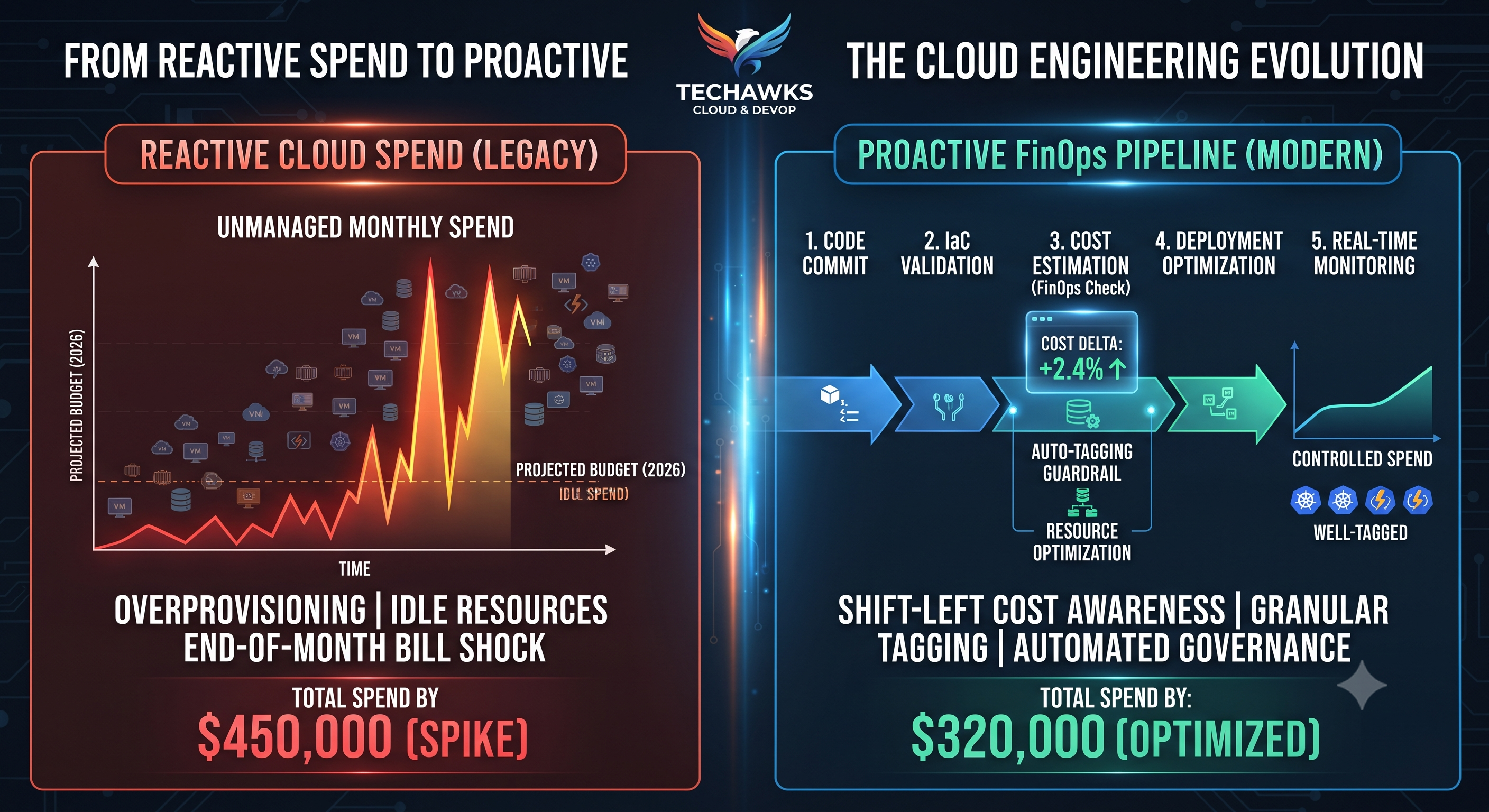
In modern cloud-native environments, provisioning massive compute clusters, idle staging nodes, and unindexed data pipelines is easier than ever. But as cloud bills scale uncontrollably, traditional "provision-first, optimize-later" approaches are no longer sustainable.
Enter FinOps and Shift-Left Cost Awareness.
Why it matters:
Cost efficiency is no longer just a business metric—it is a core engineering metric, right alongside latency and availability. When cloud engineers integrate cost visibility directly into their delivery pipelines, they catch expensive misconfigurations, unoptimized container requests, and over-provisioned instances before code ever reaches production.
How to embed FinOps into your workflow:
Expose Cost Impact Early: Use infrastructure-as-code (IaC) tools and pipeline extensions to calculate and display the financial delta of infrastructure changes during pull request reviews.
Granular Resource Tagging: Automate strict resource tagging guardrails so every cloud component maps directly to an owning team or service.
Implement Container-Level Monitoring: If you run Kubernetes, adopt dedicated tools (like Kubecost) to track CPU/memory waste down to the pod level rather than blindly paying for oversized worker nodes.
Discussion Question:
How does your team handle cloud cost management—do you rely on reactive end-of-month finance alerts, or do you enforce FinOps checks directly inside your CI/CD pipelines?
CTA (Join Cloud, DevOps & Open Source):
Ready to master cloud architecture, Kubernetes scaling, and modern platform engineering? Join the Techawks Cloud, DevOps & Open Source community today!
In modern cloud-native environments, provisioning massive compute clusters, idle staging nodes, and unindexed data pipelines is easier than ever. But as cloud bills scale uncontrollably, traditional "provision-first, optimize-later" approaches are no longer sustainable.
Enter FinOps and Shift-Left Cost Awareness.
Why it matters:
Cost efficiency is no longer just a business metric—it is a core engineering metric, right alongside latency and availability. When cloud engineers integrate cost visibility directly into their delivery pipelines, they catch expensive misconfigurations, unoptimized container requests, and over-provisioned instances before code ever reaches production.
How to embed FinOps into your workflow:
Expose Cost Impact Early: Use infrastructure-as-code (IaC) tools and pipeline extensions to calculate and display the financial delta of infrastructure changes during pull request reviews.
Granular Resource Tagging: Automate strict resource tagging guardrails so every cloud component maps directly to an owning team or service.
Implement Container-Level Monitoring: If you run Kubernetes, adopt dedicated tools (like Kubecost) to track CPU/memory waste down to the pod level rather than blindly paying for oversized worker nodes.
Discussion Question:
How does your team handle cloud cost management—do you rely on reactive end-of-month finance alerts, or do you enforce FinOps checks directly inside your CI/CD pipelines?
CTA (Join Cloud, DevOps & Open Source):
Ready to master cloud architecture, Kubernetes scaling, and modern platform engineering? Join the Techawks Cloud, DevOps & Open Source community today!
Beyond Overprovisioning: Why FinOps and Cost-Aware Pipelines are the New Standard in Cloud Engineering
In modern cloud-native environments, provisioning massive compute clusters, idle staging nodes, and unindexed data pipelines is easier than ever. But as cloud bills scale uncontrollably, traditional "provision-first, optimize-later" approaches are no longer sustainable.
Enter FinOps and Shift-Left Cost Awareness.
Why it matters:
Cost efficiency is no longer just a business metric—it is a core engineering metric, right alongside latency and availability. When cloud engineers integrate cost visibility directly into their delivery pipelines, they catch expensive misconfigurations, unoptimized container requests, and over-provisioned instances before code ever reaches production.
How to embed FinOps into your workflow:
Expose Cost Impact Early: Use infrastructure-as-code (IaC) tools and pipeline extensions to calculate and display the financial delta of infrastructure changes during pull request reviews.
Granular Resource Tagging: Automate strict resource tagging guardrails so every cloud component maps directly to an owning team or service.
Implement Container-Level Monitoring: If you run Kubernetes, adopt dedicated tools (like Kubecost) to track CPU/memory waste down to the pod level rather than blindly paying for oversized worker nodes.
Discussion Question:
How does your team handle cloud cost management—do you rely on reactive end-of-month finance alerts, or do you enforce FinOps checks directly inside your CI/CD pipelines?
CTA (Join Cloud, DevOps & Open Source):
Ready to master cloud architecture, Kubernetes scaling, and modern platform engineering? Join the Techawks Cloud, DevOps & Open Source community today!

 English
 Arabic
 French
 Spanish
 Portuguese
 Turkish
 Dutch
Dutch
 Italiano
 Russian
 Romaian
 Portuguese (Brazil)
 Greek
Greek