


Technical Debt vs. Sluggish Delivery: A Founder’s Framework for Intentional Architecture Trade-Offs
In the earliest stages of a startup, code quality is not measured by academic elegance or theoretical infinite scale. It is measured by your speed of validated learning per dollar spent.
Yet, most technical founders fall into one of two traps: building a distributed event-driven microservices fleet for zero initial users, or hacking together an undocumented, tightly coupled monolith with zero transactional safety that grinds product iterations to a halt by customer fifty.
Here is a practical framework to manage technical debt deliberately, ensuring your engineering speed remains an asset rather than a hidden balance-sheet liability.
1. Separate "Reversible" from "Irreversible" Architectural Bets
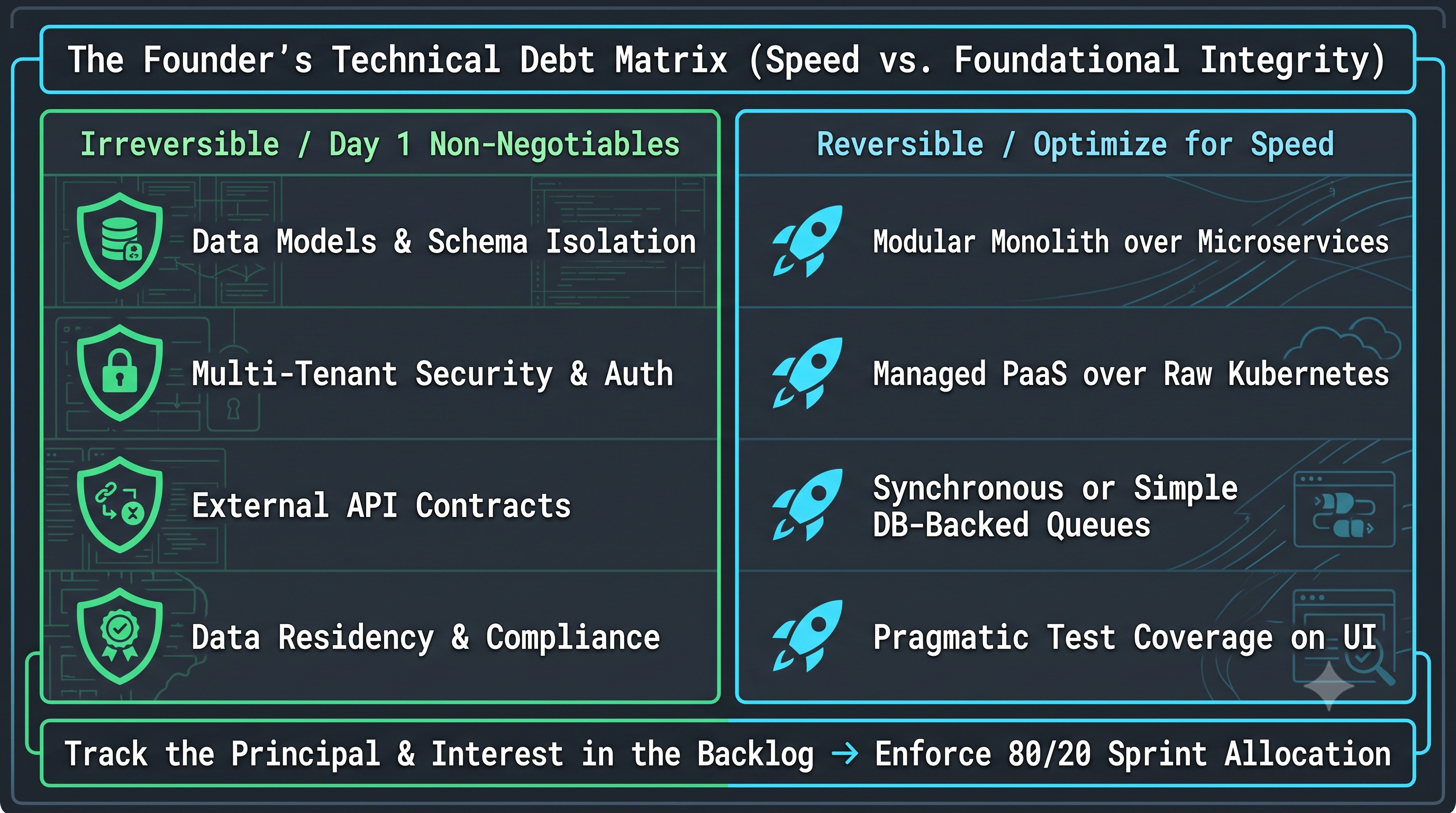
Borrowing from Amazon’s Type 1 (irreversible) vs. Type 2 (reversible) decisions, categorize technical choices before writing code:
Irreversible (Get These Right on Day 1):
Core relational data schema and foreign key boundaries (e.g., billing, ledger, tenant isolation).
Authentication, authorization scopes, and data residency boundaries.
API contracts exposed to third-party integrations or mobile clients.
Reversible (Optimize for Speed & Disposability):
Asynchronous queues vs. simple background workers (e.g., cron jobs or Postgres-backed queues like pg-boss).
Monolith vs. microservices (always start as a modular monolith).
Self-hosted infrastructure vs. managed PaaS (e.g., fly.io, Render, AWS ECS over bare-metal Kubernetes).
2. Implement the "Debt Ledger" in Your Sprint Cycles
Technical shortcuts should never be invisible:
Whenever an engineer implements a hack to hit a customer deadline (e.g., bypassing an idempotent retry mechanism or hardcoding an integration payload), require a Debt Ticket logged directly into your backlog.
Annotate the ticket with two numbers:
Principal: Time saved today (e.g., Saved 3 days of development).
Interest: Operational friction added per month (e.g., Requires manual database fix if customer retries checkout).
If interest begins to exceed 10% of total sprint velocity, the ticket gets automatically prioritized into the next release.
3. Establish the 80/20 Maintenance Allocation
Founders often promise investors or sales teams 100% feature velocity until the product abruptly stalls under bug backlogs:
Commit to a hard 80/20 rule: 80% sprint capacity dedicated to customer discovery and revenue features; 20% strictly reserved for infrastructure refactoring, test automation, and debt remediation.
This ring-fences technical health and eliminates the contentious debate over "feature work vs. tech debt."
4. Know the Exact Metric Trigger to Refactor
Never refactor based on developer boredom or abstract aesthetic desires. Refactor only when operational thresholds are breached:
Database Connection Saturation: When pool utilization consistently hits 75% at peak hours.
Deployment Lead Time: When continuous deployment cycle time stretches from 10 minutes to over 45 minutes due to fragile test suites.
Support Ticket Ratio: When bugs from legacy hacks account for more than 15% of inbound customer queries.
Key Takeaways
Categorize Decisions: Enforce rigorous architectural discipline on data schemas and auth; aggressively cut corners on background workers and hosting orchestration.
Track the Debt Ledger: Treat technical shortcuts like financial loans—track the principal saved and the recurring interest paid in operational overhead.
The 80/20 Rule: Guarantee 20% continuous engineering capacity for technical hardening to prevent catastrophic code freezes later.
Refactor on Telemetry, Not Taste: Use concrete operational triggers (deployment lead time, database load, error rates) to justify re-architecting systems.
CTA
What was the most expensive piece of technical debt you took on to ship faster—and was it ultimately worth the trade-off?
Did your early architectural choices survive your first 1,000 customers, or did you have to execute a painful ground-up rewrite? Share your hardest-earned engineering lessons below.
In the earliest stages of a startup, code quality is not measured by academic elegance or theoretical infinite scale. It is measured by your speed of validated learning per dollar spent.
Yet, most technical founders fall into one of two traps: building a distributed event-driven microservices fleet for zero initial users, or hacking together an undocumented, tightly coupled monolith with zero transactional safety that grinds product iterations to a halt by customer fifty.
Here is a practical framework to manage technical debt deliberately, ensuring your engineering speed remains an asset rather than a hidden balance-sheet liability.
1. Separate "Reversible" from "Irreversible" Architectural Bets
Borrowing from Amazon’s Type 1 (irreversible) vs. Type 2 (reversible) decisions, categorize technical choices before writing code:
Irreversible (Get These Right on Day 1):
Core relational data schema and foreign key boundaries (e.g., billing, ledger, tenant isolation).
Authentication, authorization scopes, and data residency boundaries.
API contracts exposed to third-party integrations or mobile clients.
Reversible (Optimize for Speed & Disposability):
Asynchronous queues vs. simple background workers (e.g., cron jobs or Postgres-backed queues like pg-boss).
Monolith vs. microservices (always start as a modular monolith).
Self-hosted infrastructure vs. managed PaaS (e.g., fly.io, Render, AWS ECS over bare-metal Kubernetes).
2. Implement the "Debt Ledger" in Your Sprint Cycles
Technical shortcuts should never be invisible:
Whenever an engineer implements a hack to hit a customer deadline (e.g., bypassing an idempotent retry mechanism or hardcoding an integration payload), require a Debt Ticket logged directly into your backlog.
Annotate the ticket with two numbers:
Principal: Time saved today (e.g., Saved 3 days of development).
Interest: Operational friction added per month (e.g., Requires manual database fix if customer retries checkout).
If interest begins to exceed 10% of total sprint velocity, the ticket gets automatically prioritized into the next release.
3. Establish the 80/20 Maintenance Allocation
Founders often promise investors or sales teams 100% feature velocity until the product abruptly stalls under bug backlogs:
Commit to a hard 80/20 rule: 80% sprint capacity dedicated to customer discovery and revenue features; 20% strictly reserved for infrastructure refactoring, test automation, and debt remediation.
This ring-fences technical health and eliminates the contentious debate over "feature work vs. tech debt."
4. Know the Exact Metric Trigger to Refactor
Never refactor based on developer boredom or abstract aesthetic desires. Refactor only when operational thresholds are breached:
Database Connection Saturation: When pool utilization consistently hits 75% at peak hours.
Deployment Lead Time: When continuous deployment cycle time stretches from 10 minutes to over 45 minutes due to fragile test suites.
Support Ticket Ratio: When bugs from legacy hacks account for more than 15% of inbound customer queries.
Key Takeaways
Categorize Decisions: Enforce rigorous architectural discipline on data schemas and auth; aggressively cut corners on background workers and hosting orchestration.
Track the Debt Ledger: Treat technical shortcuts like financial loans—track the principal saved and the recurring interest paid in operational overhead.
The 80/20 Rule: Guarantee 20% continuous engineering capacity for technical hardening to prevent catastrophic code freezes later.
Refactor on Telemetry, Not Taste: Use concrete operational triggers (deployment lead time, database load, error rates) to justify re-architecting systems.
CTA
What was the most expensive piece of technical debt you took on to ship faster—and was it ultimately worth the trade-off?
Did your early architectural choices survive your first 1,000 customers, or did you have to execute a painful ground-up rewrite? Share your hardest-earned engineering lessons below.
Technical Debt vs. Sluggish Delivery: A Founder’s Framework for Intentional Architecture Trade-Offs
In the earliest stages of a startup, code quality is not measured by academic elegance or theoretical infinite scale. It is measured by your speed of validated learning per dollar spent.
Yet, most technical founders fall into one of two traps: building a distributed event-driven microservices fleet for zero initial users, or hacking together an undocumented, tightly coupled monolith with zero transactional safety that grinds product iterations to a halt by customer fifty.
Here is a practical framework to manage technical debt deliberately, ensuring your engineering speed remains an asset rather than a hidden balance-sheet liability.
1. Separate "Reversible" from "Irreversible" Architectural Bets
Borrowing from Amazon’s Type 1 (irreversible) vs. Type 2 (reversible) decisions, categorize technical choices before writing code:
Irreversible (Get These Right on Day 1):
Core relational data schema and foreign key boundaries (e.g., billing, ledger, tenant isolation).
Authentication, authorization scopes, and data residency boundaries.
API contracts exposed to third-party integrations or mobile clients.
Reversible (Optimize for Speed & Disposability):
Asynchronous queues vs. simple background workers (e.g., cron jobs or Postgres-backed queues like pg-boss).
Monolith vs. microservices (always start as a modular monolith).
Self-hosted infrastructure vs. managed PaaS (e.g., fly.io, Render, AWS ECS over bare-metal Kubernetes).
2. Implement the "Debt Ledger" in Your Sprint Cycles
Technical shortcuts should never be invisible:
Whenever an engineer implements a hack to hit a customer deadline (e.g., bypassing an idempotent retry mechanism or hardcoding an integration payload), require a Debt Ticket logged directly into your backlog.
Annotate the ticket with two numbers:
Principal: Time saved today (e.g., Saved 3 days of development).
Interest: Operational friction added per month (e.g., Requires manual database fix if customer retries checkout).
If interest begins to exceed 10% of total sprint velocity, the ticket gets automatically prioritized into the next release.
3. Establish the 80/20 Maintenance Allocation
Founders often promise investors or sales teams 100% feature velocity until the product abruptly stalls under bug backlogs:
Commit to a hard 80/20 rule: 80% sprint capacity dedicated to customer discovery and revenue features; 20% strictly reserved for infrastructure refactoring, test automation, and debt remediation.
This ring-fences technical health and eliminates the contentious debate over "feature work vs. tech debt."
4. Know the Exact Metric Trigger to Refactor
Never refactor based on developer boredom or abstract aesthetic desires. Refactor only when operational thresholds are breached:
Database Connection Saturation: When pool utilization consistently hits 75% at peak hours.
Deployment Lead Time: When continuous deployment cycle time stretches from 10 minutes to over 45 minutes due to fragile test suites.
Support Ticket Ratio: When bugs from legacy hacks account for more than 15% of inbound customer queries.
Key Takeaways
Categorize Decisions: Enforce rigorous architectural discipline on data schemas and auth; aggressively cut corners on background workers and hosting orchestration.
Track the Debt Ledger: Treat technical shortcuts like financial loans—track the principal saved and the recurring interest paid in operational overhead.
The 80/20 Rule: Guarantee 20% continuous engineering capacity for technical hardening to prevent catastrophic code freezes later.
Refactor on Telemetry, Not Taste: Use concrete operational triggers (deployment lead time, database load, error rates) to justify re-architecting systems.
CTA
What was the most expensive piece of technical debt you took on to ship faster—and was it ultimately worth the trade-off?
Did your early architectural choices survive your first 1,000 customers, or did you have to execute a painful ground-up rewrite? Share your hardest-earned engineering lessons below.

 English
 Arabic
 Spanish
 Portuguese
 Deutsch
 Turkish
 Dutch
Dutch
 Italiano
 Russian
 Romaian
 Portuguese (Brazil)
 Greek
Greek