


Decoding "AI Amnesia": Why Large Language Models Seem to Forget Mid-Task (And How to Fix It)
As artificial intelligence transitions from simple question-answering tools to autonomous agents executing multi-step workflows, a frustrating bottleneck frequently breaks productivity: AI Amnesia.
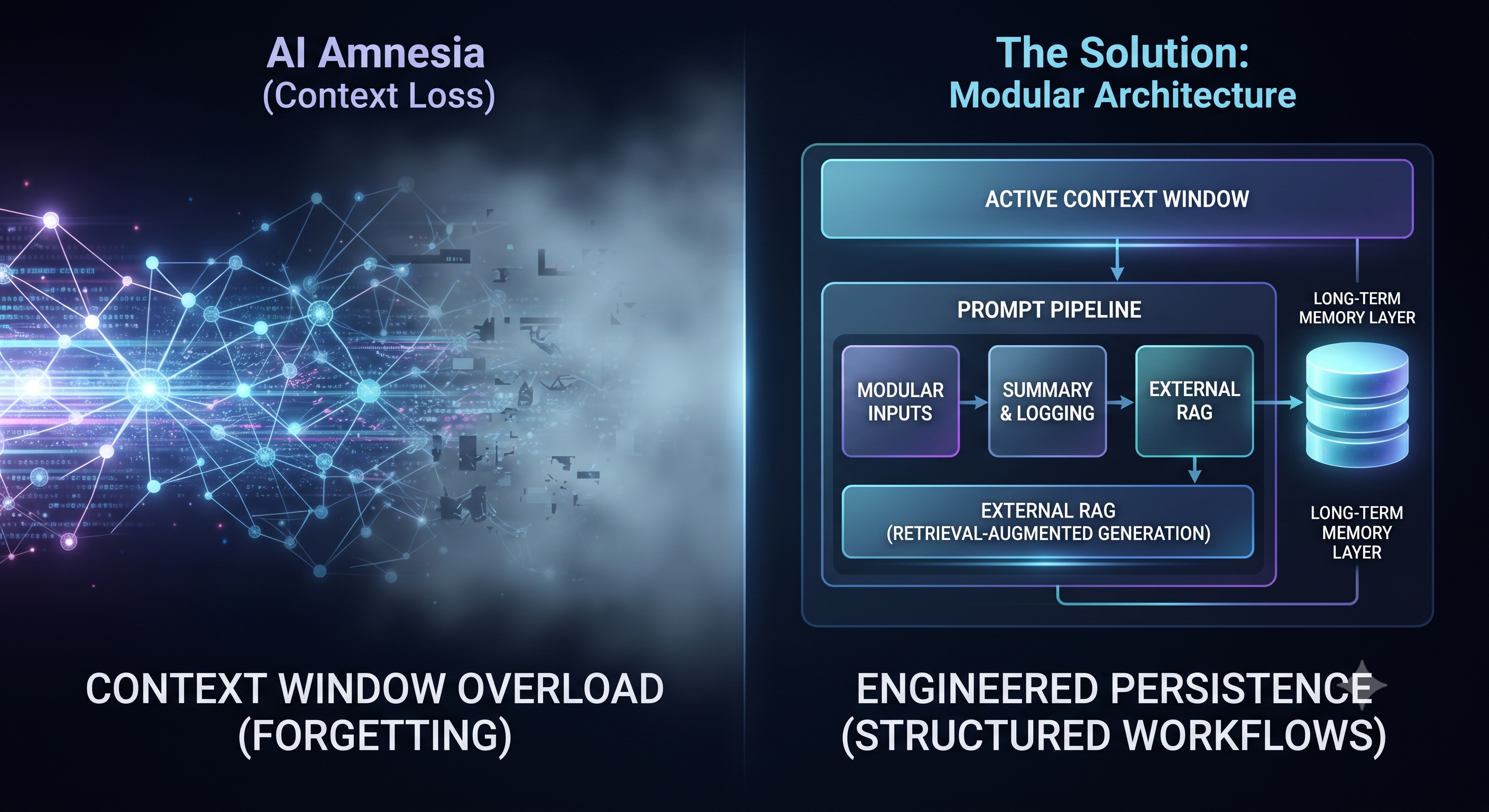
Unlike human memory, which weaves together past experiences and ongoing thoughts organically, an AI model’s memory is bound by hard structural boundaries. When an AI "forgets," it isn't experiencing cognitive fatigue. Instead, it usually stems from three distinct technical causes:
Context Window Overload: Every model has a fixed token limit. Once input and output text exceed this capacity, older information drops out of the active working memory.
Session Boundaries & Vector Drift: In chat interfaces, changing topics or hitting token caps forces the system to compress past dialogue, discarding critical granular details.
Retrieval Failures: When relying on external databases (RAG), if the search query generated by the AI fails to pull the exact snippet needed, the model behaves as though the data doesn't exist.
How to combat it: Stop treating AI like a human colleague with continuous memory. Instead, engineer your workflows to be modular. Use explicit summary prompts ("Summarize our progress so far into 3 bullet points before we proceed"), maintain external project markdown logs, and structure prompts to explicitly anchor core constraints at the very bottom of your input block where attention mechanisms weigh them most heavily.
Discussion Question
What is the longest workflow or project where you’ve hit a wall due to AI memory limits, and how did you restructure your prompts to get the model back on track?
CTA (Join Techawks General Community)
Want to master advanced system prompting, architecture breakdowns, and tech strategy alongside thousands of forward-thinking engineers and creators? Join the Techawks General Community today and level up your tech stack!
Decoding "AI Amnesia": Why Large Language Models Seem to Forget Mid-Task (And How to Fix It)
As artificial intelligence transitions from simple question-answering tools to autonomous agents executing multi-step workflows, a frustrating bottleneck frequently breaks productivity: AI Amnesia.
Unlike human memory, which weaves together past experiences and ongoing thoughts organically, an AI model’s memory is bound by hard structural boundaries. When an AI "forgets," it isn't experiencing cognitive fatigue. Instead, it usually stems from three distinct technical causes:
Context Window Overload: Every model has a fixed token limit. Once input and output text exceed this capacity, older information drops out of the active working memory.
Session Boundaries & Vector Drift: In chat interfaces, changing topics or hitting token caps forces the system to compress past dialogue, discarding critical granular details.
Retrieval Failures: When relying on external databases (RAG), if the search query generated by the AI fails to pull the exact snippet needed, the model behaves as though the data doesn't exist.
How to combat it: Stop treating AI like a human colleague with continuous memory. Instead, engineer your workflows to be modular. Use explicit summary prompts ("Summarize our progress so far into 3 bullet points before we proceed"), maintain external project markdown logs, and structure prompts to explicitly anchor core constraints at the very bottom of your input block where attention mechanisms weigh them most heavily.
Discussion Question
What is the longest workflow or project where you’ve hit a wall due to AI memory limits, and how did you restructure your prompts to get the model back on track?
CTA (Join Techawks General Community)
Want to master advanced system prompting, architecture breakdowns, and tech strategy alongside thousands of forward-thinking engineers and creators? Join the Techawks General Community today and level up your tech stack!

 English
 Arabic
 French
 Spanish
 Portuguese
 Deutsch
 Turkish
 Dutch
 Italiano
 Russian
 Portuguese (Brazil)
 Greek