


Demystifying the "Blast Radius": Why Zero Trust Architecture is Non-Negotiable for Modern Security
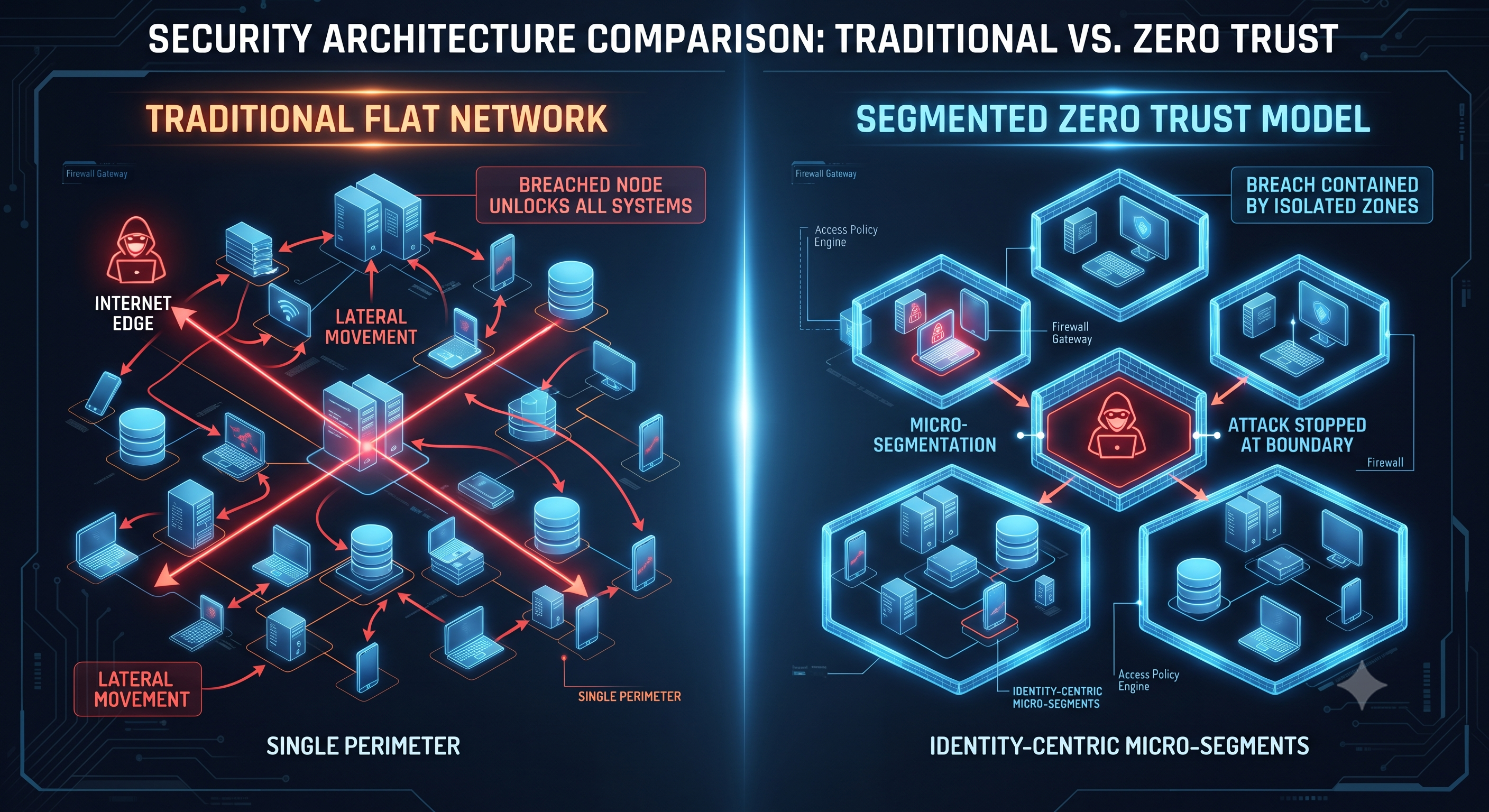
In traditional perimeter-based security, the network was viewed like a medieval castle: build a thick outer wall, trust everyone inside, and keep the bad guys out. But with remote work, cloud infrastructure, and sophisticated automated threats, the perimeter is dead. Once an attacker breaches the gate, they can easily move laterally.
Modern cybersecurity relies on a fundamental paradigm shift: Never Trust, Always Verify.
Why does this matter? Because minimizing the blast radius—the scope of damage an attacker can cause after a successful breach—is the ultimate benchmark of a resilient defense.
How to implement Zero Trust thinking in your labs and systems:
Explicit Verification: Always authenticate and authorize based on all available data points, including user identity, location, device health, and service context.
Least Privilege Access: Limit user and machine access with Just-In-Time (JIT) and Just-Enough-Access (JEA) policies, ensuring accounts only touch what they absolutely need to perform the task.
Assume Breach: Design your architecture with the mindset that attackers are already inside. Use strict micro-segmentation to isolate workloads so a single compromised container doesn't sink the entire fleet.
Discussion Question
What has been your experience implementing micro-segmentation or least-privilege access rules in your home lab or workplace? Where do you find the biggest friction?
CTA (Join Cybersecurity & Ethical Hacking)
Want to sharpen your defensive skills, explore vulnerability testing, and build resilient systems alongside a global community of security learners? Join Cybersecurity & Ethical Hacking today and master the future of defense!
In traditional perimeter-based security, the network was viewed like a medieval castle: build a thick outer wall, trust everyone inside, and keep the bad guys out. But with remote work, cloud infrastructure, and sophisticated automated threats, the perimeter is dead. Once an attacker breaches the gate, they can easily move laterally.
Modern cybersecurity relies on a fundamental paradigm shift: Never Trust, Always Verify.
Why does this matter? Because minimizing the blast radius—the scope of damage an attacker can cause after a successful breach—is the ultimate benchmark of a resilient defense.
How to implement Zero Trust thinking in your labs and systems:
Explicit Verification: Always authenticate and authorize based on all available data points, including user identity, location, device health, and service context.
Least Privilege Access: Limit user and machine access with Just-In-Time (JIT) and Just-Enough-Access (JEA) policies, ensuring accounts only touch what they absolutely need to perform the task.
Assume Breach: Design your architecture with the mindset that attackers are already inside. Use strict micro-segmentation to isolate workloads so a single compromised container doesn't sink the entire fleet.
Discussion Question
What has been your experience implementing micro-segmentation or least-privilege access rules in your home lab or workplace? Where do you find the biggest friction?
CTA (Join Cybersecurity & Ethical Hacking)
Want to sharpen your defensive skills, explore vulnerability testing, and build resilient systems alongside a global community of security learners? Join Cybersecurity & Ethical Hacking today and master the future of defense!
Demystifying the "Blast Radius": Why Zero Trust Architecture is Non-Negotiable for Modern Security
In traditional perimeter-based security, the network was viewed like a medieval castle: build a thick outer wall, trust everyone inside, and keep the bad guys out. But with remote work, cloud infrastructure, and sophisticated automated threats, the perimeter is dead. Once an attacker breaches the gate, they can easily move laterally.
Modern cybersecurity relies on a fundamental paradigm shift: Never Trust, Always Verify.
Why does this matter? Because minimizing the blast radius—the scope of damage an attacker can cause after a successful breach—is the ultimate benchmark of a resilient defense.
How to implement Zero Trust thinking in your labs and systems:
Explicit Verification: Always authenticate and authorize based on all available data points, including user identity, location, device health, and service context.
Least Privilege Access: Limit user and machine access with Just-In-Time (JIT) and Just-Enough-Access (JEA) policies, ensuring accounts only touch what they absolutely need to perform the task.
Assume Breach: Design your architecture with the mindset that attackers are already inside. Use strict micro-segmentation to isolate workloads so a single compromised container doesn't sink the entire fleet.
Discussion Question
What has been your experience implementing micro-segmentation or least-privilege access rules in your home lab or workplace? Where do you find the biggest friction?
CTA (Join Cybersecurity & Ethical Hacking)
Want to sharpen your defensive skills, explore vulnerability testing, and build resilient systems alongside a global community of security learners? Join Cybersecurity & Ethical Hacking today and master the future of defense!

 English
 Arabic
 French
 Spanish
 Deutsch
 Turkish
 Dutch
Dutch
 Italiano
 Russian
 Romaian
 Portuguese (Brazil)
 Greek
Greek