


Beyond the Dashboard: Why the "Semantic Layer" is the Most Critical Architecture Shift for Modern Data Teams
As data analytics scales across modern enterprises, the bottleneck has shifted from raw storage capacity to metric consistency. When business intelligence tools, executive reports, and AI assistants query a data warehouse directly, slight variations in SQL logic lead to conflicting numbers—destroying trust in data-driven decision making.
The ultimate solution adopted by top analytics teams is the implementation of a Semantic Layer.
What is a Semantic Layer?
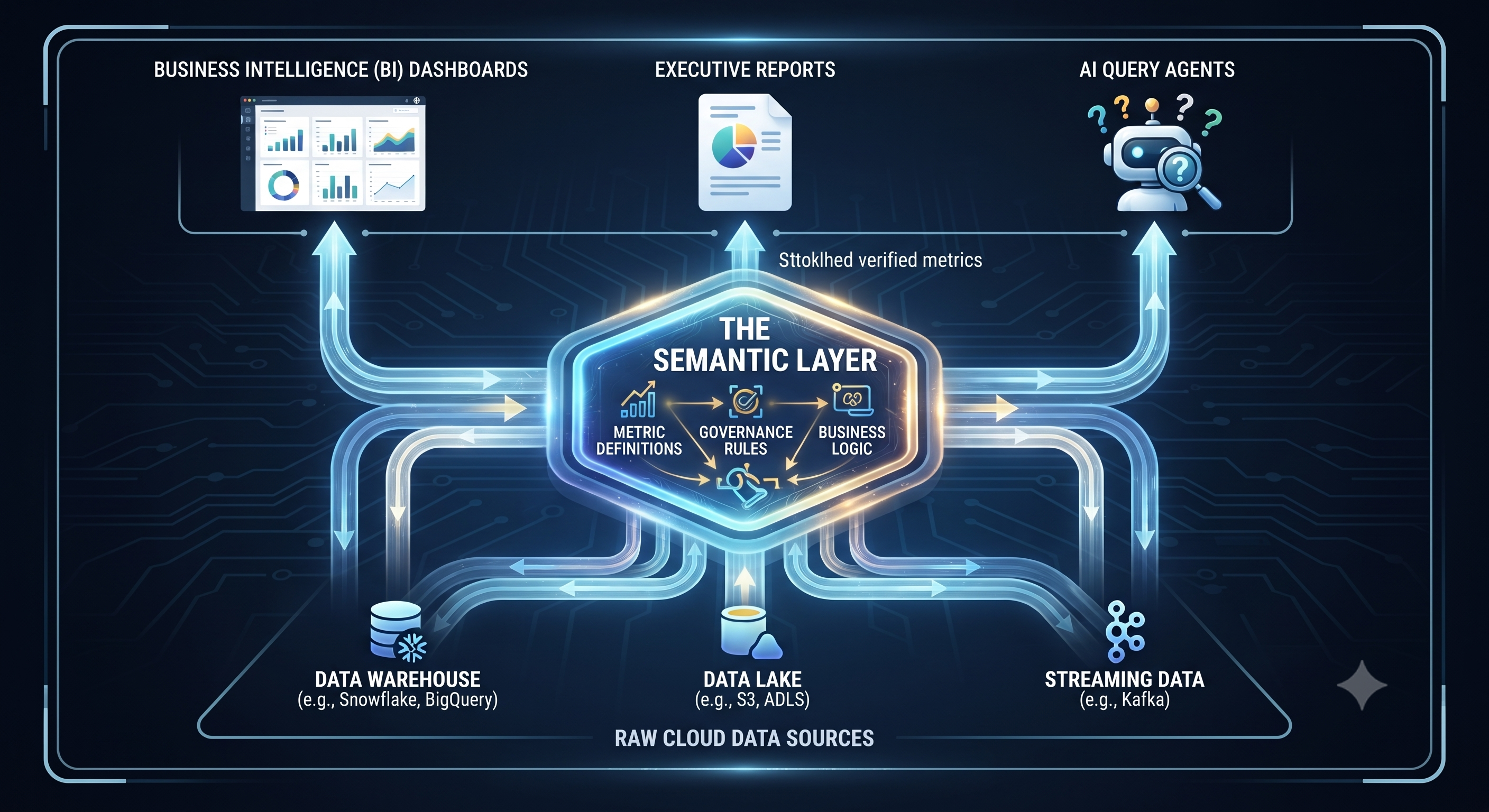
A semantic layer sits directly between your cloud data warehouse (like Snowflake, BigQuery, or Databricks) and your consumption tools (BI platforms, custom apps, or AI agents). It acts as a single, centralized source of truth that translates raw database tables into business-friendly metrics.
Why does this architecture matter so much?
Single Definition of Truth: Define a metric like "Monthly Active Users" or "Net Revenue Retention" once. Every dashboard, report, and AI query pulls that exact same definition.
Future-Proofing for AI: As organizations integrate AI tools and automated agents, those agents need governed, structured definitions rather than guessing raw table schemas.
Performance Optimization: By handling pre-aggregations and caching within the semantic layer, query latency drops dramatically across heavy enterprise workloads.
Discussion Question
How does your team currently handle metric definitions? Do you rely on centralized modeling tools (like dbt or Cube) or are calculations still embedded directly inside individual BI dashboards?
CTA (Join Data Science & Analytics)
Want to master modern data architecture, advanced SQL, cloud pipelines, and analytics engineering alongside a global community of data professionals? Join Data Science & Analytics today and build robust data systems!
As data analytics scales across modern enterprises, the bottleneck has shifted from raw storage capacity to metric consistency. When business intelligence tools, executive reports, and AI assistants query a data warehouse directly, slight variations in SQL logic lead to conflicting numbers—destroying trust in data-driven decision making.
The ultimate solution adopted by top analytics teams is the implementation of a Semantic Layer.
What is a Semantic Layer?
A semantic layer sits directly between your cloud data warehouse (like Snowflake, BigQuery, or Databricks) and your consumption tools (BI platforms, custom apps, or AI agents). It acts as a single, centralized source of truth that translates raw database tables into business-friendly metrics.
Why does this architecture matter so much?
Single Definition of Truth: Define a metric like "Monthly Active Users" or "Net Revenue Retention" once. Every dashboard, report, and AI query pulls that exact same definition.
Future-Proofing for AI: As organizations integrate AI tools and automated agents, those agents need governed, structured definitions rather than guessing raw table schemas.
Performance Optimization: By handling pre-aggregations and caching within the semantic layer, query latency drops dramatically across heavy enterprise workloads.
Discussion Question
How does your team currently handle metric definitions? Do you rely on centralized modeling tools (like dbt or Cube) or are calculations still embedded directly inside individual BI dashboards?
CTA (Join Data Science & Analytics)
Want to master modern data architecture, advanced SQL, cloud pipelines, and analytics engineering alongside a global community of data professionals? Join Data Science & Analytics today and build robust data systems!
Beyond the Dashboard: Why the "Semantic Layer" is the Most Critical Architecture Shift for Modern Data Teams
As data analytics scales across modern enterprises, the bottleneck has shifted from raw storage capacity to metric consistency. When business intelligence tools, executive reports, and AI assistants query a data warehouse directly, slight variations in SQL logic lead to conflicting numbers—destroying trust in data-driven decision making.
The ultimate solution adopted by top analytics teams is the implementation of a Semantic Layer.
What is a Semantic Layer?
A semantic layer sits directly between your cloud data warehouse (like Snowflake, BigQuery, or Databricks) and your consumption tools (BI platforms, custom apps, or AI agents). It acts as a single, centralized source of truth that translates raw database tables into business-friendly metrics.
Why does this architecture matter so much?
Single Definition of Truth: Define a metric like "Monthly Active Users" or "Net Revenue Retention" once. Every dashboard, report, and AI query pulls that exact same definition.
Future-Proofing for AI: As organizations integrate AI tools and automated agents, those agents need governed, structured definitions rather than guessing raw table schemas.
Performance Optimization: By handling pre-aggregations and caching within the semantic layer, query latency drops dramatically across heavy enterprise workloads.
Discussion Question
How does your team currently handle metric definitions? Do you rely on centralized modeling tools (like dbt or Cube) or are calculations still embedded directly inside individual BI dashboards?
CTA (Join Data Science & Analytics)
Want to master modern data architecture, advanced SQL, cloud pipelines, and analytics engineering alongside a global community of data professionals? Join Data Science & Analytics today and build robust data systems!

 English
 Arabic
 French
 Spanish
 Portuguese
 Deutsch
 Turkish
 Dutch
Dutch
 Italiano
 Russian
 Portuguese (Brazil)
 Greek
Greek