


Feature Store vs. Database View: Where Should Your Real-Time Feature Logic Actually Live?
When scaling production machine learning, the boundary between data engineering and machine learning operations often blurs around one critical component: feature transformation and retrieval.
A common debate among data platforms is whether to invest in a dedicated Feature Store (like Feast, Hopsworks, or managed cloud alternatives) or rely on Optimized Database Views/dbt pipelines running against an analytical warehouse or low-latency operational store (like Redis, DynamoDB, or PostgreSQL).
Here is how the trade-offs break down in practice:
Point-in-Time Correctness (Time-Travel Joins)
Database Views: Complex to write and computationally expensive when reconstructing feature values as of an exact timestamp without data leakage.
Feature Stores: Built natively with point-in-time correctness, joining historical labels with the exact feature values that were valid at prediction time.
Training-Serving Skew
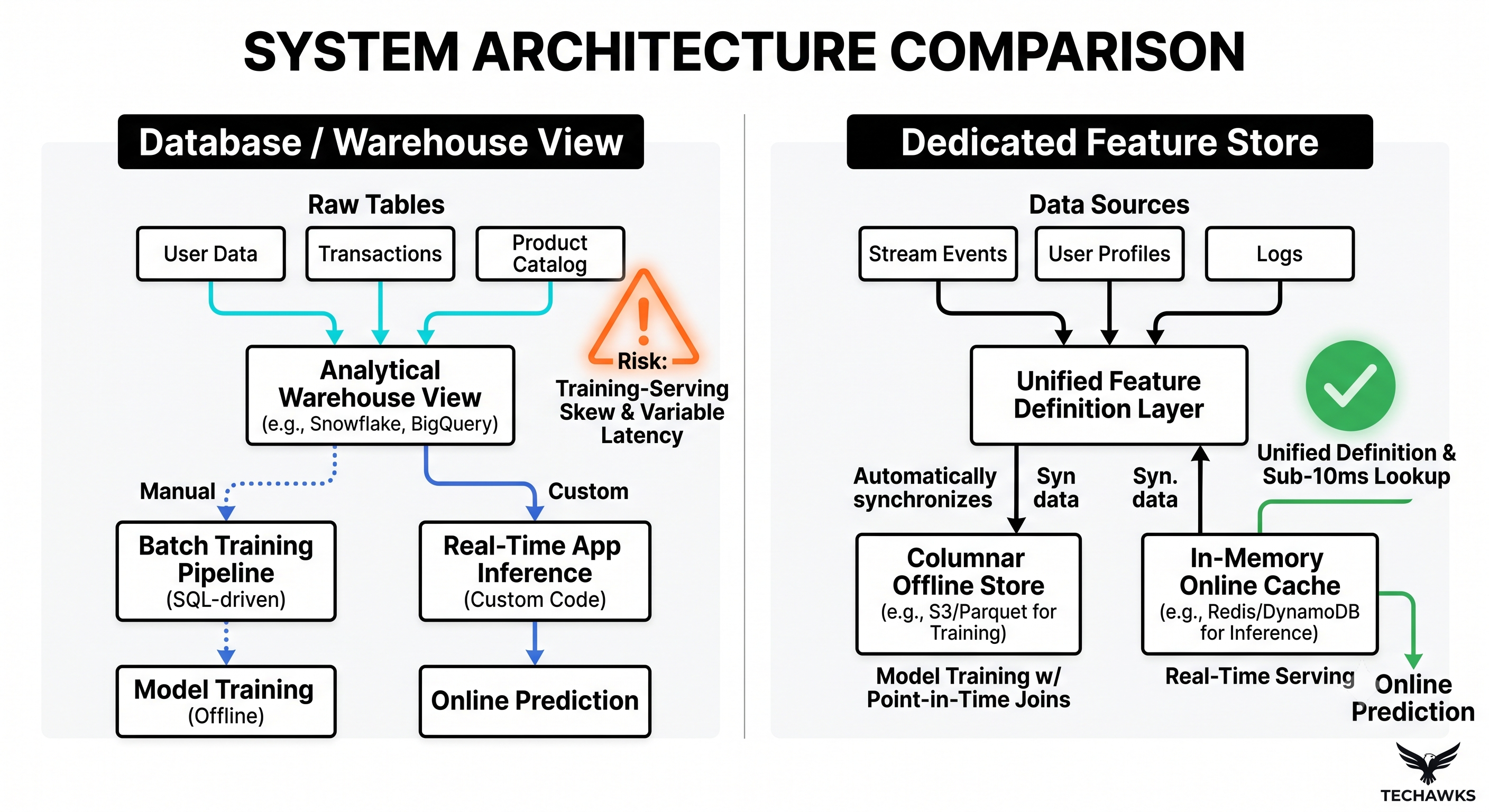
Database Views: Often require dual implementations: SQL for historical training batches, and Python/Go microservices for low-latency production inference. Any subtle divergence between these definitions causes silent model degradation.
Feature Stores: Provide a single definition interface. Features are computed once and pushed to both the offline store (for model training) and the low-latency online store (for real-time inference).
Latency and Query Semantics
Database Views: Complex aggregations (e.g., number of transactions in the last 10 minutes) can struggle to maintain sub-50ms p99 SLA under high-concurrency production load unless heavily pre-indexed or cached.
Feature Stores: Pre-materialize real-time entity features directly into an in-memory key-value cache, reducing inference lookup to single-digit milliseconds.
The catch? A feature store introduces platform complexity, extra synchronization layers, and maintenance overhead that smaller teams may not need if their inference workflows are purely batch-driven.
Key Takeaways
Stick to DB Views/dbt if your inference is batch-only, features update on daily/hourly schedules, and latency under 100ms is not a hard constraint.
Adopt a Feature Store when you have online/real-time inference, multiple models sharing the same entity features, or recurring issues with data leakage during training set creation.
Consistency across the offline/online boundary is usually the deciding factor, not just storage speed.
CTA
Where does your team draw the line?
If you are currently serving models in production: Have you migrated to a dedicated feature store, or are you successfully managing offline-to-online parity using warehouse transformations and key-value tables? Let's break down the architectural choices in the comments.
When scaling production machine learning, the boundary between data engineering and machine learning operations often blurs around one critical component: feature transformation and retrieval.
A common debate among data platforms is whether to invest in a dedicated Feature Store (like Feast, Hopsworks, or managed cloud alternatives) or rely on Optimized Database Views/dbt pipelines running against an analytical warehouse or low-latency operational store (like Redis, DynamoDB, or PostgreSQL).
Here is how the trade-offs break down in practice:
Point-in-Time Correctness (Time-Travel Joins)
Database Views: Complex to write and computationally expensive when reconstructing feature values as of an exact timestamp without data leakage.
Feature Stores: Built natively with point-in-time correctness, joining historical labels with the exact feature values that were valid at prediction time.
Training-Serving Skew
Database Views: Often require dual implementations: SQL for historical training batches, and Python/Go microservices for low-latency production inference. Any subtle divergence between these definitions causes silent model degradation.
Feature Stores: Provide a single definition interface. Features are computed once and pushed to both the offline store (for model training) and the low-latency online store (for real-time inference).
Latency and Query Semantics
Database Views: Complex aggregations (e.g., number of transactions in the last 10 minutes) can struggle to maintain sub-50ms p99 SLA under high-concurrency production load unless heavily pre-indexed or cached.
Feature Stores: Pre-materialize real-time entity features directly into an in-memory key-value cache, reducing inference lookup to single-digit milliseconds.
The catch? A feature store introduces platform complexity, extra synchronization layers, and maintenance overhead that smaller teams may not need if their inference workflows are purely batch-driven.
Key Takeaways
Stick to DB Views/dbt if your inference is batch-only, features update on daily/hourly schedules, and latency under 100ms is not a hard constraint.
Adopt a Feature Store when you have online/real-time inference, multiple models sharing the same entity features, or recurring issues with data leakage during training set creation.
Consistency across the offline/online boundary is usually the deciding factor, not just storage speed.
CTA
Where does your team draw the line?
If you are currently serving models in production: Have you migrated to a dedicated feature store, or are you successfully managing offline-to-online parity using warehouse transformations and key-value tables? Let's break down the architectural choices in the comments.
Feature Store vs. Database View: Where Should Your Real-Time Feature Logic Actually Live?
When scaling production machine learning, the boundary between data engineering and machine learning operations often blurs around one critical component: feature transformation and retrieval.
A common debate among data platforms is whether to invest in a dedicated Feature Store (like Feast, Hopsworks, or managed cloud alternatives) or rely on Optimized Database Views/dbt pipelines running against an analytical warehouse or low-latency operational store (like Redis, DynamoDB, or PostgreSQL).
Here is how the trade-offs break down in practice:
Point-in-Time Correctness (Time-Travel Joins)
Database Views: Complex to write and computationally expensive when reconstructing feature values as of an exact timestamp without data leakage.
Feature Stores: Built natively with point-in-time correctness, joining historical labels with the exact feature values that were valid at prediction time.
Training-Serving Skew
Database Views: Often require dual implementations: SQL for historical training batches, and Python/Go microservices for low-latency production inference. Any subtle divergence between these definitions causes silent model degradation.
Feature Stores: Provide a single definition interface. Features are computed once and pushed to both the offline store (for model training) and the low-latency online store (for real-time inference).
Latency and Query Semantics
Database Views: Complex aggregations (e.g., number of transactions in the last 10 minutes) can struggle to maintain sub-50ms p99 SLA under high-concurrency production load unless heavily pre-indexed or cached.
Feature Stores: Pre-materialize real-time entity features directly into an in-memory key-value cache, reducing inference lookup to single-digit milliseconds.
The catch? A feature store introduces platform complexity, extra synchronization layers, and maintenance overhead that smaller teams may not need if their inference workflows are purely batch-driven.
Key Takeaways
Stick to DB Views/dbt if your inference is batch-only, features update on daily/hourly schedules, and latency under 100ms is not a hard constraint.
Adopt a Feature Store when you have online/real-time inference, multiple models sharing the same entity features, or recurring issues with data leakage during training set creation.
Consistency across the offline/online boundary is usually the deciding factor, not just storage speed.
CTA
Where does your team draw the line?
If you are currently serving models in production: Have you migrated to a dedicated feature store, or are you successfully managing offline-to-online parity using warehouse transformations and key-value tables? Let's break down the architectural choices in the comments.

 Arabic
 French
 Spanish
 Portuguese
 Deutsch
 Turkish
 Dutch
Dutch
 Italiano
 Russian
 Romaian
 Portuguese (Brazil)
 Greek
Greek