


The 2026 SaaS Unit Economics Pivot: Why AI Margin Compression Means You Must Redesign Your LTV:CAC Ratio Today
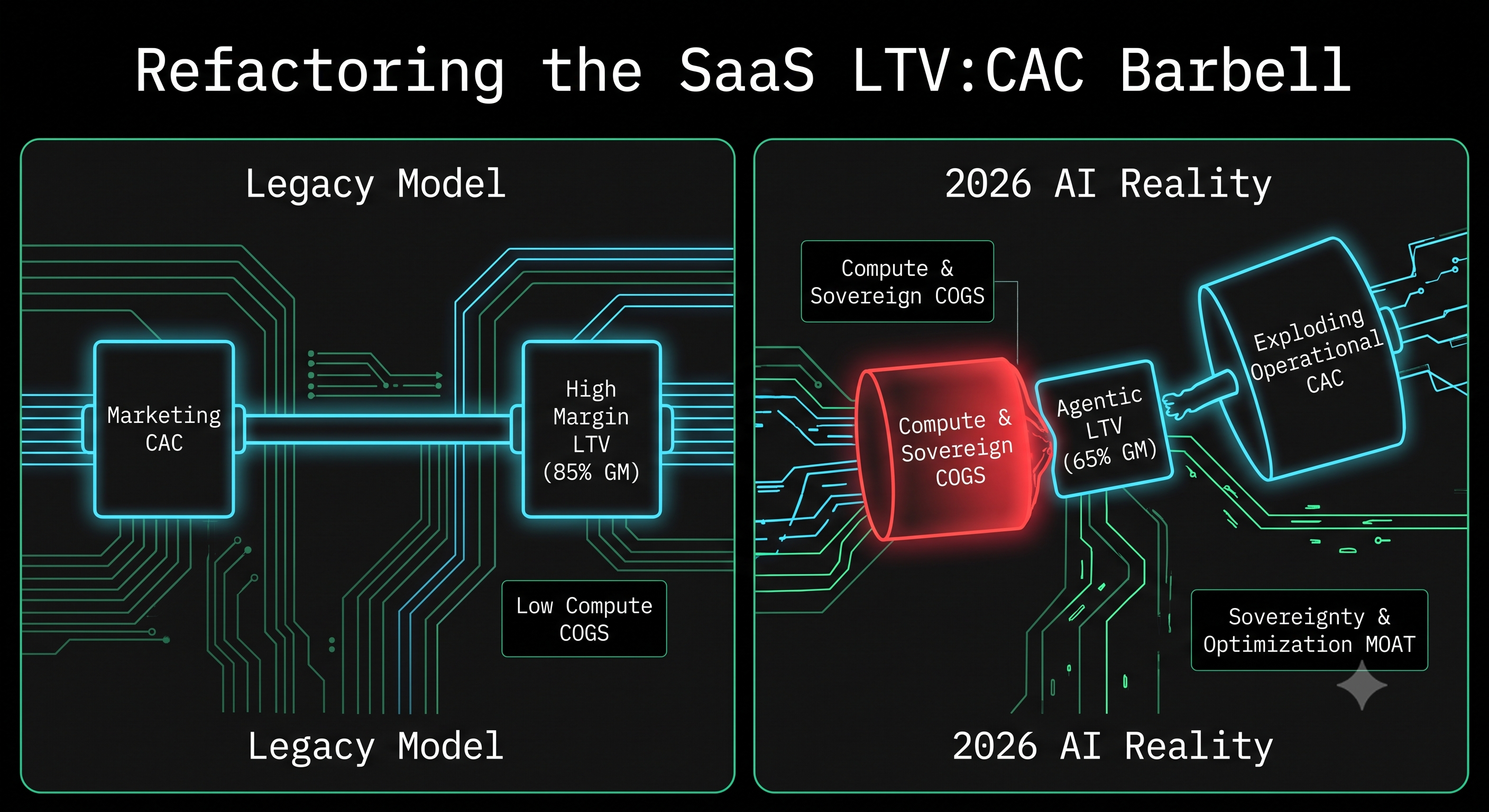
We are witnessing a fundamental barbell shift in software value. The era where generalist SaaS models enjoyed 80%+ gross margins—while relying on cheap, sequential marketing spend to drive growth—is ending.
AI integration has introduced the "Compute Tax": the reality that deep feature sets (like autonomous agents, continuous RAG re-indexing, and multimodal processing) introduce variable COGS that scale aggressively with user engagement. This compresses gross margins below historical SaaS benchmarks.
Why This Matters to Founders (The Capital View):
Seed and Series A investors in 2026 are aggressively discounting startups that mask high inference costs in their R&D budget rather than the Cost of Goods Sold (COGS).
To maintain healthy unit economics when your gross margin compresses to 60–70% (due to LLM API calls and sovereign GPU compute), you cannot rely purely on decreasing marketing CAC. You must refactor your LTV generation engine.
Tactical Playbook: The Sovereignty Pivot
To defend your LTV:CAC ratio, move beyond generic prompt-engineering and build structural Sovereign-Margin Moats:
Implement Sovereign-First Hybrid Runtimes:
Sending sensitive B2B telemetry or financial data to foreign, multi-tenant LLM APIs is now a critical regulatory liability (under UAE PDPL, Quebec Law 25, etc.).
Transition your critical agentic workloads to in-country, sovereign VPC clusters (like Core42 or localized AWS/Azure ca-central-1 instances).
Self-host optimized open-weight models (like Falcon or fine-tuned compact architectures) within your secure boundary. This locks data sovereignty and locks in deterministic inference COGS, preventing margin leakage from volatile vendor API pricing.
Context-Aware Semantic Scrubbing Before Inference:
Build a local upstream proxy layer that automatically redsacts PII (Emirates ID numbers, Canadian SSNs, regional bank IBANs) using lightweight local BERT-based models before routing sanitized data to external foundation models for non-sensitive reasoning. This satisfies compliance and dramatically prunes expensive token count.
Decouple Value from Sequential Engagement:
Stop charging purely by the sequential seat. Instead of [User input -> LLM wait -> Output], design asynchronous, value-driven agentic loops where users pay for finalized tasks or outcomes (e.g., a processed accounting audit or a generated regulatory filing), decoupled from variable, sequential token execution.
Discussion Question
What is the current relationship between your AI feature usage and your Gross Margin? Have you successfully decoupled your pricing model from sequential, autoregressive engagement, or are you still relying on traditional seat-based licensing while bearing high inference COGS?
CTA (Encourage founders to share lessons)
Drop your real numbers and hard lessons below: Have you migrated critical workloads to in-country sovereign clouds (Falcon/Llama-local) to protect margins and satisfy data sovereignty? Let’s compare architecture playbooks and refactor our 2026 unit economics models.
We are witnessing a fundamental barbell shift in software value. The era where generalist SaaS models enjoyed 80%+ gross margins—while relying on cheap, sequential marketing spend to drive growth—is ending.
AI integration has introduced the "Compute Tax": the reality that deep feature sets (like autonomous agents, continuous RAG re-indexing, and multimodal processing) introduce variable COGS that scale aggressively with user engagement. This compresses gross margins below historical SaaS benchmarks.
Why This Matters to Founders (The Capital View):
Seed and Series A investors in 2026 are aggressively discounting startups that mask high inference costs in their R&D budget rather than the Cost of Goods Sold (COGS).
To maintain healthy unit economics when your gross margin compresses to 60–70% (due to LLM API calls and sovereign GPU compute), you cannot rely purely on decreasing marketing CAC. You must refactor your LTV generation engine.
Tactical Playbook: The Sovereignty Pivot
To defend your LTV:CAC ratio, move beyond generic prompt-engineering and build structural Sovereign-Margin Moats:
Implement Sovereign-First Hybrid Runtimes:
Sending sensitive B2B telemetry or financial data to foreign, multi-tenant LLM APIs is now a critical regulatory liability (under UAE PDPL, Quebec Law 25, etc.).
Transition your critical agentic workloads to in-country, sovereign VPC clusters (like Core42 or localized AWS/Azure ca-central-1 instances).
Self-host optimized open-weight models (like Falcon or fine-tuned compact architectures) within your secure boundary. This locks data sovereignty and locks in deterministic inference COGS, preventing margin leakage from volatile vendor API pricing.
Context-Aware Semantic Scrubbing Before Inference:
Build a local upstream proxy layer that automatically redsacts PII (Emirates ID numbers, Canadian SSNs, regional bank IBANs) using lightweight local BERT-based models before routing sanitized data to external foundation models for non-sensitive reasoning. This satisfies compliance and dramatically prunes expensive token count.
Decouple Value from Sequential Engagement:
Stop charging purely by the sequential seat. Instead of [User input -> LLM wait -> Output], design asynchronous, value-driven agentic loops where users pay for finalized tasks or outcomes (e.g., a processed accounting audit or a generated regulatory filing), decoupled from variable, sequential token execution.
Discussion Question
What is the current relationship between your AI feature usage and your Gross Margin? Have you successfully decoupled your pricing model from sequential, autoregressive engagement, or are you still relying on traditional seat-based licensing while bearing high inference COGS?
CTA (Encourage founders to share lessons)
Drop your real numbers and hard lessons below: Have you migrated critical workloads to in-country sovereign clouds (Falcon/Llama-local) to protect margins and satisfy data sovereignty? Let’s compare architecture playbooks and refactor our 2026 unit economics models.
The 2026 SaaS Unit Economics Pivot: Why AI Margin Compression Means You Must Redesign Your LTV:CAC Ratio Today
We are witnessing a fundamental barbell shift in software value. The era where generalist SaaS models enjoyed 80%+ gross margins—while relying on cheap, sequential marketing spend to drive growth—is ending.
AI integration has introduced the "Compute Tax": the reality that deep feature sets (like autonomous agents, continuous RAG re-indexing, and multimodal processing) introduce variable COGS that scale aggressively with user engagement. This compresses gross margins below historical SaaS benchmarks.
Why This Matters to Founders (The Capital View):
Seed and Series A investors in 2026 are aggressively discounting startups that mask high inference costs in their R&D budget rather than the Cost of Goods Sold (COGS).
To maintain healthy unit economics when your gross margin compresses to 60–70% (due to LLM API calls and sovereign GPU compute), you cannot rely purely on decreasing marketing CAC. You must refactor your LTV generation engine.
Tactical Playbook: The Sovereignty Pivot
To defend your LTV:CAC ratio, move beyond generic prompt-engineering and build structural Sovereign-Margin Moats:
Implement Sovereign-First Hybrid Runtimes:
Sending sensitive B2B telemetry or financial data to foreign, multi-tenant LLM APIs is now a critical regulatory liability (under UAE PDPL, Quebec Law 25, etc.).
Transition your critical agentic workloads to in-country, sovereign VPC clusters (like Core42 or localized AWS/Azure ca-central-1 instances).
Self-host optimized open-weight models (like Falcon or fine-tuned compact architectures) within your secure boundary. This locks data sovereignty and locks in deterministic inference COGS, preventing margin leakage from volatile vendor API pricing.
Context-Aware Semantic Scrubbing Before Inference:
Build a local upstream proxy layer that automatically redsacts PII (Emirates ID numbers, Canadian SSNs, regional bank IBANs) using lightweight local BERT-based models before routing sanitized data to external foundation models for non-sensitive reasoning. This satisfies compliance and dramatically prunes expensive token count.
Decouple Value from Sequential Engagement:
Stop charging purely by the sequential seat. Instead of [User input -> LLM wait -> Output], design asynchronous, value-driven agentic loops where users pay for finalized tasks or outcomes (e.g., a processed accounting audit or a generated regulatory filing), decoupled from variable, sequential token execution.
Discussion Question
What is the current relationship between your AI feature usage and your Gross Margin? Have you successfully decoupled your pricing model from sequential, autoregressive engagement, or are you still relying on traditional seat-based licensing while bearing high inference COGS?
CTA (Encourage founders to share lessons)
Drop your real numbers and hard lessons below: Have you migrated critical workloads to in-country sovereign clouds (Falcon/Llama-local) to protect margins and satisfy data sovereignty? Let’s compare architecture playbooks and refactor our 2026 unit economics models.

 Arabic
 French
 Spanish
 Portuguese
 Deutsch
 Turkish
 Dutch
Dutch
 Italiano
 Russian
 Romaian
 Portuguese (Brazil)
 Greek
Greek