


Resizing Stateful Streaming Without Checkpoint Wipeouts: The End of Cold Replays
Scaling stateless stream processing (mapping, filtering, schema casting) is trivial—you spin up more consumer nodes. Scaling stateful operations (sessionization, rolling aggregations, continuous watermarking, and real-time anomaly detection) has historically been an architectural headache.
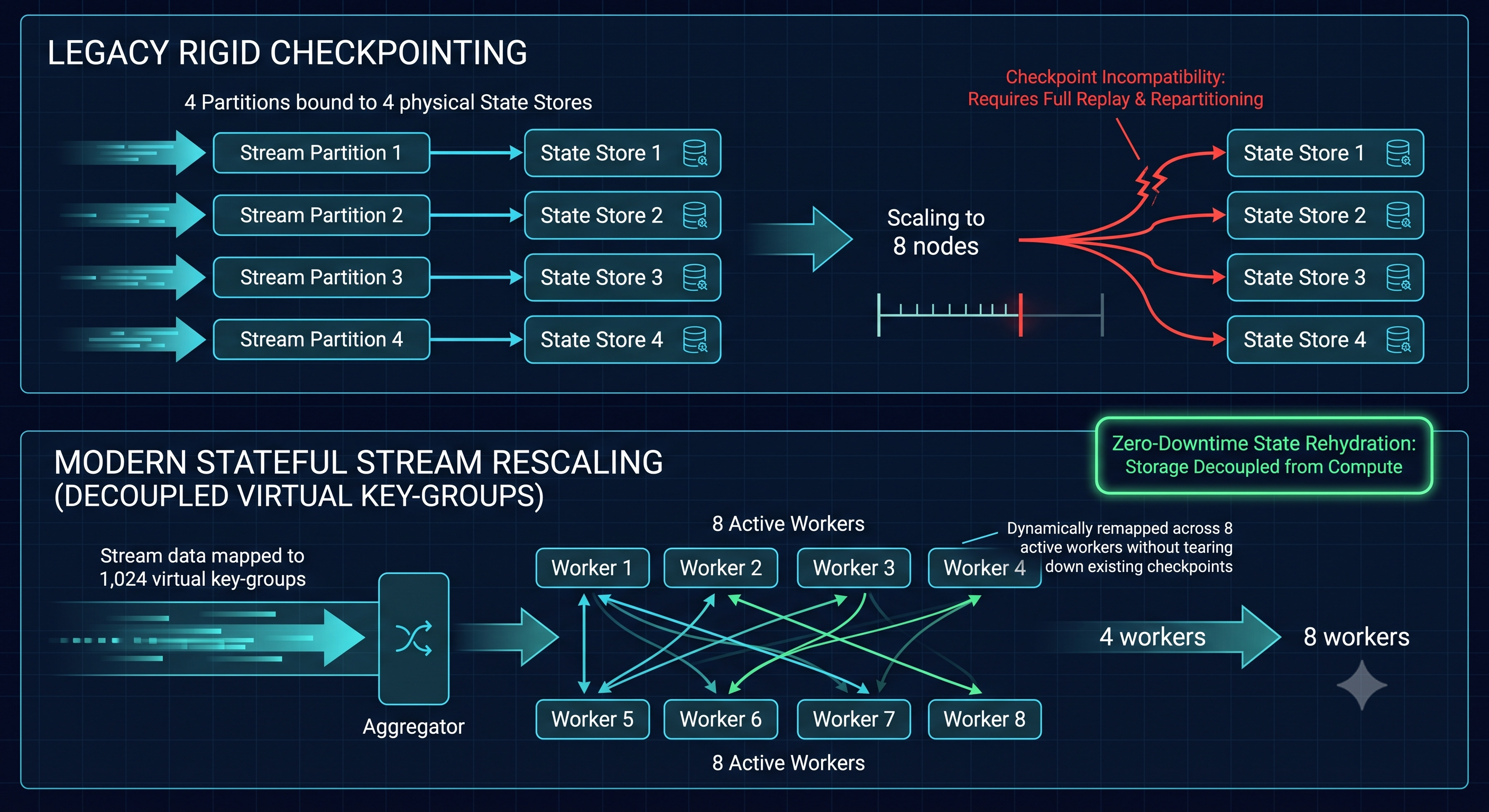
When state is tied directly to physical partition geometry via serialized checkpoint directories (such as RocksDB state stores), altering parallel task slots typically breaks partition-to-state affinity. If your stream lags during an unexpected surge, your options used to be brutal: over-provision 24/7 or endure downtime while rehydrating multi-gigabyte state buffers.
Recent engine upgrades across the streaming ecosystem—most notably dynamic partition reassignment and checkpoint-preserving rescaling in modern Spark Structured Streaming and Flink deployments—fundamentally change how data teams manage live ML inference and real-time aggregations.
Key Technical Takeaway: Decoupled Key-Group Routing
Instead of binding checkpointed state directly to partition IDs:
Virtual Key-Grouping: Continuous aggregations distribute incoming keys across a fixed, oversized virtual key-space (e.g., 1024 virtual buckets) rather than hardcoded physical worker partitions.
State Store Decoupling: When worker capacity scales from 4 to 16 executors, the streaming runtime re-assigns virtual key ranges across the newly allocated workers.
Differential State Rehydration: Workers fetch only their designated slice of the checkpoint state asynchronously from object storage, avoiding total pipeline stops and eliminating manual consumer group offset resets.
Operational Checklist: Evaluating Stateful Resiliency
Check State Serialization Overhead: Ensure your stateful operators use native memory formats or off-heap engines to prevent JVM garbage-collection pauses during rebalance.
Audit Watermark Lateness Policies: Tighten allowed lateness windows. Storing unnecessary out-of-order records inflates checkpoint size, making live worker re-allocation drag.
Implement Asynchronous Snapshotting: Decouple state persistence from message commit loops so scaling operations don't cascade backpressure into Kafka or event-bus ingest layers.
Discussion Question
How does your team handle partition scaling for stateful streaming pipelines during volume spikes—do you over-provision baseline compute, rely on dynamic slot reassignment, or run scheduled checkpoint rebuilds?
CTA
Share your streaming architecture tradeoffs and war stories in the comments. Let's dig into how your team balances state durability, low latency, and cloud infrastructure costs.
Scaling stateless stream processing (mapping, filtering, schema casting) is trivial—you spin up more consumer nodes. Scaling stateful operations (sessionization, rolling aggregations, continuous watermarking, and real-time anomaly detection) has historically been an architectural headache.
When state is tied directly to physical partition geometry via serialized checkpoint directories (such as RocksDB state stores), altering parallel task slots typically breaks partition-to-state affinity. If your stream lags during an unexpected surge, your options used to be brutal: over-provision 24/7 or endure downtime while rehydrating multi-gigabyte state buffers.
Recent engine upgrades across the streaming ecosystem—most notably dynamic partition reassignment and checkpoint-preserving rescaling in modern Spark Structured Streaming and Flink deployments—fundamentally change how data teams manage live ML inference and real-time aggregations.
Key Technical Takeaway: Decoupled Key-Group Routing
Instead of binding checkpointed state directly to partition IDs:
Virtual Key-Grouping: Continuous aggregations distribute incoming keys across a fixed, oversized virtual key-space (e.g., 1024 virtual buckets) rather than hardcoded physical worker partitions.
State Store Decoupling: When worker capacity scales from 4 to 16 executors, the streaming runtime re-assigns virtual key ranges across the newly allocated workers.
Differential State Rehydration: Workers fetch only their designated slice of the checkpoint state asynchronously from object storage, avoiding total pipeline stops and eliminating manual consumer group offset resets.
Operational Checklist: Evaluating Stateful Resiliency
Check State Serialization Overhead: Ensure your stateful operators use native memory formats or off-heap engines to prevent JVM garbage-collection pauses during rebalance.
Audit Watermark Lateness Policies: Tighten allowed lateness windows. Storing unnecessary out-of-order records inflates checkpoint size, making live worker re-allocation drag.
Implement Asynchronous Snapshotting: Decouple state persistence from message commit loops so scaling operations don't cascade backpressure into Kafka or event-bus ingest layers.
Discussion Question
How does your team handle partition scaling for stateful streaming pipelines during volume spikes—do you over-provision baseline compute, rely on dynamic slot reassignment, or run scheduled checkpoint rebuilds?
CTA
Share your streaming architecture tradeoffs and war stories in the comments. Let's dig into how your team balances state durability, low latency, and cloud infrastructure costs.
Resizing Stateful Streaming Without Checkpoint Wipeouts: The End of Cold Replays
Scaling stateless stream processing (mapping, filtering, schema casting) is trivial—you spin up more consumer nodes. Scaling stateful operations (sessionization, rolling aggregations, continuous watermarking, and real-time anomaly detection) has historically been an architectural headache.
When state is tied directly to physical partition geometry via serialized checkpoint directories (such as RocksDB state stores), altering parallel task slots typically breaks partition-to-state affinity. If your stream lags during an unexpected surge, your options used to be brutal: over-provision 24/7 or endure downtime while rehydrating multi-gigabyte state buffers.
Recent engine upgrades across the streaming ecosystem—most notably dynamic partition reassignment and checkpoint-preserving rescaling in modern Spark Structured Streaming and Flink deployments—fundamentally change how data teams manage live ML inference and real-time aggregations.
Key Technical Takeaway: Decoupled Key-Group Routing
Instead of binding checkpointed state directly to partition IDs:
Virtual Key-Grouping: Continuous aggregations distribute incoming keys across a fixed, oversized virtual key-space (e.g., 1024 virtual buckets) rather than hardcoded physical worker partitions.
State Store Decoupling: When worker capacity scales from 4 to 16 executors, the streaming runtime re-assigns virtual key ranges across the newly allocated workers.
Differential State Rehydration: Workers fetch only their designated slice of the checkpoint state asynchronously from object storage, avoiding total pipeline stops and eliminating manual consumer group offset resets.
Operational Checklist: Evaluating Stateful Resiliency
Check State Serialization Overhead: Ensure your stateful operators use native memory formats or off-heap engines to prevent JVM garbage-collection pauses during rebalance.
Audit Watermark Lateness Policies: Tighten allowed lateness windows. Storing unnecessary out-of-order records inflates checkpoint size, making live worker re-allocation drag.
Implement Asynchronous Snapshotting: Decouple state persistence from message commit loops so scaling operations don't cascade backpressure into Kafka or event-bus ingest layers.
Discussion Question
How does your team handle partition scaling for stateful streaming pipelines during volume spikes—do you over-provision baseline compute, rely on dynamic slot reassignment, or run scheduled checkpoint rebuilds?
CTA
Share your streaming architecture tradeoffs and war stories in the comments. Let's dig into how your team balances state durability, low latency, and cloud infrastructure costs.

 Arabic
 French
 Spanish
 Portuguese
 Deutsch
 Turkish
 Dutch
Dutch
 Italiano
 Russian
 Romaian
 Portuguese (Brazil)
 Greek
Greek