


Beyond the Perimeter: Why Identity Is the New Security Control Plane
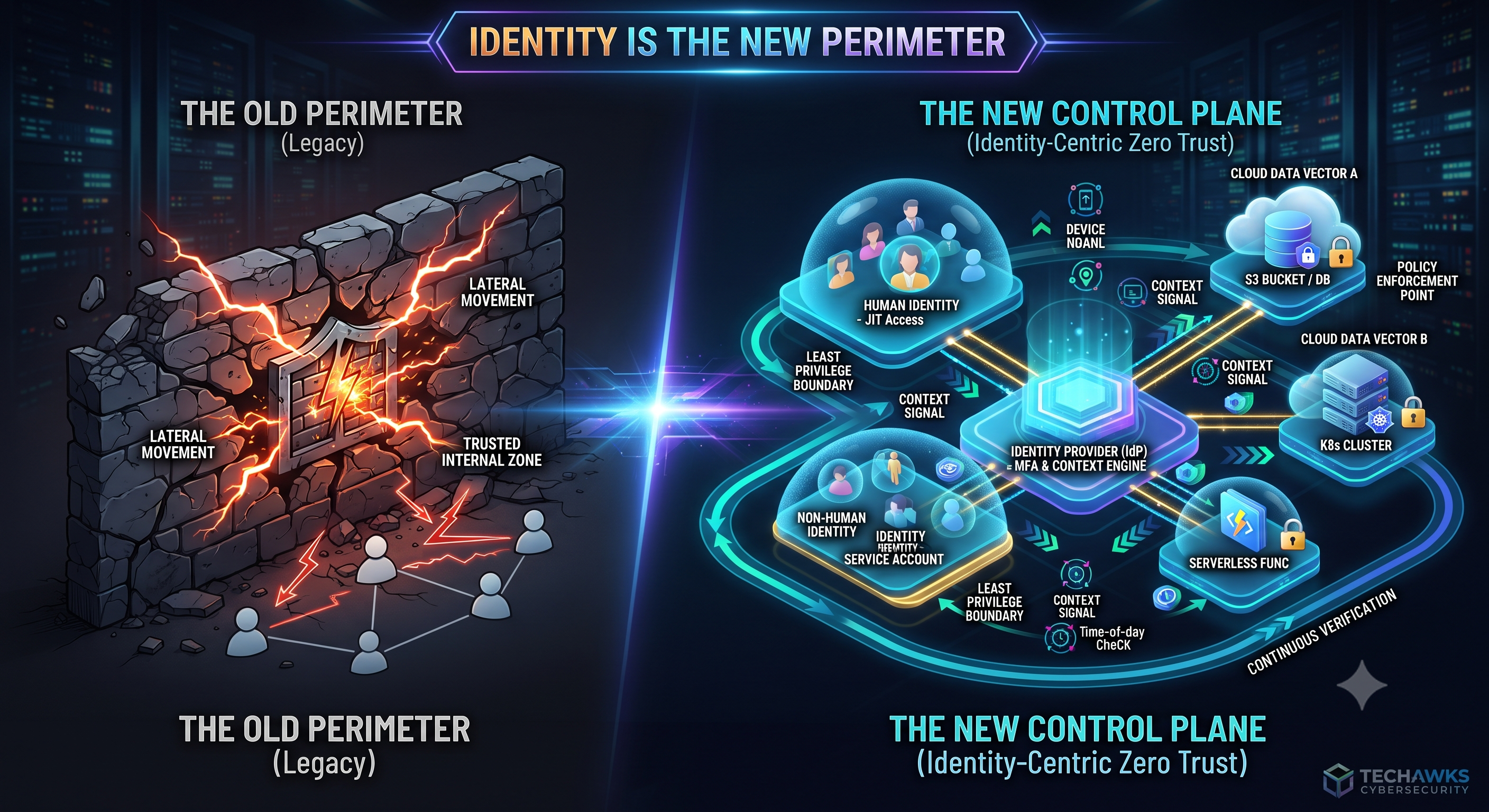
As modern architectures shift toward cloud ecosystems and automated systems, Identity and Access Management (IAM) has officially replaced the firewall as the frontline perimeter.
Attackers no longer need to brute-force a network perimeter when they can simply steal or abuse legitimate credentials and non-human identities. Under a Zero Trust model, security is no longer about where a request originates, but who or what is making it, and whether their context justifies access.
Why This Matters
The Rise of Non-Human Identities: APIs, microservices, and autonomous AI workflows now outnumber human users, creating a massive, often unmonitored attack surface.
Lateral Movement Risks: Once an attacker compromises a single weak credential in a legacy setup, they can roam freely across internal resources. Zero Trust micro-segmentation stops this blast radius.
Contextual Blindness: Static passwords and single-point logins are obsolete. Modern threats require continuous, real-time evaluation of device posture, user behavior, and risk signals.
What You Can Learn: Implementing Zero Trust Fundamentals
To harden your security posture and master identity-centric defense, focus on these core execution principles:
Enforce Least Privilege (PoLP): Ensure human users, workloads, and service accounts possess only the exact permissions needed for their immediate tasks—nothing more.
Mandate Adaptive MFA & JIT Access: Move beyond static multi-factor authentication by implementing Just-In-Time (JIT) elevation and context-aware conditional access policies.
Audit Non-Human Identities (NHIs): Treat API keys, service tokens, and agent connections with the same rigorous governance and rotation lifecycle applied to human admin accounts.
Discussion Question
How is your team currently tracking and governing non-human identities and service accounts? Are you noticing privilege sprawl in your cloud environments? Let’s secure the conversation below!
CTA (Join Cybersecurity & Ethical Hacking)
Want to dive deeper into Zero Trust architecture, threat hunting, and modern defense strategies? Join Cybersecurity & Ethical Hacking today to collaborate with defenders worldwide.
As modern architectures shift toward cloud ecosystems and automated systems, Identity and Access Management (IAM) has officially replaced the firewall as the frontline perimeter.
Attackers no longer need to brute-force a network perimeter when they can simply steal or abuse legitimate credentials and non-human identities. Under a Zero Trust model, security is no longer about where a request originates, but who or what is making it, and whether their context justifies access.
Why This Matters
The Rise of Non-Human Identities: APIs, microservices, and autonomous AI workflows now outnumber human users, creating a massive, often unmonitored attack surface.
Lateral Movement Risks: Once an attacker compromises a single weak credential in a legacy setup, they can roam freely across internal resources. Zero Trust micro-segmentation stops this blast radius.
Contextual Blindness: Static passwords and single-point logins are obsolete. Modern threats require continuous, real-time evaluation of device posture, user behavior, and risk signals.
What You Can Learn: Implementing Zero Trust Fundamentals
To harden your security posture and master identity-centric defense, focus on these core execution principles:
Enforce Least Privilege (PoLP): Ensure human users, workloads, and service accounts possess only the exact permissions needed for their immediate tasks—nothing more.
Mandate Adaptive MFA & JIT Access: Move beyond static multi-factor authentication by implementing Just-In-Time (JIT) elevation and context-aware conditional access policies.
Audit Non-Human Identities (NHIs): Treat API keys, service tokens, and agent connections with the same rigorous governance and rotation lifecycle applied to human admin accounts.
Discussion Question
How is your team currently tracking and governing non-human identities and service accounts? Are you noticing privilege sprawl in your cloud environments? Let’s secure the conversation below!
CTA (Join Cybersecurity & Ethical Hacking)
Want to dive deeper into Zero Trust architecture, threat hunting, and modern defense strategies? Join Cybersecurity & Ethical Hacking today to collaborate with defenders worldwide.
Beyond the Perimeter: Why Identity Is the New Security Control Plane
As modern architectures shift toward cloud ecosystems and automated systems, Identity and Access Management (IAM) has officially replaced the firewall as the frontline perimeter.
Attackers no longer need to brute-force a network perimeter when they can simply steal or abuse legitimate credentials and non-human identities. Under a Zero Trust model, security is no longer about where a request originates, but who or what is making it, and whether their context justifies access.
Why This Matters
The Rise of Non-Human Identities: APIs, microservices, and autonomous AI workflows now outnumber human users, creating a massive, often unmonitored attack surface.
Lateral Movement Risks: Once an attacker compromises a single weak credential in a legacy setup, they can roam freely across internal resources. Zero Trust micro-segmentation stops this blast radius.
Contextual Blindness: Static passwords and single-point logins are obsolete. Modern threats require continuous, real-time evaluation of device posture, user behavior, and risk signals.
What You Can Learn: Implementing Zero Trust Fundamentals
To harden your security posture and master identity-centric defense, focus on these core execution principles:
Enforce Least Privilege (PoLP): Ensure human users, workloads, and service accounts possess only the exact permissions needed for their immediate tasks—nothing more.
Mandate Adaptive MFA & JIT Access: Move beyond static multi-factor authentication by implementing Just-In-Time (JIT) elevation and context-aware conditional access policies.
Audit Non-Human Identities (NHIs): Treat API keys, service tokens, and agent connections with the same rigorous governance and rotation lifecycle applied to human admin accounts.
Discussion Question
How is your team currently tracking and governing non-human identities and service accounts? Are you noticing privilege sprawl in your cloud environments? Let’s secure the conversation below!
CTA (Join Cybersecurity & Ethical Hacking)
Want to dive deeper into Zero Trust architecture, threat hunting, and modern defense strategies? Join Cybersecurity & Ethical Hacking today to collaborate with defenders worldwide.

 English
 Arabic
 French
 Spanish
 Portuguese
 Deutsch
 Turkish
 Dutch
Dutch
 Russian
 Romaian
 Portuguese (Brazil)
 Greek
Greek