


The 3-Tier Rule: How to Future-Proof Your Tech Career Beyond the Next Hype Cycle
If your entire value as a developer or technical professional relies on knowing a specific framework or tool, you're constantly at the mercy of the hype cycle.
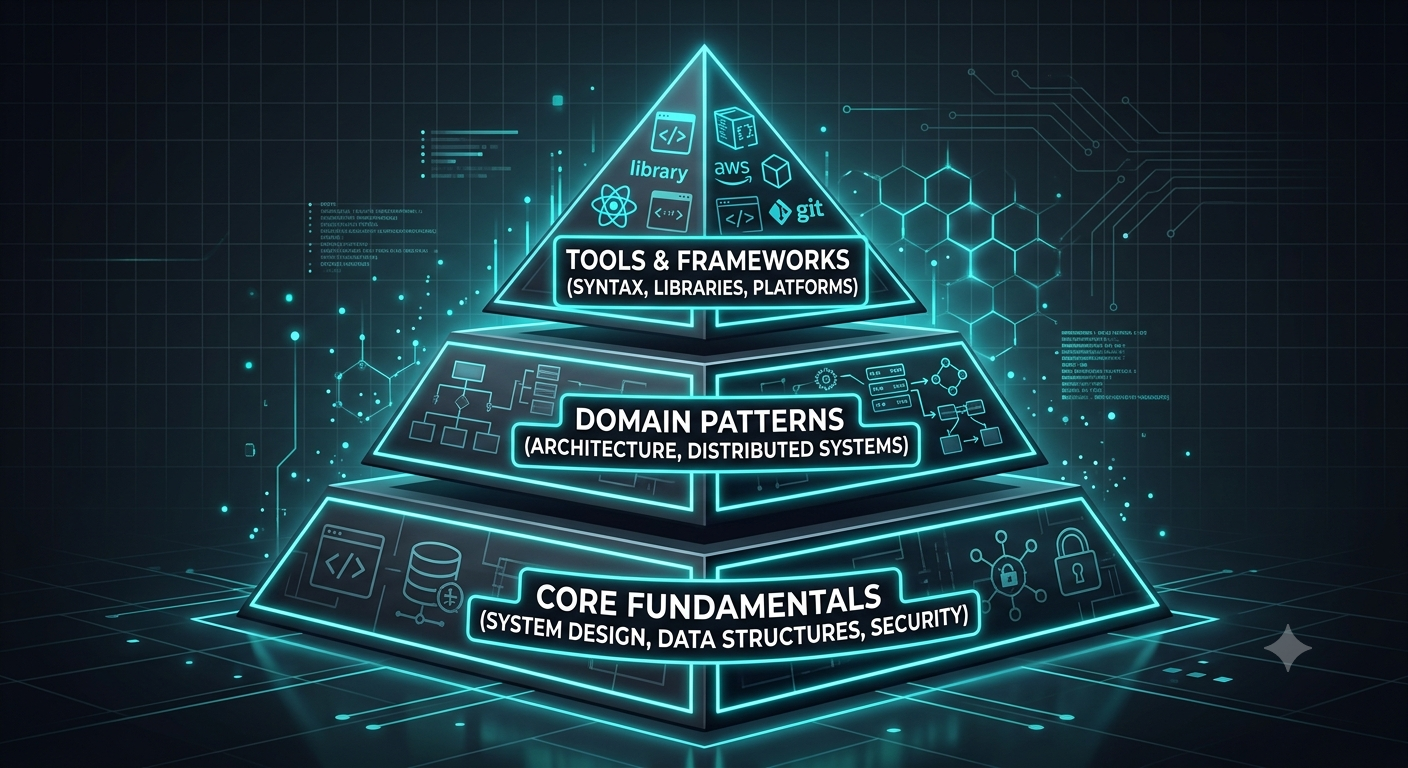
To build a resilient, long-term tech career, structure your continuous learning using The 3-Tier Skill Stack:
1. Tier 1: The Core Fundamentals (The Bedrock)
What it is: System design, data structures, networking, security, and algorithmic thinking.
Why it matters: Fundamentals rarely change. A deep understanding of how systems handle concurrency, memory, and latency will serve you whether you are writing Rust, Python, or a language that hasn't been invented yet.
Action: Allocate 30% of your dedicated learning time to fundamentals, even as a senior engineer.
2. Tier 2: Adaptable Domain Patterns (The Engine)
What it is: Architectural patterns, distributed systems, event-driven design, and API design principles.
Why it matters: Frameworks come and go, but the architectural problems they solve remain identical. When you master patterns rather than syntax, switching stacks takes days, not months.
Action: Whenever you learn a new library, ask yourself: "What underlying architectural pattern is this abstraction hiding?"
3. Tier 3: High-Leverage Execution Tools (The Edge)
What it is: Specific syntax, modern AI coding tools, deployment platforms, and niche libraries.
Why it matters: This is where your immediate daily productivity lives. It gets you hired today, but relying only on Tier 3 makes you vulnerable tomorrow.
Action: Treat tools as disposable. Be quick to adopt what speeds you up, but never confuse tool fluency with core capability.
Key Takeaways
Tools decay, principles compound: Invest the majority of your long-term energy into low-turnover knowledge.
Learn patterns, not just syntax: Understanding why an architecture works makes you adaptable across any tech stack.
Stay curious, stay grounded: Use the latest tools to execute faster, but rely on fundamentals to solve the hard problems.
CTA
Looking to grow alongside engineers who prioritize deep technical mastery?
Join the Techawks General Community today to share insights, level up your career, and connect with global tech professionals.
If your entire value as a developer or technical professional relies on knowing a specific framework or tool, you're constantly at the mercy of the hype cycle.
To build a resilient, long-term tech career, structure your continuous learning using The 3-Tier Skill Stack:
1. Tier 1: The Core Fundamentals (The Bedrock)
What it is: System design, data structures, networking, security, and algorithmic thinking.
Why it matters: Fundamentals rarely change. A deep understanding of how systems handle concurrency, memory, and latency will serve you whether you are writing Rust, Python, or a language that hasn't been invented yet.
Action: Allocate 30% of your dedicated learning time to fundamentals, even as a senior engineer.
2. Tier 2: Adaptable Domain Patterns (The Engine)
What it is: Architectural patterns, distributed systems, event-driven design, and API design principles.
Why it matters: Frameworks come and go, but the architectural problems they solve remain identical. When you master patterns rather than syntax, switching stacks takes days, not months.
Action: Whenever you learn a new library, ask yourself: "What underlying architectural pattern is this abstraction hiding?"
3. Tier 3: High-Leverage Execution Tools (The Edge)
What it is: Specific syntax, modern AI coding tools, deployment platforms, and niche libraries.
Why it matters: This is where your immediate daily productivity lives. It gets you hired today, but relying only on Tier 3 makes you vulnerable tomorrow.
Action: Treat tools as disposable. Be quick to adopt what speeds you up, but never confuse tool fluency with core capability.
Key Takeaways
Tools decay, principles compound: Invest the majority of your long-term energy into low-turnover knowledge.
Learn patterns, not just syntax: Understanding why an architecture works makes you adaptable across any tech stack.
Stay curious, stay grounded: Use the latest tools to execute faster, but rely on fundamentals to solve the hard problems.
CTA
Looking to grow alongside engineers who prioritize deep technical mastery?
Join the Techawks General Community today to share insights, level up your career, and connect with global tech professionals.
The 3-Tier Rule: How to Future-Proof Your Tech Career Beyond the Next Hype Cycle
If your entire value as a developer or technical professional relies on knowing a specific framework or tool, you're constantly at the mercy of the hype cycle.
To build a resilient, long-term tech career, structure your continuous learning using The 3-Tier Skill Stack:
1. Tier 1: The Core Fundamentals (The Bedrock)
What it is: System design, data structures, networking, security, and algorithmic thinking.
Why it matters: Fundamentals rarely change. A deep understanding of how systems handle concurrency, memory, and latency will serve you whether you are writing Rust, Python, or a language that hasn't been invented yet.
Action: Allocate 30% of your dedicated learning time to fundamentals, even as a senior engineer.
2. Tier 2: Adaptable Domain Patterns (The Engine)
What it is: Architectural patterns, distributed systems, event-driven design, and API design principles.
Why it matters: Frameworks come and go, but the architectural problems they solve remain identical. When you master patterns rather than syntax, switching stacks takes days, not months.
Action: Whenever you learn a new library, ask yourself: "What underlying architectural pattern is this abstraction hiding?"
3. Tier 3: High-Leverage Execution Tools (The Edge)
What it is: Specific syntax, modern AI coding tools, deployment platforms, and niche libraries.
Why it matters: This is where your immediate daily productivity lives. It gets you hired today, but relying only on Tier 3 makes you vulnerable tomorrow.
Action: Treat tools as disposable. Be quick to adopt what speeds you up, but never confuse tool fluency with core capability.
Key Takeaways
Tools decay, principles compound: Invest the majority of your long-term energy into low-turnover knowledge.
Learn patterns, not just syntax: Understanding why an architecture works makes you adaptable across any tech stack.
Stay curious, stay grounded: Use the latest tools to execute faster, but rely on fundamentals to solve the hard problems.
CTA
Looking to grow alongside engineers who prioritize deep technical mastery?
Join the Techawks General Community today to share insights, level up your career, and connect with global tech professionals.

 Arabic
 French
 Spanish
 Portuguese
 Deutsch
 Turkish
 Dutch
Dutch
 Italiano
 Russian
 Romaian
 Portuguese (Brazil)
 Greek
Greek