


Which Area of Technical Debt Holds Your Team Back the Most?
Every engineering team takes on technical debt. But high-performing teams know where their debt lives and proactively manage it before it halts velocity.
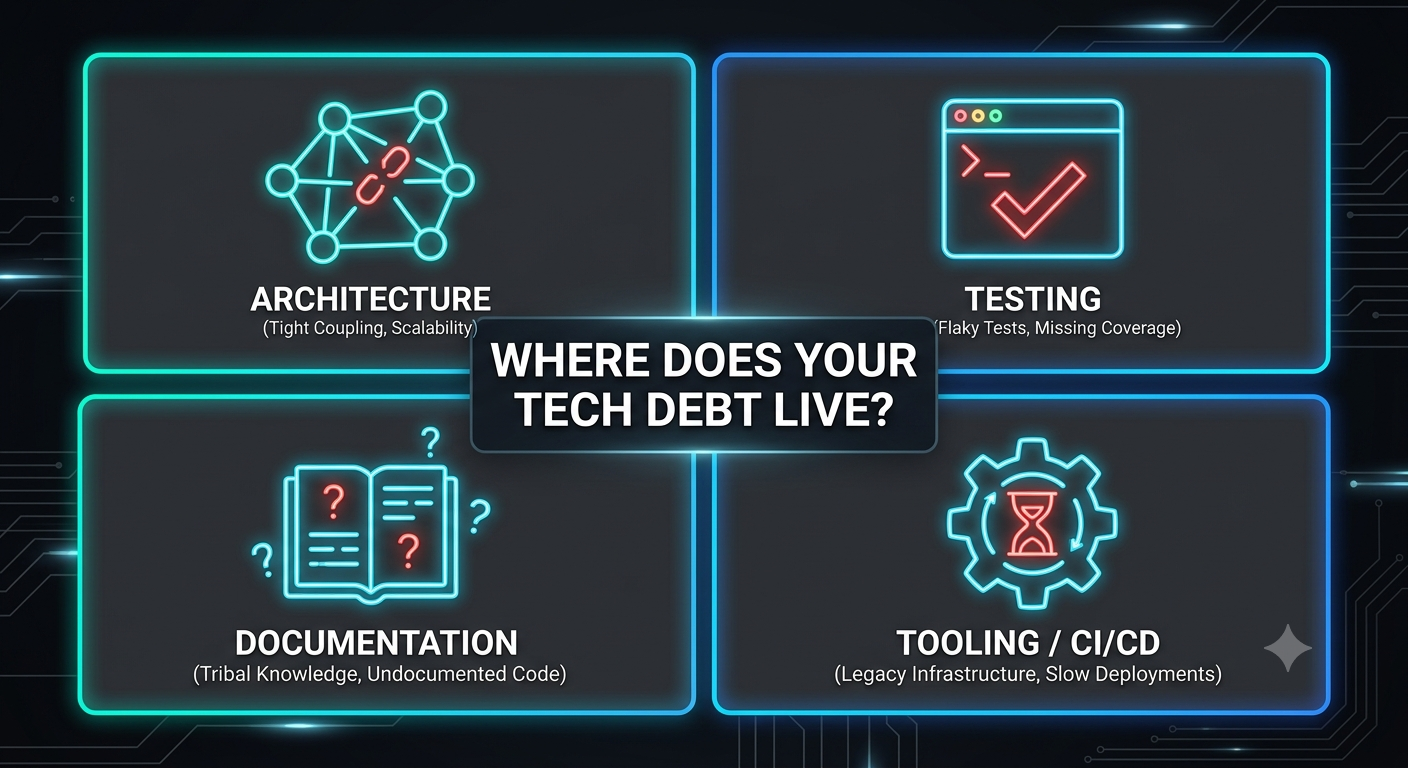
To help frame how we tackle debt, let’s break down the 4 Core Dimensions of Tech Debt:
Architecture Debt: Monoliths that should be microservices (or vice versa), tight coupling, and brittle integration points that make simple changes risky.
Testing & Quality Debt: Flaky test suites, low coverage on critical paths, or manual QA bottlenecks that turn releases into high-stress events.
Documentation & Context Debt: Zero onboarding guides, tribal knowledge locked in senior devs' heads, and missing API specs.
Tooling & Dependency Debt: Outdated frameworks, deprecated libraries, and slow CI/CD pipelines that waste hours every day.
🗳️ Community Poll:
If you could eliminate ONE category of tech debt from your codebase tomorrow, which would it be?
A) Architecture & Design (Tight coupling, scalability bottlenecks)
B) Test Suite & QA (Flaky tests, manual deployment checks)
C) Documentation & Context (Tribal knowledge, missing specs)
D) Tooling & Infrastructure (Legacy dependencies, slow CI/CD)
(Vote in the poll options above and drop your reasoning in the comments!)
Key Takeaways
Identify before you refactor: Categorizing technical debt helps you prioritize fixes that yield the highest return on developer velocity.
Documentation is leverage: Missing context (Type C debt) often slows down teams just as much as broken code.
Make debt visible: Refactoring shouldn't be a secret project—track it as part of your team's regular sprint allocation.
CTA
Want to master engineering leadership, system design, and clean architecture practices?
Join the Techawks General Community today to participate in weekly polls, trade strategies with lead engineers worldwide, and level up your engineering workflow.
Every engineering team takes on technical debt. But high-performing teams know where their debt lives and proactively manage it before it halts velocity.
To help frame how we tackle debt, let’s break down the 4 Core Dimensions of Tech Debt:
Architecture Debt: Monoliths that should be microservices (or vice versa), tight coupling, and brittle integration points that make simple changes risky.
Testing & Quality Debt: Flaky test suites, low coverage on critical paths, or manual QA bottlenecks that turn releases into high-stress events.
Documentation & Context Debt: Zero onboarding guides, tribal knowledge locked in senior devs' heads, and missing API specs.
Tooling & Dependency Debt: Outdated frameworks, deprecated libraries, and slow CI/CD pipelines that waste hours every day.
🗳️ Community Poll:
If you could eliminate ONE category of tech debt from your codebase tomorrow, which would it be?
A) Architecture & Design (Tight coupling, scalability bottlenecks)
B) Test Suite & QA (Flaky tests, manual deployment checks)
C) Documentation & Context (Tribal knowledge, missing specs)
D) Tooling & Infrastructure (Legacy dependencies, slow CI/CD)
(Vote in the poll options above and drop your reasoning in the comments!)
Key Takeaways
Identify before you refactor: Categorizing technical debt helps you prioritize fixes that yield the highest return on developer velocity.
Documentation is leverage: Missing context (Type C debt) often slows down teams just as much as broken code.
Make debt visible: Refactoring shouldn't be a secret project—track it as part of your team's regular sprint allocation.
CTA
Want to master engineering leadership, system design, and clean architecture practices?
Join the Techawks General Community today to participate in weekly polls, trade strategies with lead engineers worldwide, and level up your engineering workflow.
Which Area of Technical Debt Holds Your Team Back the Most?
Every engineering team takes on technical debt. But high-performing teams know where their debt lives and proactively manage it before it halts velocity.
To help frame how we tackle debt, let’s break down the 4 Core Dimensions of Tech Debt:
Architecture Debt: Monoliths that should be microservices (or vice versa), tight coupling, and brittle integration points that make simple changes risky.
Testing & Quality Debt: Flaky test suites, low coverage on critical paths, or manual QA bottlenecks that turn releases into high-stress events.
Documentation & Context Debt: Zero onboarding guides, tribal knowledge locked in senior devs' heads, and missing API specs.
Tooling & Dependency Debt: Outdated frameworks, deprecated libraries, and slow CI/CD pipelines that waste hours every day.
🗳️ Community Poll:
If you could eliminate ONE category of tech debt from your codebase tomorrow, which would it be?
A) Architecture & Design (Tight coupling, scalability bottlenecks)
B) Test Suite & QA (Flaky tests, manual deployment checks)
C) Documentation & Context (Tribal knowledge, missing specs)
D) Tooling & Infrastructure (Legacy dependencies, slow CI/CD)
(Vote in the poll options above and drop your reasoning in the comments!)
Key Takeaways
Identify before you refactor: Categorizing technical debt helps you prioritize fixes that yield the highest return on developer velocity.
Documentation is leverage: Missing context (Type C debt) often slows down teams just as much as broken code.
Make debt visible: Refactoring shouldn't be a secret project—track it as part of your team's regular sprint allocation.
CTA
Want to master engineering leadership, system design, and clean architecture practices?
Join the Techawks General Community today to participate in weekly polls, trade strategies with lead engineers worldwide, and level up your engineering workflow.

 Arabic
 French
 Spanish
 Portuguese
 Deutsch
 Turkish
 Dutch
Dutch
 Italiano
 Russian
 Romaian
 Portuguese (Brazil)
 Greek
Greek